 stockrow
UNITED STATES
SECURITIES AND EXCHANGE COMMISSION
Washington, D.C. 20549
FORM 10-K
| ☑ | ANNUAL REPORT PURSUANT TO SECTION 13 OR 15(d) OF THE SECURITIES EXCHANGE ACT OF 1934 |
For the fiscal year ended September 30, 2026
OR
| ☐ | TRANSITION REPORT PURSUANT TO SECTION 13 OR 15(d) OF THE SECURITIES EXCHANGE ACT OF 1934 |
For the transition period from _________ to ___________
Commission file number 001-37884
VALVOLINE INC.
| Kentucky | 30-0939371 |
| (State or other jurisdiction of incorporation or organization) | (I.R.S. Employer Identification No.) |
100 Valvoline Way, Suite 100
Lexington, Kentucky 40509
Telephone Number (859) 357-7777
Securities registered pursuant to Section 12(b) of the Act:
| Title of each class | Trading Symbol | Name of each exchange on which registered |
| Common stock, par value $0.01 per share | VVV | New York Stock Exchange |
Securities registered pursuant to Section 12(g) of the Act: None
Indicate by check mark if the registrant is a well-known seasoned issuer, as defined in Rule 405 of the Securities Act. Yes ☑ No ☐
Indicate by check mark if the registrant is not required to file reports pursuant to Section 13 or Section 15(d) of the Act. Yes ☐ No ☑
Indicate by check mark whether the registrant (1) has filed all reports required to be filed by Section 13 or 15(d) of the Securities Exchange Act of 1934
during the preceding 12 months (or for such shorter period that the registrant was required to file such reports), and (2) has been subject to such filing
requirements for the past 90 days. Yes ☑ No ☐
Indicate by check mark whether the registrant has submitted electronically every Interactive Data File required to be submitted pursuant to Rule 405 of
Regulation S-T (§ 232.405 of this chapter) during the preceding 12 months (or for such shorter period that the registrant was required to submit such
files). Yes ☑ No ☐
Indicate by check mark whether the registrant is a large accelerated filer, an accelerated filer, a non-accelerated filer, a smaller reporting company, or an
emerging growth company. See the definitions of “large accelerated filer,” “accelerated filer,” “smaller reporting company,” and “emerging growth
company” in Rule 12b-2 of the Exchange Act.
| Large accelerated filer | ☑ | Accelerated filer | ☐ |
| Non-accelerated filer | ☐ | Smaller reporting company | ☐ |
| Emerging growth company | ☐ |
If an emerging growth company, indicate by check mark if the registrant has elected not to use the extended transition period for complying with any new
or revised financial accounting standards provided pursuant to Section 13(a) of the Exchange Act. ☐
Indicate by check mark whether the registrant has filed a report on and attestation to its management's assessment of the effectiveness of its internal
control over financial reporting under Section 404(b) of the Sarbanes-Oxley Act (15 U.S.C. 7262(b)) by the registered public accounting firm that
prepared or issued its audit report. ☑
If securities are registered pursuant to Section 12(b) of the Act, indicate by check mark whether the financial statements of the registrant included in the
filing reflect the correction of an error to previously issued financial statements. ☐
Indicate by check mark whether any of those error corrections are restatements that required a recovery analysis of incentive-based compensation
received by any of the registrant’s executive officers during the relevant recovery period pursuant to §240.10D-1(b). ☐
Indicate by check mark whether the registrant is a shell company (as defined in Rule 12b-2 of the Act). Yes ☐ No ☑
The aggregate market value of voting common stock held by non-affiliates at March 31, 2026 was approximately $4.3 billion. At November 13, 2026,
there were 127,590,073 shares of common stock outstanding.
DOCUMENTS INCORPORATED BY REFERENCE
Portions of the registrant’s definitive proxy statement for its 2027 Annual Meeting of Shareholders (the “Proxy Statement”) are incorporated by reference
into Part III of this Annual Report on Form 10-K and will be filed within 120 days of the registrant’s fiscal year end.
2
3
Forward-Looking Statements
Certain statements in this Annual Report on Form 10-K, other than statements of historical fact, are forward-looking
statements within the meaning of the Private Securities Litigation Reform Act of 1995. Such forward-looking
statements may include, without limitation, statements about executing on the growth strategy to create shareholder
value by driving the full potential in Valvoline’s core business, delivering sustainable network growth through new
store development, franchise expansion and acquisitions, and innovating to meet the changing needs of customers
and the car parc, including through fleet and non-oil change services; realizing the benefits from acquisitions and
refranchising transactions, including the anticipated benefits and synergies of Breeze Autocare; the use of
technology, including artificial intelligence, to support the business; and any other statements regarding Valvoline's
future operations, financial or operating results, capital allocation, including share repurchases, debt reduction and
leverage objectives, anticipated business levels, dividend policy, anticipated growth, market opportunities,
strategies, competition, and other expectations and targets for future periods. Valvoline has identified some of these
forward-looking statements with words such as “anticipates,” “believes,” “expects,” “estimates,” “intends,” “plans,”
“targets,” “is likely,” “predicts,” “projects,” “forecasts,” “may,” “will,” “should,” “could,” “would,” and “continue,” and the
negative of these words or other comparable terminology. These forward-looking statements are based on
Valvoline’s current expectations, estimates, projections, and assumptions as of the date such statements are made
and are subject to risks and uncertainties that may cause results to differ materially from those expressed or implied
in the forward-looking statements. Factors that might cause such differences include, but are not limited to: rising or
volatile supply costs, supply constraints, including as a result of the conflict in the Middle East, and dependence on
Valvoline Global Operations (“VGO”) for substantially all lubricant supply; information technology, cybersecurity and
artificial intelligence-related risks; economic conditions, inflation, interest rates and energy prices that affect
consumer demand, miles driven and customer response to pricing actions; changes in vehicle technology, including
electric vehicle adoption and longer service intervals; the financial performance and growth of, and access to
financing by, franchisees; maintaining effective internal controls; competition and pricing pressure; the ability to
achieve growth goals, including new store development, acquisitions, and the integration of Breeze Autocare and
conversion of its Oil Changers stores to the VIOCSM brand; the ability to attract and retain qualified employees and
key management; damage to the Valvoline brand, including under the brand-sharing arrangement with VGO;
Valvoline’s substantial indebtedness and access to capital; changes in laws and regulations, including privacy,
franchise and environmental, health and safety requirements; business disruptions from severe weather or other
catastrophic events; and those discussed under the headings “Risk Factors” in Item 1A of Part I of this Annual
Report on Form 10-K, “Management’s Discussion and Analysis of Financial Condition and Results of Operations” in
Item 7 of Part II of this Annual Report on Form 10-K and “Quantitative and Qualitative Disclosures about Market
Risk” in Item 7A of Part II of this Annual Report on Form 10-K. Valvoline assumes no obligation to update or revise
these forward-looking statements for any reason, even if new information becomes available in the future, unless
required by law.
4
PART I
ITEM 1. BUSINESS
Overview
Valvoline Inc. is a leader in automotive preventive maintenance delivering convenient and trusted services in its
retail stores throughout the United States (“U.S.”) and Canada. The terms “Valvoline,” the “Company,” “we,” “us,”
“management,” and “our” as used herein refer to Valvoline Inc., its predecessors and its consolidated subsidiaries,
except where the context indicates otherwise.
As the quick, easy, trusted leader in automotive preventive maintenance, Valvoline is creating shareholder value by
driving the full potential of its core business, delivering sustainable network growth, and continuing to innovate to
meet the evolving needs of customers and the car parc. With average customer ratings that indicate high levels of
service satisfaction, Valvoline and the Company’s franchisees simplify vehicle care so customers can do what
drives them. This includes approximately 15-minute stay-in-your-car oil changes; battery, bulb and wiper
replacements; tire rotations; and other manufacturer recommended maintenance services. The Company operates
and franchises more than 2,500 service center locations primarily through its Valvoline Instant Oil ChangeSM
(“VIOC”) and Valvoline Great Canadian Oil Change (“GCOC”) retail locations and supports nearly 240 locations
through its Express CareTM platform. Valvoline has consistently adapted to address changing technologies and
customer needs and is well positioned to service evolving vehicle maintenance needs with its growing network of
stores.
Company background
Established in 1866, Valvoline has a history of innovation spanning 160 years when Dr. John Ellis founded
Valvoline by discovering the lubricating properties of distilled crude oil and formulated the world's first petroleum-
based lubricant. Valvoline was trademarked seven years later in 1873, making it the first trademarked motor oil
brand in the U.S. Soon thereafter, as vehicle ownership rapidly grew, Valvoline became widely known in the
automotive world through racing victories and as a recommended oil for the iconic Ford Model T, while expanding
its product offerings and global reach through its innovative automotive maintenance and heavy-duty engine
applications.
Valvoline was acquired by Ashland (currently doing business as Ashland Inc., and together with its predecessors
and consolidated subsidiaries, referred to herein as “Ashland”), in 1950 and continued accelerating through the
development of all-climate and racing motor oils, in addition to supporting notable automobile racing victories by
some of the biggest legends of the sport. Forty years ago, Valvoline began operating and franchising VIOC service
center stores, expanding into consumer-focused automotive preventive maintenance and quick lube services.
Valvoline maintained its focus on innovating for evolving vehicle technologies and the needs of customers through
the late 1990s and early 2000s by introducing synthetic and high-mileage motor oils.
Valvoline was incorporated in May 2016 as a subsidiary of Ashland, followed by the transfer of the Valvoline
business and certain other legacy Ashland assets and liabilities from Ashland to Valvoline. Valvoline completed its
initial public offering of common stock in September 2016, and Ashland distributed its remaining ownership interest
in Valvoline in May 2017. On March 1, 2023, Valvoline completed the sale of its former Global Products reportable
segment (“Global Products”), now doing business as Valvoline Global Operations (“VGO”) to Aramco Overseas
Company B.V. ("Aramco”). The operating results and cash flows associated with and directly attributed to the Global
Products disposal group are reflected as discontinued operations. Today, Valvoline operates as an independent
corporation that trades on the New York Stock Exchange (“NYSE”) under the symbol “VVV” as a pure play
automotive retail services provider focused on delivering quick, easy, and trusted vehicle maintenance services.
Unless otherwise noted, disclosures herein relate solely to the Company’s continuing operations.
5
Valvoline’s retail services
Valvoline operates and franchises more than 2,500 service center locations through its VIOC and GCOC retail
locations and supports nearly 240 locations through its Express Care platform. The Company has built a reputation
as the quick, easy, trusted name in automotive preventive maintenance through its full-service oil changes from
certified technicians in approximately 15-minutes, including a free 18-point maintenance check. Valvoline continues
to build market share through its differentiated stay-in-your-car service model, convenient locations, trusted brand,
and consistent customer experience. Valvoline technicians utilize the Company’s proprietary SuperProTM system to
deliver a superior customer experience and make timely service recommendations based upon visual inspection,
vehicle service history, and original equipment manufacturer (“OEM”) recommendations. The SuperPro system is
utilized in both company-operated and franchised service center locations, creating a consistent service experience
for customers.
The following summarizes the primary services Valvoline offers at most retail service center stores:
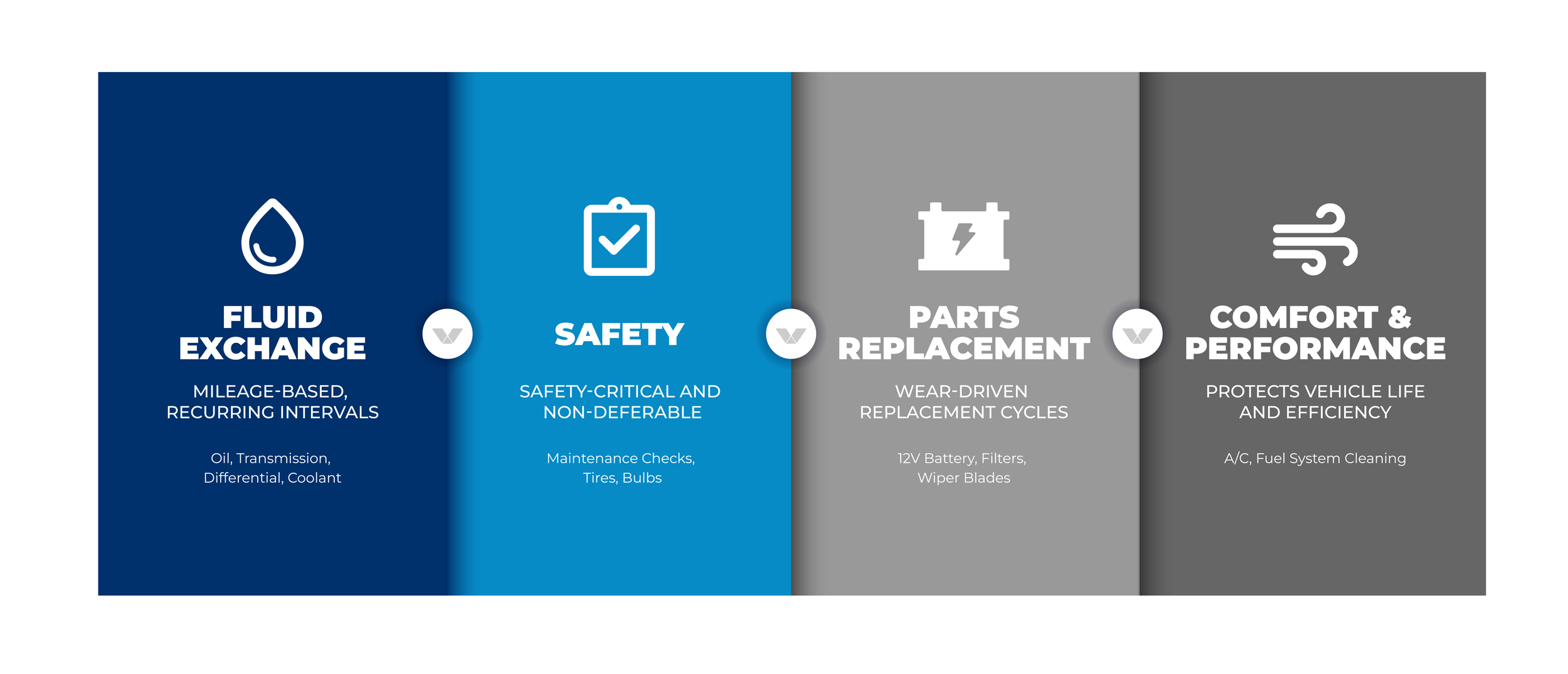
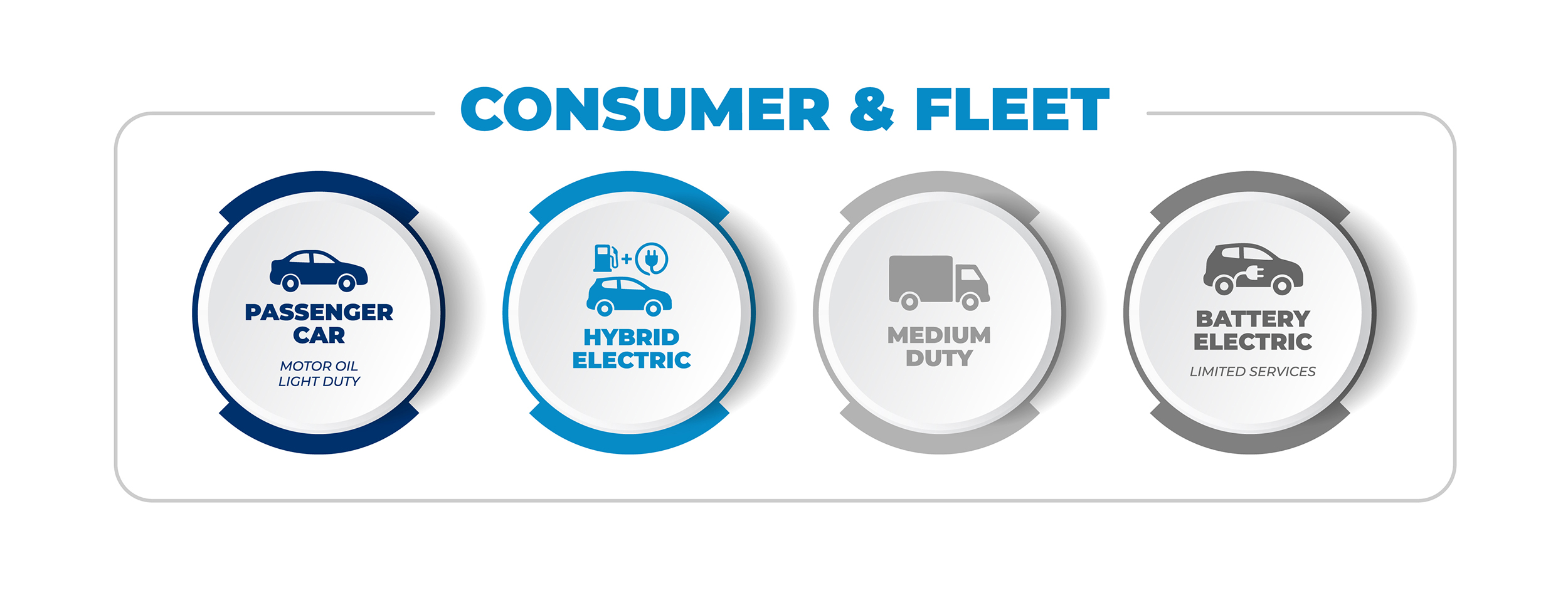
Valvoline’s services are offered to a wide range of vehicle types, serving both consumers and commercial
customers, as shown below:
6
Industry overview
Demand for automotive aftermarket services benefits from the growing number and age of vehicles in operation as
well as increasing vehicle complexity and ongoing increases in miles driven. In addition, the resilient North
American automotive aftermarket services market is highly fragmented, which creates a significant opportunity for
consolidation. Based on industry surveys and management estimates, the U.S. total addressable market depicted
below demonstrates the magnitude of the opportunity in the U.S. for Valvoline:
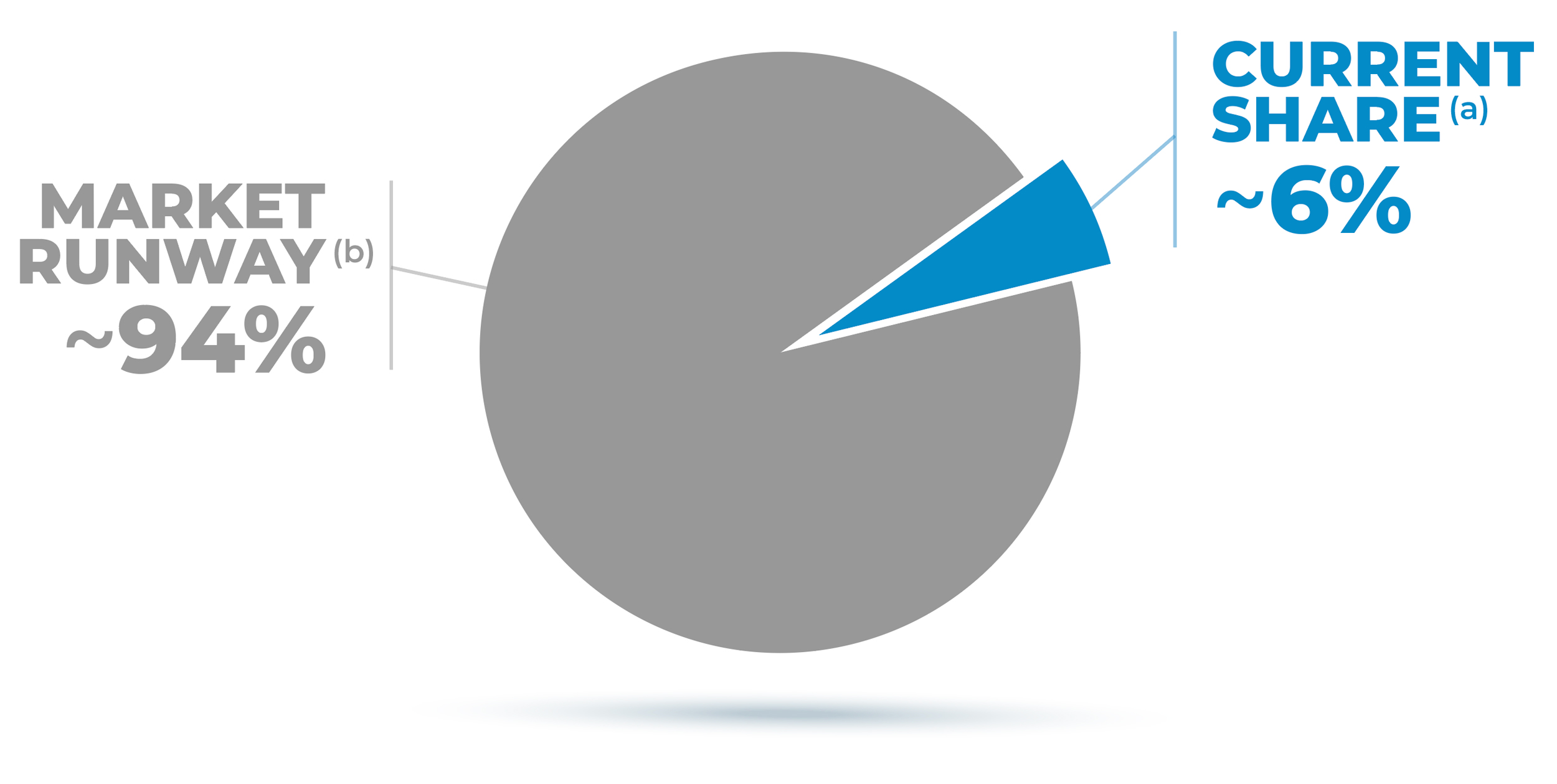
- Based on approximately 32 million oil changes in fiscal year 2026 (U.S. company-operated and franchised stores)
- Management estimates developed utilizing internal and industry data for U.S. passenger car, light truck, and single-unit truck oil changes
Business and growth strategies
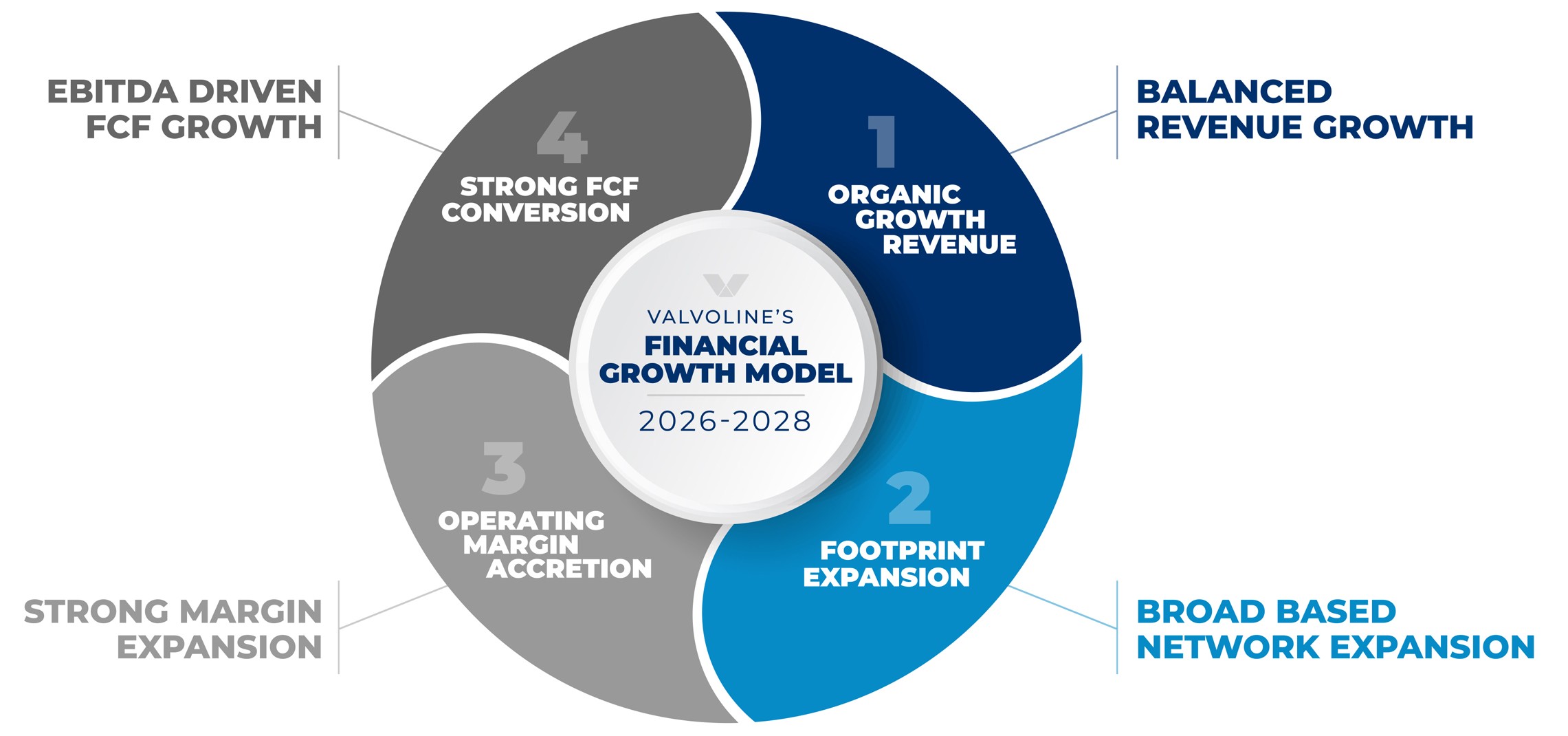
As a pure play automotive retail services provider and the trusted leader in preventive automotive maintenance,
Valvoline is well positioned to create long-term shareholder value through executing the Company’s strategic
initiatives, which include:
•Driving the full potential of the core business through strategic reinvestment and improving operational
efficiency in existing stores by building on Valvoline’s strong foundation in marketing, technology, and data
insights;
•Delivering sustainable network growth through company-operated store expansion and continued
acceleration in franchise store openings; and
•Innovating to meet the changing needs of customers and the car parc, targeting customer and service
expansion with a focus on fleet business, and driving non-oil change service penetration.
7
Retail store development
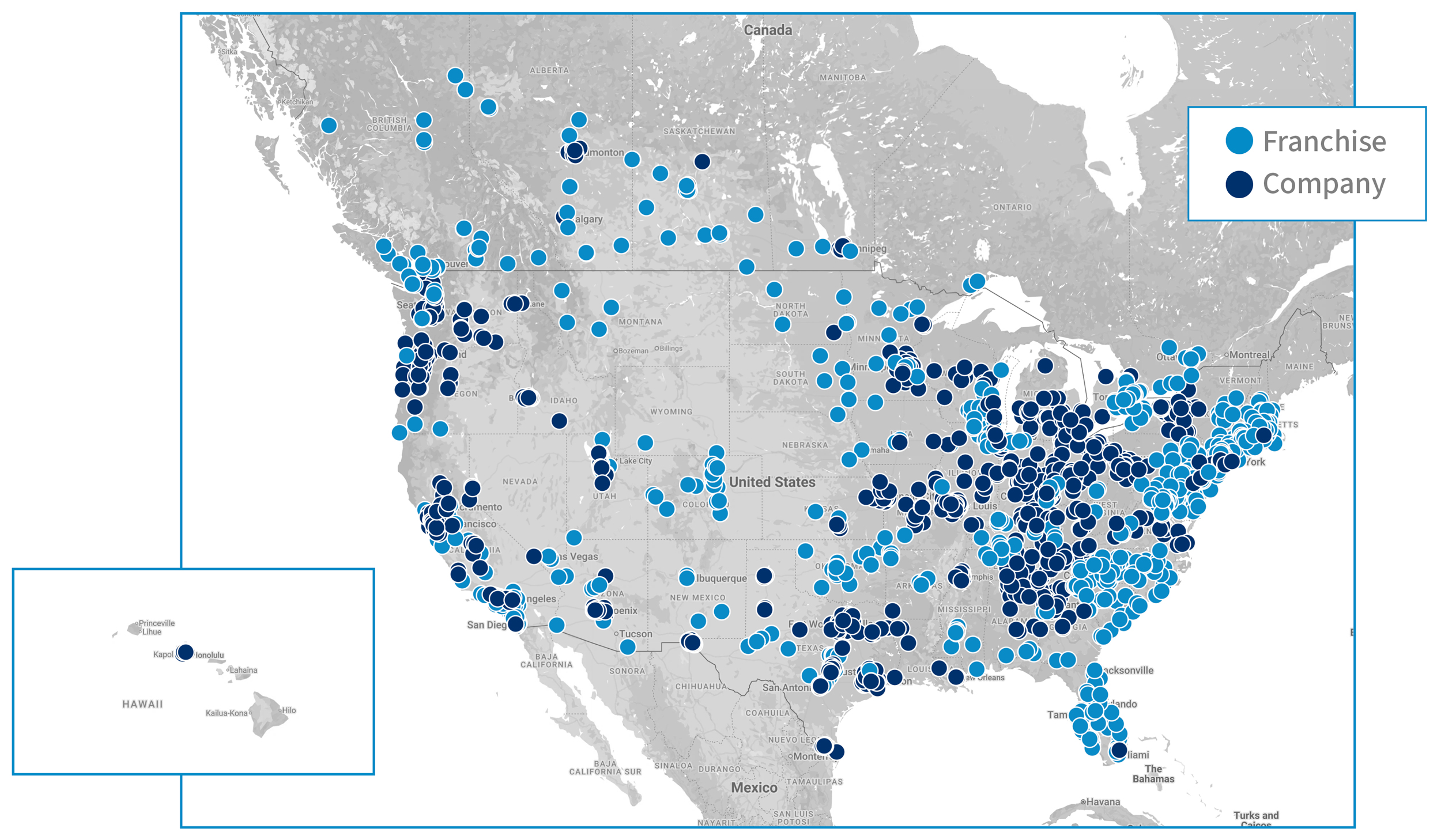
Valvoline’s network of retail service centers delivered its 20th consecutive year of system-wide same-store sales
(“SSS”) growth in fiscal 2026, demonstrating the system's operational excellence. As shown below, Valvoline
operates, either directly or through its franchisees, 2,517 service center stores across the U.S. and Canada as of
September 30, 2026:
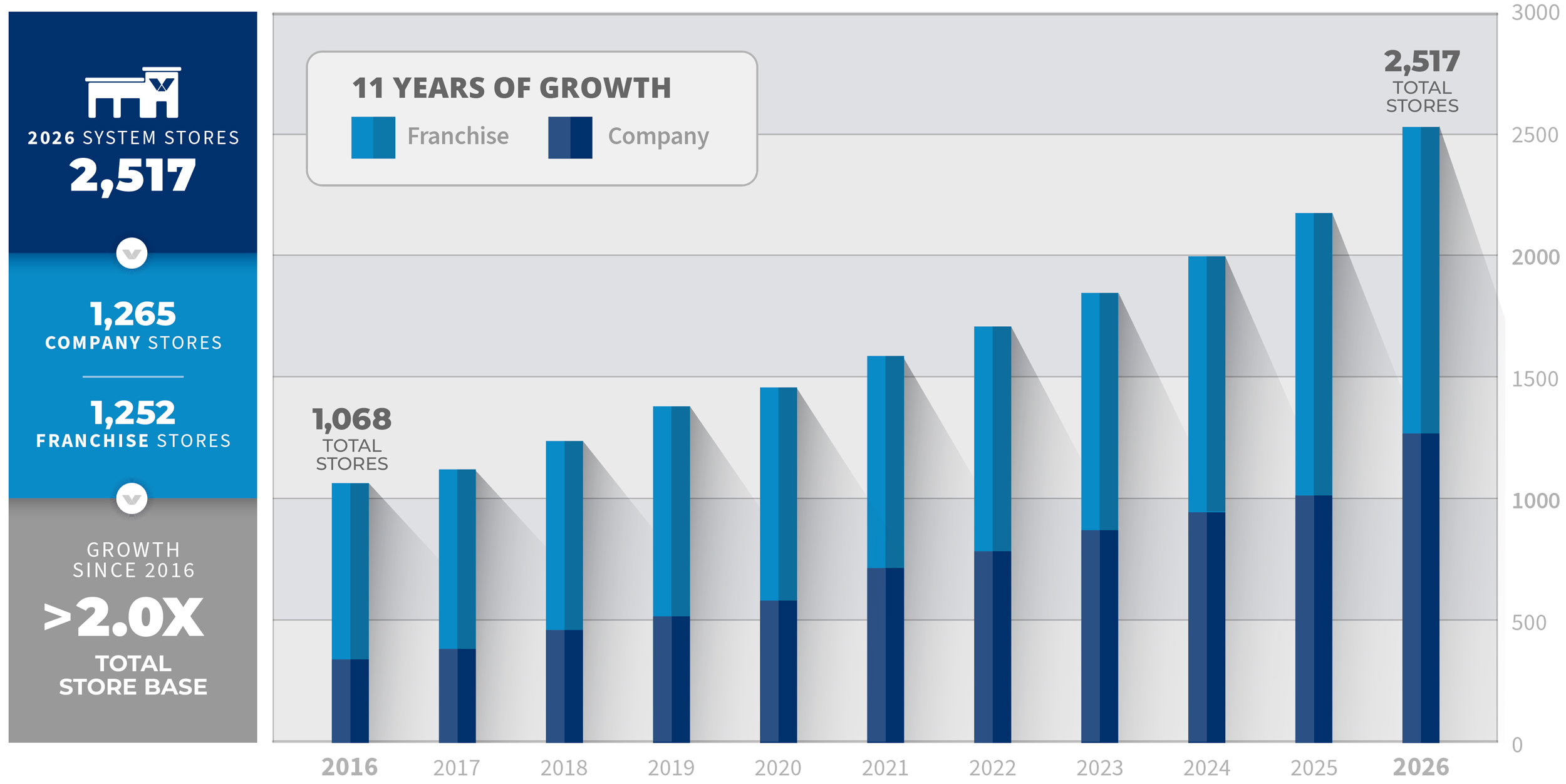
Valvoline utilizes a three-pronged approach to grow its retail network, including 1) franchisee store expansion, 2)
opportunistic acquisitions, and 3) new store development. This approach has driven system-wide store growth of
nearly 60% over the last five years. During this period, Valvoline added 923 net new stores to the system. The retail
services network growth and system-wide SSS growth are summarized as follows:
System-wide Store Count(a)(b)
8
System-wide SSS Growth(a)(b)
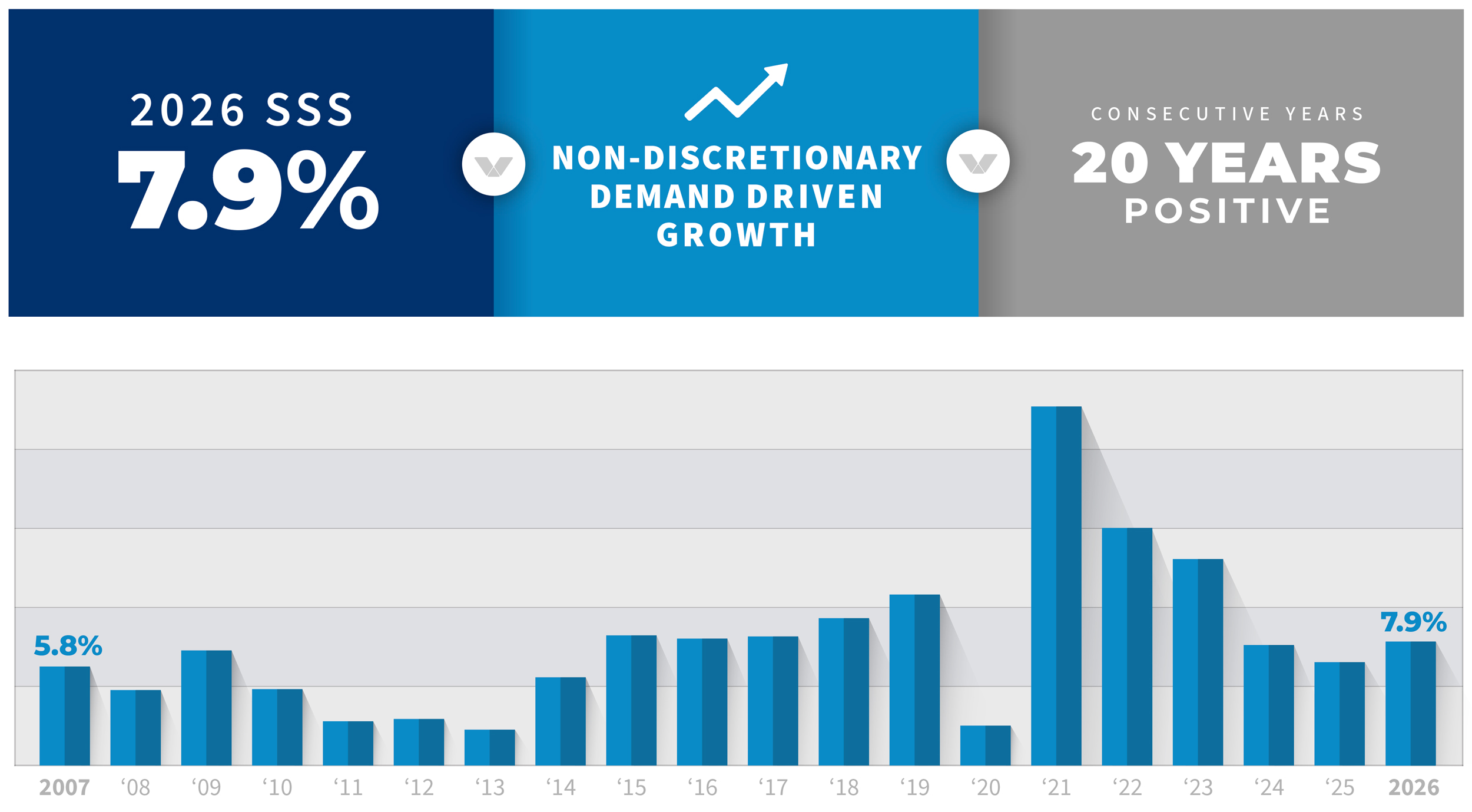
- Refer to "Key Business Measures" in Item 7 of Part II of this Annual Report on Form 10-K for a description of management's use and determination of key metrics, including store counts and SSS. Measures include franchisees, which are distinct independent legal entities and Valvoline does not consolidate the results of operations of its franchisees.
- Beginning with fiscal 2025, Valvoline determines SSS growth as the year-over-year change in net revenues of U.S. VIOC system-wide same stores with same stores defined as those that have been in operation within the system for at least 12 full months. Beginning in fiscal 2026, SSS also includes mobile service net revenues in markets that leverage store marketing channels. Previously, SSS was determined utilizing net revenues of U.S. VIOC stores, with new stores, including franchised conversions, excluded from the metric until the completion of their first full fiscal year in operation. Beginning with fiscal year 2022, SSS measures have been recast to conform with the current approach and all fiscal years prior to this period remain presented consistent with the former SSS approach.
Competition
Valvoline faces competition across its service offerings based on several key criteria, including brand recognition,
quality of service, price, convenience, speed, location, and customer experience, in addition to the ability to deliver
innovative services to meet evolving customer needs. Valvoline competes for customers in the highly fragmented
automotive aftermarket service industry with automotive dealerships, automotive repair and maintenance centers,
as well as other regional and independent quick lube operators.
Additionally, Valvoline’s retail stores compete for consumers and franchisees with other major franchised brands
that offer a turn-key operations management system, such as Jiffy Lube, Grease Monkey, Take 5 Oil Change,
Express Oil Change, Tire Engineers, and Mr. Lube in Canada. Valvoline competes with other franchisors in
automotive services and across other industries on the basis of the expected return on investment and the value
propositions offered to franchisees.
Valvoline also competes for Express Care operators and customers with national branded companies that offer an
independent quick lube platform with a professional signage program and limited business model support.
Marketing and customer experience
Valvoline places a high priority on delivering an in-store customer experience that is quick, easy, and trusted. To
both acquire and retain customers, marketing plays an important role in demonstrating the distinct experience that
Valvoline offers customers, as well as providing information on locations, promotions, services offered, and wait
times.
The Company’s marketing is intended to build awareness of and create demand for its automotive preventive
maintenance services. Valvoline markets through search and direct response channels, invests in advertising
through video, social and digital media, and leverages targeted geographic sponsorships to reach specific
audiences. The Company’s modeled marketing strategies are efficient and yield strong rates of return.
9
Valvoline leverages its digital tools to obtain customer feedback across the retail network of stores. Customer
feedback is frequently measured and monitored to ensure that any service issues are quickly addressed to maintain
high levels of customer satisfaction. Valvoline also utilizes its digital infrastructure and technology to more efficiently
interact with customers, driving customer engagement, acquisition and retention, and consistency of experience.
The Company's strengths in digital marketing and data analytics are leveraged to attract new and retain existing
customers, including tailored marketing campaigns directed to specific customers when they are in the market for
their next service.
Intellectual property
Valvoline holds approximately 410 trademarks in 80 countries across the world, including the Valvoline and “V”
brand logo trademarks. These trademarks have a perpetual life, are generally subject to renewal every ten years,
and are among Valvoline's most protected and valuable assets. With the completion of the sale of Global Products,
Valvoline owns the Valvoline brand for all global retail services, excluding China and certain countries in the Middle
East and North Africa, while VGO owns the Valvoline brand for all product uses globally. Valvoline partners with
VGO to ensure that Valvoline's iconic brand is managed in a consistent and holistic manner.
Valvoline trade names and service marks used in its business include ValvolineSM, Valvoline Instant Oil ChangeSM,
and VIOCSM, among others. Valvoline is also party to arrangements that license its intellectual property to others in
return for revenues. Valvoline owns approximately 740 domain names that are used to promote Valvoline services
and provide information about the Company.
Product supply and price
The products used in Valvoline’s retail service delivery are principally sourced from VGO. In connection with the
sale of Global Products, Valvoline entered into a long-term supply agreement for the purchase of substantially all
lubricant and certain ancillary products for its stores from VGO (the “Supply Agreement”).
Valvoline is able to leverage its scale, as well as the scale of its suppliers, for favorable terms in the arrangement of
product supply for its store operations across the network. This benefit enhances the value proposition to new and
existing independent store operators as well as to the profits of Valvoline’s company store operations. Valvoline’s
arrangement of product supply for its independent operators provides recurring fees and margins that benefit
ongoing results. As Valvoline continues to grow organically and through acquisitions, the business is well-positioned
to continue driving increased benefits to the overall system of retail stores.
Valvoline works diligently to preserve margins by adjusting its pricing in response to changes in costs. The
Company’s customer value proposition focuses on convenience and quality service which provides the ability to
leverage pricing power to raise prices while maintaining customer loyalty. Pricing adjustments to products sold to
Valvoline's independent operators are generally made pursuant to their contracts and are based on movements in
published base oil indices.
Seasonality
Valvoline’s business is moderately impacted by seasonality. Transaction volumes follow driving patterns of
consumers, which generally trend with the length of daylight hours, North American holidays, and vacation timing.
As a result, the second half of the fiscal year ordinarily is more robust as miles driven tends to be higher. Weather
conditions can modestly affect transaction volumes, and geographic variation typically limits weather impacts to
specific regions.
Regulatory and environmental matters
Valvoline is subject to various federal, state, provincial and local laws and governmental regulations in the U.S. and
Canada relating to the operation of its business, including those regarding employment and labor practices;
workplace safety; building and zoning requirements; the handling, storage and disposal of hazardous substances
and waste, including used motor oil, oil filters and lead-acid batteries; the ownership, construction and operation of
real property, and the advertising and marketing of Valvoline’s services, among others. Valvoline maintains policies
and procedures designed to manage these risks and monitor compliance with applicable laws and regulations.
10
These laws and regulations require Valvoline to obtain and comply with permits, registrations or other authorizations
issued by governmental authorities. These authorities can modify or revoke the Company’s permits, registrations or
other authorizations and can enforce compliance through fines, sanctions and injunctions.
Valvoline inventories lubricating and vehicle maintenance products and handles used automotive oils and filters.
Accordingly, Valvoline is subject to numerous federal, state, provincial and local environmental laws including the
Comprehensive Environmental Response Compensation and Liability Act. In addition, the U.S. Environmental
Protection Agency, under the Resource Conservation and Recovery Act, as well as Canadian federal and provincial
authorities and various state and local environmental protection agencies, regulate the handling and disposal of
certain waste products and other materials.
As a franchisor, Valvoline is subject to various federal, state and provincial franchising laws in the U.S. and Canada.
The Federal Trade Commission (the “FTC”) regulates franchising activities in the U.S. and requires franchisors to
make extensive disclosure to prospective franchisees before the execution of a franchise agreement. Certain
jurisdictions require registration or specific disclosure in connection with franchise offers and sales, or have laws
that limit franchisor rights regarding the termination, renewal or transfer of franchise agreements.
Valvoline is subject to various federal, state, provincial and local laws and regulations relating to information
security, privacy, payment card processing, consumer credit, consumer protection and fraud prevention, as well as
industry standards such as the Payment Card Industry Data Security Standard. An increasing number of
governments and industry groups have established data privacy laws and standards for the protection of personal
information, including financial information (e.g., credit card numbers), Social Security numbers, and health
information. The Company is also subject to labor and employment laws, including regulations established by the
U.S. Department of Labor and other federal, state, provincial and local agencies, governing working conditions, paid
leave, workplace safety, wage and hour standards, and hiring and employment practices.
Compliance with these laws and regulations has not had, and is not expected to have, a material effect on
Valvoline’s capital expenditures, earnings or competitive position. For additional information regarding regulatory
risks, see Item 1A of Part I, “Risk Factors,” of this Annual Report on Form 10-K.
Human capital management
"It all starts with our people" is one of Valvoline's core values, and the Company endeavors to create an
environment that promotes safety, fosters diversity, encourages creativity, rewards performance, and emphasizes
culture and purpose. To recruit and retain the most qualified team members, Valvoline focuses on treating team
members well by paying competitive wages, offering an attractive benefit package, and providing robust training
and career development opportunities. Valvoline is committed to actively creating an environment where each team
member is empowered to learn, grow, and maximize their personal contribution.
Workforce
As of September 30, 2026, Valvoline had approximately 13,400 employees (excluding contract employees) in the
U.S. and Canada, including approximately 12,400 full-time employees. None of these employees are covered by a
collective bargaining agreement. Valvoline operates 1,265 company-owned retail service center stores throughout
the U.S. and Canada and supports its network of more than 2,500 stores through centralized teams.
The table below provides the Company's approximate distribution of employees, which includes its company-
operated service center stores, central supporting teams, and excludes independent contractors:
| Number of employees | |
|---|---|
| Company-operated store employees | 11,900 |
| Central supporting team members | 1,500 |
| Total employee headcount | 13,400 |
Valvoline seeks to attract, develop, and retain highly qualified talent as summarized further below.
11
Talent acquisition
Valvoline strives to foster a workplace culture that attracts and retains top, diverse talent at every level. Valvoline's
talent acquisition is based on qualifications and experiences of target employees, including "building block" traits
and capabilities that support strong development early in an employee's career with the Company. Valvoline
continues to benefit from substantial investment in talent acquisition to ensure the Company has the right skill set to
attract and recruit exceptional diverse talent along with supporting technology to increase efficiency in staffing
stores. Valvoline utilizes innovative technology and structured processes intended to attract qualified candidates,
including engaging job descriptions designed to reach a larger audience, a quick and mobile-friendly application
process, online chat features to proactively address applicant questions, and video storytelling that offers a view of
Valvoline's culture through the lens of its own employees. These tools have been created to convey what makes
Valvoline unique as an employer to better attract diverse and ideal candidates, and these strong branding and
sourcing efforts allow Valvoline to select among the very best.
The Company’s focus on aggressive growth, including the addition of 337 net new system-wide stores in fiscal
2026, creates a critical need for talent to operate those stores. Valvoline utilizes its tools and processes to attract
qualified candidates, including providing support to franchise sourcing efforts. Franchisees collaborate through
periodic sharing of hiring experiences and best practices to ensure company-operated and franchised locations
attract and hire the best candidates to deliver consistent and superior service to Valvoline’s customers.
Learning, development, and leadership focus
The opportunity to develop and advance, regardless of job role or location, is critical to the success of Valvoline. A
key component of the Company’s talent development approach is to provide each team member with the necessary
tools and training opportunities to develop within their area of subject matter knowledge. Training is tailored to
specific job roles and functions incorporating both on-the-job training as well as virtual or in-person classes and e-
learning. Valvoline provides new VIOC and GCOC store employees 270 hours of training that is generally
completed within the first 60 days of employment leading to their first certification and another 240 hours of training
in the next 140 days that supports promotability.
Valvoline provides an Introduction to Management program for its VIOC and GCOC stores where assistant
managers interact with leadership team members and peers from other stores to learn about Valvoline's culture,
share best practices, and receive management training to prepare them for career advancement. Valvoline offers
similar programs targeting recently promoted service center managers through aspiring market managers. The
combination of these efforts enable Valvoline to continue a promote-from-within strategy which has led to a majority
of service center managers, area managers, and market manager promotions in the last year being earned by team
members who started in hourly positions at VIOC. By engaging team members early, Valvoline provides them with
the necessary tools to learn and acquire new skills which increases their value as an employee and, most
importantly, affords them the opportunity to advance their careers. Valvoline has been presented with multiple
awards over the years that recognize the training and development of its employees.
Employee communication and feedback
In an ongoing effort to understand employees’ needs and deliver on the Company’s values of trust, accountability
and collaboration, Valvoline remains focused on transparency and employee feedback. The Company regularly
hosts company-wide town halls in which Valvoline’s Chief Executive Officer and other members of senior
management inform employees about performance, strategic initiatives, activities, and policies along with providing
opportunities for them to ask questions. In addition, Valvoline management is focused on listening to understand
what is on the minds of employees by regularly surveying team members to gather real-time feedback as well as
identifying opportunities for continuous improvement. Valvoline believes employee survey results are important to
evaluate areas for improved communication and are meaningful to recruit and retain top talent, believing satisfied
employees are more likely to have a positive impact in the workplace and deliver great customer service.
Total rewards
Valvoline’s total rewards philosophy is to help attract, develop, engage, and retain a talented and diverse workforce.
The Company offers competitive, comprehensive compensation and benefits programs designed to care for the
physical, mental, emotional, social, and financial well-being of its employees. Valvoline also emphasizes company
12
culture, career development and meaningful work because total rewards go beyond just pay and benefits, including
workplace flexibility.
The Company’s compensation programs blend competitive base pay and, for eligible employees, short-term and
long-term incentive opportunities. Employee compensation is determined based on job level and responsibility, the
location and labor markets in which the Company operates, employee and company performance, as well as
employee education, experience, knowledge, and skill set.
The Company provides a wide variety of benefits to eligible full-time and part-time employees. Valvoline’s strategy
is to provide competitive benefit programs that align to the competitive business environment and meet the needs of
employees through all stages of life. These include:
•Affordable healthcare coverage (medical, prescription, dental, vision, condition care, fertility, and telehealth)
•Life, disability, and accident insurance coverage
•Health savings account (HSA) with company contributions
•401(k) retirement savings plan with generous company basic and matching contributions
•Employee assistance and advocacy programs to support both employees and their families
•Tuition reimbursement, adoption, and surrogacy programs
•Paid time off, holiday pay, paid disability, paid maternity and family leave, and other leave programs.
The Compensation Committee of the Board of Directors and senior management provide oversight into the
Company’s Total Rewards philosophy and strategy.
Health and safety
The Company designs, builds and operates its facilities to promote and protect the health and safety of its
employees, known as its "Vamily." Valvoline strives to create a safe and secure environment for every employee
and customer and fosters a sense of belonging to promote emotional well-being that enables employees to deliver
“V-Class” service to customers. To help reduce the number of incidents at the Company, Valvoline employs safety-
specific education as part of its training programs for all employees. Employees begin this training on day one to
instill safety precautions and best practices. As part of the broader training curriculum, team members are required
to successfully complete recertifications confirming a strong understanding of Valvoline safety measures. Valvoline
reinforces this training with an ongoing safety program designed to keep all employees at the store level engaged
with the safety culture and focuses on mitigating the risk of incidents.
People-first focus
At Valvoline, engagement and belonging are key parts of building a successful culture. The Company aims for its
workforce to reflect the communities it serves. Valvoline’s goal is for all employees to feel they belong and are
valued and supported.
The Company also supports employee-led networking groups (Employee Resource Groups or “ERGs”), which are
open to all employees. These ERGs provide a forum to communicate and exchange ideas, build a network of
relationships across the Company and pursue personal and professional development. The Company also actively
sponsors activities across the business to spark engagement, increase education and drive execution.
Corporate citizenship
Valvoline is committed to serving the communities where its employees live and work, by supporting employees in
volunteering their time and talents and through corporate charitable efforts.
The Company defines its community impact work through its Happy to Help program. This initiative is focused on
supporting causes that impact children’s physical and mental health. For more than 15 years, one of the Company’s
primary non-profit partners has been Children’s Miracle Network. In November, all company-operated stores, as
well as participating franchise stores, raise money for local children’s hospitals through customer donations. Each
year, the funds raised by the campaign stay local in each community to support the local children’s hospital.
13
In fiscal 2026, Valvoline became Ronald McDonald House Global’s first corporate partner dedicated solely to
funding mental health initiatives. Over three years, the Company will donate $750,000 in the form of $25,000 local
grants to Ronald McDonald House chapters in the United States and Canada.
Additionally, Valvoline employees support a program that assists Company employees during times of personal
hardship by providing short-term financial assistance to eligible service center and corporate employees in
immediate financial need because of an accident, illness, injury, death, natural disaster, or other catastrophic event
or emergency.
Available information
More information about Valvoline is available on the Company’s website at http://investors.valvoline.com. On this
website, Valvoline makes available, free of charge, its Annual Reports on Form 10-K, Quarterly Reports on Form
10-Q, Current Reports on Form 8-K and any amendments to those reports, as well as any beneficial ownership
reports filed by its officers and directors on Forms 3, 4 and 5. All such reports are available as soon as reasonably
practicable after they are electronically filed with, or electronically furnished to, the U.S. Securities and Exchange
Commission (the “SEC”). Valvoline also makes available, free of charge on its website, its Amended and Restated
Articles of Incorporation, By-Laws, Corporate Governance Guidelines, Board Committee Charters, Director
Independence Standards, and Code of Conduct, which applies to Valvoline’s directors, officers and employees. The
information contained on Valvoline’s website is not part of this Annual Report on Form 10-K and is not incorporated
by reference in this document. References to website addresses are provided as inactive textual references only.
The SEC also maintains a website (http://www.sec.gov) that contains reports, proxy and information statements,
and other information regarding issuers, including Valvoline, that file electronically with the SEC.
Executive officers of Valvoline
The following table sets forth information concerning Valvoline's executive officers as of November 13, 2026:
| Name | Age | Title |
| Lori A. Flees | 56 | President and Chief Executive Officer and Director |
| J. Kevin Willis | 61 | Senior Vice President and Chief Financial Officer |
| Julie M. O’Daniel | 59 | Senior Vice President, Chief Legal Officer and Corporate Secretary |
| Jonathan L. Caldwell | 49 | Senior Vice President and Chief People Officer |
| Linwood R. Fulcher | 55 | Senior Vice President and Chief Operating Officer |
| Hitesh Patel | 59 | Senior Vice President, Chief Technology and Cybersecurity Officer |
| Adam Worsham | 42 | Senior Vice President and Chief Franchising Officer |
| Jordan M. Denny | 37 | Vice President, Chief Accounting Officer and Controller |
Lori A. Flees has served as a director and President and Chief Executive Officer of Valvoline since October 2023.
Ms. Flees served as President, Retail Services of Valvoline from April 2022 to September 2023. Prior to joining
Valvoline, Ms. Flees held various leadership positions at Walmart Inc., serving as Senior Vice President and Chief
Operating Officer of Health & Wellness from August 2020 to March 2022; Senior Vice President and General
Merchandising Manager, Sam’s Club Health & Wellness from June 2018 to August 2020; and Senior Vice
President, Next Generation Retail and Principal Store No.8 from September 2017 to June 2019.
J. Kevin Willis has served as Valvoline's Senior Vice President and Chief Financial Officer since May 2025. Prior to
joining Valvoline, Mr. Willis held various leadership positions at Ashland Inc., including serving as Senior Vice
President and Chief Financial Officer from May 2013 to April 2025.
Julie M. O’Daniel has served as Valvoline’s Senior Vice President, Chief Legal Officer and Corporate Secretary
since January 2017. Ms. O’Daniel served as General Counsel and Corporate Secretary of Valvoline from
September 2016 to January 2017 and as Lead Commercial Counsel of Valvoline from April 2014 to September
2016.
14
Jonathan L. Caldwell has served as Valvoline's Senior Vice President and Chief People Officer since April 2020.
Mr. Caldwell served as Senior Director, Human Resources of Valvoline from March 2018 to April 2020 and as
Senior Director, Global Talent Management of Valvoline from October 2016 to March 2018.
Linwood R. Fulcher has served as Valvoline's Senior Vice President and Chief Operating Officer since October
2023. Mr. Fulcher served as Vice President, Central Operations and Customer Experience Optimization from
August 2022 to September 2023. Prior to joining Valvoline, Mr. Fulcher held various leadership positions at Walmart
Inc., serving as Vice President Customer Strategy, Science and Journeys from October 2019 to August 2021; and
Vice President Returns from February 2017 to October 2019.
Hitesh Patel has served as Valvoline's Senior Vice President, Chief Technology and Cybersecurity Officer since
November 2025. Prior to joining Valvoline, Mr. Patel served as Senior Vice President, Chief Information Officer of
Sleep Number from April 2022 to October 2025 and Vice President, Technology and Customer Service Centers at
Advance Auto Parts from June 2019 to April 2022.
Adam Worsham has served as Valvoline's Senior Vice President and Chief Franchising Officer since October
2023. Mr. Worsham joined Valvoline in 2008 and was promoted to increasing levels of leadership with Valvoline’s
former parent company, Ashland Inc., and Valvoline Inc. In these roles he has led franchise marketing, fleet sales,
and product strategy, as well as managed sales territories and business development efforts.
Jordan M. Denny has served as Valvoline's Vice President, Chief Accounting Officer and Controller since March
2026. Mr. Denny served as Vice President, Corporate Development, Investor Relations & Treasurer from April 2023
to March 2026; as Vice President, Finance & Controller — Retail Services from November 2021 to April 2023; and
as Director, Financial Planning & Analysis — Retail Services from August 2020 to November 2021. Prior to such
time, Mr. Denny held roles of increasing responsibility in Treasury, FP&A and Corporate Development at Valvoline
and its former parent company from May 2013 to August 2020.
ITEM 1A. RISK FACTORS
The following risks could materially and adversely affect Valvoline’s business, operations, financial position or future
financial performance. This information should be considered when reviewing this Annual Report on Form 10-K,
including Management’s Discussion and Analysis of Financial Condition and Results of Operations, in addition to
the consolidated financial statements and related notes thereto. These risk factors could cause future results to
differ from those in forward-looking statements and from historical trends. These risks are not the only risks that
Valvoline faces. Additional risks and uncertainties that are not presently known, or that Valvoline currently believes
are not material, may also become meaningful and adversely affect Valvoline’s business.
Risks related to the industries in which Valvoline operates
Valvoline faces significant competition from other companies, which could reduce demand for its
services, place downward pressure on prices and margins, and may adversely affect Valvoline’s
growth and results of operations.
Valvoline operates in a highly competitive market, competing against a wide variety of companies across the
automotive services industry. Competition is based on several key criteria, including brand recognition, quality of
service, price, convenience, speed, location, customer experience, and the ability to bring innovative services to the
marketplace. Competitors include national, regional and local automotive repair and maintenance shops,
automobile dealerships, and quick lube operators, including other national franchised brands. Some competitors are
expanding their store networks, including in markets where Valvoline operates, which could increase competition for
customers, real estate sites and acquisition targets. Valvoline also competes with other franchisors to attract and
retain qualified franchisees. Competitors’ pricing, promotional or marketing activities could require Valvoline to
reduce prices or increase promotional or marketing spending, which could negatively affect Valvoline’s margins and
profitability. If Valvoline is unable to compete effectively, it could lose market share, experience lower transaction
volumes or slower store growth, and its business and results of operations could be adversely affected.
15
Rising and volatile supply costs, supply disruptions, including those resulting from the conflict in
the Middle East, and dependence on VGO for substantially all lubricant and certain ancillary
products could adversely affect Valvoline’s results of operations.
Valvoline’s service center locations require large quantities of automotive products and supplies. The Company’s
success depends in part on the ability to anticipate and react to changes in supply costs, and the Company is
susceptible to increases in primary and secondary supply costs as a result of factors beyond its control.
These factors include general economic conditions, including recessions, significant variations in supply and
demand, pandemics, armed conflicts, war, geopolitical disruptions, changes in trade policies, including potential
increases in taxes and tariffs, which could increase the cost or limit the availability of certain products or raw
materials, constraints in the availability of raw materials, including base oils used in finished lubricants, weather
conditions, currency fluctuations where Valvoline operates, commodity market speculation, labor strikes, including
rail strikes, and government regulations. Since early 2026, the conflict in the Middle East has significantly reduced
the global supply of base oils, particularly Group III base oils used in synthetic motor oils, which has increased
costs. As a result, the Company has experienced increases in finished lubricant costs during fiscal 2026, and such
costs could remain elevated or increase further, particularly if the conflict persists or escalates or if supply
constraints continue for an extended period. The Company has taken pricing actions and other measures to secure
product supply and offset a substantial portion of these increased costs; however, higher product costs have
adversely affected Valvoline’s gross margin rate. There may also be a delay between when increased costs are
incurred and when mitigating actions become effective, and the Company may not be able to fully offset future cost
increases through pricing or other actions without adversely affecting customer demand.
Additionally, should conditions such as supply chain congestion, constraints in the availability of key products or raw
materials, geopolitical disruptions, or availability related to severe weather or climate conditions become severe or
last for an extended period of time, Valvoline's inventory of supplies may not be sufficient to meet customer
demands. If supply constraints continue for an extended period, the Company could be placed on allocation, limiting
the quantity of products available to Valvoline or its franchisees. Allocation could require the Company to prioritize
certain products, services or locations, substitute alternative products or formulations, or source products from other
suppliers at higher cost or on less favorable terms, and could result in product shortages at service center stores.
Any of these events could reduce transaction volumes or the availability of certain services, including synthetic oil
changes, harm customer satisfaction and the Valvoline brand, adversely affect franchisee results and the
Company’s royalty and product revenues. Government regulations related to the manufacture or transport of
products provided by the supplier may also impede Valvoline’s ability to obtain those supplies on commercially
reasonable terms. Although the Company works with VGO and its other suppliers to mitigate potential supply
constraints, these efforts may not be sufficient under all circumstances. If Valvoline is unable to obtain and retain
product supply under commercially acceptable terms, its ability to deliver services in a competitive and profitable
manner or grow its business successfully could be adversely affected.
In connection with the sale of Global Products in fiscal 2023, Valvoline and VGO entered into a Supply Agreement.
Pursuant to the Supply Agreement, Valvoline is dependent on VGO for product supply as it purchases substantially
all lubricant and certain ancillary products for its stores from VGO. Any interruption, delay, quality issue or other
failure in product supply could adversely affect the business and results of operations and result in disputes
between the parties.
Demand for Valvoline’s services could be adversely affected by spending trends, declining
economic conditions, industry trends, pricing actions, and a number of other factors, many of
which are beyond its control.
Demand for Valvoline’s services may be affected by a number of factors, many of which it cannot control, including
the number and age of vehicles in operation, changes in laws and regulations, technological advances in the
automotive industry and changes in engine technology, including the adoption rate of electric or other alternative
engine technologies, changing automotive OEM specifications and longer recommended intervals between
services. In addition, during periods of declining economic conditions, including recessions, customers may defer
vehicle maintenance. Similarly, increases in energy prices, including as a result of the conflict in the Middle East, or
other factors may cause miles driven to decline, resulting in less vehicle wear and tear and reducing demand for
maintenance, which may lead to customers deferring or forgoing Valvoline’s services. During fiscal 2026, the
Company experienced a more value-conscious consumer environment, including pockets of pressure among lower-
income households and some softness in the purchase of certain non-oil-change services, although overall
16
customer demand and oil change service transactions remained resilient. The Company increased prices during
fiscal 2026, including in response to significant increases in product and supply costs, and may take additional
pricing actions in the future. While pricing actions have offset a substantial portion of increased product costs on a
dollar basis, higher prices may increase customer price sensitivity and could adversely affect transaction volumes or
the frequency or types of services purchased in the future.
Failure to develop and market new services and technologies or capitalize on technological
advancements could adversely affect Valvoline’s competitive position, business and results of
operations.
Valvoline’s efforts to respond to changes in customer demand in a timely and cost-efficient manner to drive growth
could be adversely affected by difficulties or delays in service innovation, including the inability to identify or gain
market acceptance of new services. Due to competition, there can be no assurance that any of the services
Valvoline is currently developing, or may develop in the future, will achieve substantial commercial success.
Valvoline may also experience operating losses for new services after they are introduced and after they are
launched because of start-up costs or lack of demand. In addition, the Company’s inability to effectively adopt or
capitalize on emerging technologies, including artificial intelligence (“AI”), could limit opportunities to enhance
customer acquisition and engagement, improve the efficiency and effectiveness of its operations or otherwise
support its growth strategy. Changes in the manner in which customers search for or access automotive services,
including through AI-enabled search tools, or the potential for automotive OEMs or other third parties to monetize or
restrict access to vehicle software, data or digital platforms, could also adversely affect the Company’s ability to
attract and retain customers or increase customer acquisition costs.
The automotive maintenance service industry is subject to periodic technological change and ongoing product
improvements. Increased adoption of electric vehicles over time could reduce demand for lubricant services, but
expands the opportunity for other services required by electric vehicles, including coolants, fluids and greases. If
Valvoline is unable to develop and market services for electric vehicles, its business and results of operations could
be adversely impacted. As automotive technologies evolve, Valvoline could become subject to new or more
stringent laws or regulations, which could require additional expenditures and adversely affect its results of
operations.
Damage to Valvoline’s brand and reputation could have an adverse effect on its business.
Maintaining Valvoline’s strong reputation with customers is a key component of its business. Liability claims, false
advertising claims, service complaints, and governmental investigations could result in substantial and unexpected
expenditures and affect consumer or customer confidence in Valvoline's services, which may materially and
adversely affect its business operations, decrease sales and increase costs. Negative publicity, whether or not
accurate, can spread rapidly through social media, online review platforms and other digital channels, including AI-
generated content, and the Company may have limited ability to respond in a timely or effective manner.
Additionally, as customers increasingly adopt electric and hybrid vehicles, the inability of Valvoline to continue its
development of new services to meet those changing demands could affect the Company's reputation and reduce
demand for its services. Further, legislators, regulators, customers, investors and other stakeholders have differing
and evolving expectations regarding environmental, social and governance matters, and related laws and
disclosure requirements continue to evolve and may be inconsistent across jurisdictions. This focus could result in
new or increased legislation or disclosure requirements. In the event that such requirements result in increased
costs or a negative perception of the Company, there could be an adverse effect on the business or its results of
operations.
If allegations are made that Valvoline’s automotive maintenance services were not provided in a manner consistent
with its vision and values, the public may develop a negative perception of Valvoline, its brands, image and
reputation. In addition, if Valvoline’s franchisees or Express Care operators experience service failures or do not
successfully operate their service centers in a manner consistent with Valvoline’s standards, its brand, image and
reputation could be harmed, which in turn could negatively impact its business and operating results. A negative
public perception of Valvoline’s brands, whether justified or not, could impair its reputation, involve it in litigation,
damage its brand equity and have a material adverse effect on its business. In addition, damage to the reputation of
Valvoline’s competitors or others in the automotive maintenance services industry could negatively impact
Valvoline’s reputation and business.
17
In connection with the sale of Global Products, Valvoline and VGO entered into a brand agreement (the “Brand
Agreement”). Pursuant to the Brand Agreement, Valvoline retains ownership of the Valvoline brand for substantially
all retail services purposes, and VGO owns the brand for all product uses. The brand sharing arrangement may
increase the risk of inconsistency in its use or messaging, and actions by VGO over which Valvoline has limited
control, including product quality or supply issues, could damage the brand, which could have an adverse impact on
Valvoline’s reputation and business and result in lengthy and expensive litigation or settlements.
Risks related to executing Valvoline’s strategy
Valvoline has set aggressive growth goals for its business, including increasing sales, cash flow,
market share, margins and number of service center stores and business plans to facilitate that
growth involve a number of risks.
Valvoline has set aggressive growth goals for its business to meet its long-term strategic objectives and improve
shareholder value by growing through new store development, opportunistic acquisitions and increased emphasis
on franchise development. Valvoline’s failure to meet one or more of these goals or objectives could negatively
impact its business. Aspects of that risk include, among others, changes to the economic conditions, limited
availability of, or failure to identify, suitable acquisition targets or real estate sites for new stores to grow the
Company’s network of retail service center stores, real estate and construction costs or delays limiting new store
growth, changes to the competitive landscape, including those related to automotive maintenance
recommendations and customer preferences, entry of new competitors or expansion of existing competitors,
attraction and retention of skilled employees, failure to successfully develop and implement digital platforms to
support the Company’s growth initiatives, failure to comply with existing or new regulatory requirements, failure to
maintain a competitive cost structure and other risks outlined in greater detail in this “Risk Factors” section.
The Company’s network growth strategy also depends in part on the success of its prior refranchising transactions.
Failure to achieve the expected benefits of the refranchising transactions could negatively impact the Company’s
operating results and its overall long-term strategic growth objectives, including accelerating franchise store growth.
In addition, if franchisees are unsuccessful in continuing productivity and growth objectives within their respective
markets, the Company’s business results could be adversely affected. Valvoline has also guaranteed future lease
commitments related to certain refranchised stores and the Company’s operating results could be negatively
impacted if franchisees default on lease agreements guaranteed by the Company.
Valvoline's performance is also highly dependent on attracting and retaining appropriately qualified employees in its
service center stores and supporting and corporate teams. Labor market conditions have at times made it
challenging to staff, and failure to recruit or retain qualified employees in the future, or the Company's inability to
implement corresponding adjustments to its labor model, including compensation and benefit packages, could
impair the Company's ability to grow and meet its strategic goals.
Valvoline may be unable to execute its growth strategy, and acquisitions, investments and
strategic partnerships could result in operating difficulties, dilution and other harmful
consequences that may adversely impact Valvoline’s business and results of operations.
Acquisitions are an important element of Valvoline’s overall growth strategy. Valvoline has completed a significant
number of acquisitions in recent years and has developed a pipeline of future viable targets expected to
complement the Company’s growth initiatives. Valvoline expects to continue to evaluate potential acquisitions and
other strategic transactions. An inability to execute these plans could have an adverse impact on Valvoline’s
financial condition and results of operations.
A limited number of suitable acquisition targets, increased competition for those targets, or the Company’s inability
to successfully acquire those targets, may have a negative impact on Valvoline's ability to achieve its future growth
objectives. In addition, acquisitions involve risks and the successful integration of strategic acquisitions is not
guaranteed and may fail to deliver anticipated benefits and synergies leading to operational disruptions and
increased costs. Retaining key employees and customers is crucial and significant acquisitions can create
uncertainty resulting in talent loss, customer attrition, and cultural integration challenges, which can negatively
impact productivity, competitiveness and organizational alignment.
18
The integration of Breeze Autocare, which the Company acquired in fiscal 2026, is expected to continue over
multiple years and includes the conversion of its Oil Changers stores to the VIOC brand. The Company may
encounter difficulties or delays in executing these conversions, including temporary disruptions to store operations
or customer traffic during rebranding, maintaining operational stability, retaining customers and employees,
integrating systems and processes, or otherwise realizing the anticipated benefits of the acquisition. These
integration activities may also divert management's focus from core operations, create challenges in maintaining
internal controls and require greater resources or investment than anticipated.
Valvoline’s acquisitions, investments and strategic partnerships could also result in dilutive issuances of its equity
securities, the incurrence of debt, contingent liabilities or amortization expenses, exposure to unknown liabilities of
acquired businesses, including environmental liabilities at acquired sites, impairment of goodwill or purchased long-
lived assets and restructuring charges, any of which could harm its financial condition, results of operations and
cash flows.
Valvoline’s business depends in part on the performance and financial health of its franchisees,
and adverse developments affecting franchisees could adversely affect Valvoline’s business and
results of operations.
Valvoline’s business is made up of a network of both company-operated and franchised stores. Valvoline’s success
relies in part on the operational and financial success of its franchisees and their cooperation in implementing the
Company’s growth strategy. However, Valvoline has limited influence over its franchisees’ operations and the
quality of franchised store operations may be diminished by a number of factors beyond the Company’s control.
Valvoline’s franchisees manage their businesses independently and are responsible for the day-to-day operations
of 50% of the Company’s system-wide service center stores as of September 30, 2026. Valvoline’s royalty, product,
and other revenues from franchised stores are largely dependent on franchisee sales and compliance with
franchise agreements. Valvoline’s revenues and margins could be negatively affected should franchisees
experience limited or no sales growth, or if franchisees fail to renew their franchise agreements or otherwise fulfill
their obligations under negotiated business development, franchise, or supply agreements with Valvoline.
Franchisees are also subject to many of the same risks as Valvoline, including rising labor and product costs,
product supply constraints, and weak economic conditions, which could adversely affect their financial health and
reduce Valvoline’s revenues. If sales or business performance trends worsen for franchisees, their financial results
may deteriorate, which could result in, among other things, store closures, delayed or reduced royalties and
purchases and reduced growth in the number of service center stores.
Valvoline’s success also depends on the willingness and ability of its independent franchisees to implement major
initiatives, which may require additional investment by them, and to remain aligned with Valvoline on operating,
promotional and capital-intensive reinvestment plans. The ability of franchisees to fund new store development,
remodels and other initiatives depends in large part on the availability of financing on reasonable terms, which may
be affected by financial market conditions and the creditworthiness of individual franchisees. If the franchisees are
unable to obtain such financing, they may postpone or cancel planned projects, which could limit the Company’s
ability to grow its retail network. A significant portion of franchised stores are operated by a limited number of large
franchisees, and the loss of, financial difficulty at, or misalignment with any of these franchisees could have a
disproportionate effect on the Company’s growth strategy and results of operations.
Risks related to operating Valvoline's business
Valvoline previously identified a material weakness related to its enterprise resource planning
(“ERP”) system implementation, and future changes to its information systems could adversely
impact its business and internal controls.
Valvoline relies on its ERP application to assist in managing certain business processes and summarizing
operational and financial results. Following the sale of Global Products in fiscal 2023, and as part of Valvoline’s
continued evolution to a standalone retail business, the Company separated certain business processes,
information systems and applications that were previously shared to support both businesses. On January 1, 2024,
Valvoline implemented a new ERP application intended to better accommodate the retail business model and
support the Company’s continued growth. The implementation of the ERP system resulted in disruptions to the
Company’s internal control environment and contributed to a material weakness in internal control over financial
reporting, including deficiencies related to certain business processes that were not adequately designed at the time
19
of implementation. The Company has devoted significant personnel and financial resources to remediate these
deficiencies.
As described in Item 9A, Controls and Procedures, management, under the oversight of the Audit Committee and
the Board of Directors, continued to execute and enhance its remediation efforts in fiscal 2026 and has
implemented measures to remediate the remaining business process control deficiencies that aggregated to the
noted material weakness. The controls that address the material weakness have been designed, implemented and
operated effectively as of September 30, 2026 and for a sufficient period of time during fiscal 2026 in order for
management to test these controls and conclude that the material weakness has been remediated as of
September 30, 2026.
Although the ERP implementation and related remediation activities have been completed, future enhancements or
changes to the ERP system or other information systems could result in operational disruptions, loss of information,
unauthorized access, integration challenges or deficiencies in internal controls. Such disruptions could result in
unexpected costs, diversion of management’s attention and resources, interruptions or delays in business
processes, or difficulty maintaining effective internal controls and reporting timely and accurate financial results.
Changes in economic conditions that impact customer spending could harm Valvoline’s business
and results of operations.
Economic downturns, including a recession, may reduce customer demand or inhibit Valvoline’s ability to provide its
services. Valvoline’s business and operating results are sensitive to declining economic conditions, tight credit
markets, declining customer and business confidence, volatile currency exchange and interest rates, continuing
inflation, changes in trade policies, including tariffs, and other challenges, including those related to geopolitical
conflicts, including the conflict in the Middle East, that can affect the economy and financial markets. Inflation,
higher interest rates, unemployment, increases in energy prices and other economic pressures may reduce
customers’ disposable income and purchasing power or increase their price sensitivity. In the event of adverse
developments or stagnation in the economy or financial markets, Valvoline’s customers may defer vehicle
maintenance, oil changes, or other services, may repair and maintain their vehicles themselves, or may be unable
to obtain credit, reducing their ability to spend.
Economic weakness and uncertainty may cause changes in customer preferences and habits, and if such economic
conditions persist for an extended period of time, this may result in customers making long-lasting changes to their
spending behaviors, including the frequency or types of services purchased, which could unfavorably impact
Valvoline’s business, its results of operations and cash flows. Additionally, during periods of favorable economic
conditions, customers may be more likely to purchase new vehicles rather than maintaining and servicing older
vehicles, which could also have an adverse impact on Valvoline’s business, results of operations, cash flows and
strategic objectives.
In prolonged periods of economic uncertainty, downturns or recession, these risks and uncertainties could become
more pronounced and have a material negative impact on Valvoline’s business, financial condition and results of
operations. The severity and duration of a downturn in economic and financial market conditions, as well as the
timing, strength and sustainability of a recovery, are unknown and outside the Company’s control.
If Valvoline does not attract, train and retain quality employees in appropriate numbers, including
key employees and management, performance could be adversely affected.
Valvoline’s performance is dependent on recruiting, developing, training, and retaining quality service center
employees in large numbers. Valvoline’s service center positions are subject to high rates of turnover. Valvoline’s
ability to meet labor needs while controlling costs is subject to external factors, such as unemployment levels,
prevailing wage rates, wage legislation, changes in rules governing overtime eligibility, changes in immigration
policy, and changing demographics. If wage rates increase and Valvoline does not increase wages competitively,
staffing levels, workforce quality and customer service could suffer. Valvoline’s earnings could decrease if wage
rates increase, whether in response to market demands or new wage legislation, and Valvoline is unable to adjust
pricing to offset the additional costs. In addition, inflation and economic uncertainty may negatively impact
Valvoline’s ability to attract and retain employees.
20
Valvoline’s success also depends on the efforts of key management personnel. Valvoline’s failure to develop an
adequate succession plan for one or more of these key positions could reduce Valvoline’s institutional knowledge
base and competitive advantage during a transition. The loss or limited availability of the services of one or more
key management personnel, or Valvoline’s inability to recruit and retain qualified candidates in the future, could, at
least temporarily, have an adverse effect on Valvoline’s operating results and financial condition. Additionally,
turnover in other key positions can disrupt progress in implementing business strategies, result in a loss of
institutional knowledge, cause greater workload demands for remaining team members and divert attention away
from key areas of the business, or otherwise negatively impact the Company’s growth prospects or future operating
results.
Valvoline uses information technology systems to conduct business, and cybersecurity threats,
including those involving AI, as well as data breaches, security incidents, failures of key
information technology systems, or the inability to enhance its capabilities could adversely affect
Valvoline’s business, results of operations and reputation.
Valvoline relies on its information technology systems, including systems that are managed or provided by third-
party service providers, to conduct its business. The Company’s point-of-sale platforms for company-operated and
franchisee retail stores could be subject to cybersecurity threats, service outages, or data breaches. Software-
induced interruptions or any security breach involving the point-of-sale or other systems within the Valvoline network
could harm business operations, result in a loss of consumer confidence, or cause costs to be incurred associated
with data recovery, investigation, remediation, and data breach notification obligations required under data privacy
laws, which can be significant and vary by jurisdiction.
The Company uses and may increasingly use AI and other emerging technologies to support its operations and
digital capabilities. These technologies may produce inaccurate or unreliable results, expose confidential or
personal information, or create additional cybersecurity, privacy, intellectual property and regulatory risks. Valvoline
also relies on third-party technology providers that may incorporate AI into their products and services, which may
limit the Company’s ability to fully identify or control these risks. In addition, AI may increase the sophistication and
frequency of cybersecurity threats. Any of these risks could disrupt Valvoline’s operations, increase costs, result in
legal or regulatory exposure, or harm its reputation.
Despite employee training and other mitigation measures, cybersecurity threats to its information technology
systems, and those of its third-party service providers, are increasing and becoming more advanced and cyber
incidents have occurred and could occur as a result of unauthorized access, business email compromise, viruses,
malicious code, ransomware, phishing, organized cyber-attacks, social engineering, break-ins, and security
breaches due to error or misconduct by its employees, contractors or third-party service providers. To date, the
cyber incidents that have occurred have not resulted in a material loss to Valvoline; however, a material breach of
or failure of Valvoline’s information technology systems, including systems in which data is stored or may be
transferred across third-party platforms, could lead to the loss and destruction of trade secrets, confidential
information, proprietary data, intellectual property, customer and supplier data, and employee personal information,
and could disrupt business operations which could adversely affect Valvoline’s relationships with business partners
and harm its brands, reputation and financial results.
Valvoline’s customer and vendor data may include names, addresses, phone numbers, email addresses and
payment account information, among other information. Depending on the nature of the data that is compromised,
Valvoline may also have obligations to notify individuals, regulators, law enforcement or payment companies about
the incident and may need to provide some form of remedy. Valvoline could also face fines and penalties should it
fail to adequately notify affected parties pursuant to new and evolving privacy laws in various jurisdictions in which it
does business, as outlined in greater detail in the "Regulatory, legal, and financial risks" section below.
Valvoline is continuing to expand, upgrade and develop its information technology capabilities, including the
Company’s core ERP system. If the Company is unable to adequately transition its information technology
organization’s skills and capabilities rapidly enough, including the ability to capitalize on the advancements in AI
software and platforms, it may not effectively support the modernization of Valvoline’s technology architecture and
environment. This could hinder Valvoline’s ability to keep pace with its growth and digital initiatives for the
consumer-oriented, data driven, mobility enabled nature of the business. Consequently, this might inhibit Valvoline’s
ability to meet stakeholder needs and preferences.
21
Business disruptions from natural, operational and other catastrophic events could adversely
affect Valvoline’s operations and financial performance and result in significant liabilities.
Business disruptions, including those related to operating hazards inherent in servicing vehicles, natural disasters,
severe weather conditions, climate change, supply or logistics disruptions, increasing energy costs, temporary store
or power outages, information technology systems and network disruptions, cybersecurity breaches, terrorist
attacks, armed conflicts and war, including the conflict in the Middle East, pandemics or other public health crises,
fires, floods or other catastrophic events, could harm Valvoline’s operations as well as the operations of its
customers and suppliers and adversely impact its financial performance. Such events could reduce demand for
Valvoline’s services or make it difficult or impossible for Valvoline to deliver services to its customers, disrupt labor
markets, increase operating costs, reduce customer traffic or automobile use, impair the Company’s ability to attract
and retain employees, or delay the construction, acquisition or opening of service center stores. Prolonged or
severe disruptions could also adversely affect financial markets, the Company’s access to capital or its ability to
execute its growth strategy. A catastrophic event at one of Valvoline’s service center stores or involving its
employees could also result in substantial legal liabilities or claims.
While Valvoline maintains business continuity plans intended to allow it to continue operations or mitigate the
effects of events that could disrupt its business, there can be no assurance that its plans would fully protect it from
all such events. Insurance maintained by Valvoline to protect against property damage, loss of business and other
consequences resulting from catastrophic events is subject to significant retentions and coverage limitations and
may not be sufficient to cover all resulting losses or liabilities. Such insurance may also be unavailable or may not
be available at commercially reasonable rates.
The limited diversification of Valvoline’s operations may make it more vulnerable to changing
market, regulatory and economic conditions, which could adversely affect its business and
results of operations.
As a pure play automotive retail services provider, Valvoline is a smaller, less diversified company than it was prior
to the sale of Global Products in fiscal 2023, potentially making it more vulnerable to changing market, regulatory
and economic conditions. Valvoline’s operations are concentrated geographically in the U.S. and Canada and in
serving the automotive aftermarket through company-operated, independent franchised and Express Care stores
that service vehicles with Valvoline products and relies on VGO for substantially all of its lubricant products. In
addition, Valvoline may have less purchasing leverage and financial flexibility than larger, more diversified
companies, which could limit its ability to obtain goods and services on favorable terms or absorb unexpected costs
or expenses, whether due to contingencies or other risks as described herein. Any of these factors could have an
adverse effect on Valvoline’s business, financial condition, results of operations, or cash flows.
Operating in numerous locations in the U.S. and Canada increases the scrutiny on Valvoline’s reputation for safety,
quality, friendliness, trustworthy service, integrity and business ethics. Any negative publicity about these or other
areas involving the business, including Valvoline’s response or lack thereof to external events involving civil unrest,
social justice, and political issues, whether or not based in fact, could damage Valvoline’s reputation and the value
of the brand.
Regulatory, legal, and financial risks
Data protection requirements could increase operating costs and a breach in information privacy
or other related risks could adversely affect Valvoline’s business and reputation.
Valvoline is subject to federal, state, provincial and local laws, and regulations in the U.S. and Canada relating to
the collection, use, retention, disclosure, security and transfer of personal data relating to its customers and
employees. These laws and regulations, and their interpretation and enforcement continue to evolve and may be
inconsistent from jurisdiction to jurisdiction. For example, the California Consumer Privacy Act (“CCPA”) applies to
Valvoline's activities conducted in the state of California. Valvoline is also subject to Canadian data privacy laws,
such as the Personal Information Protection and Electronic Documents Act (“PIPEDA”), due to its operations in
Canada. Complying with the CCPA, PIPEDA and other similar emerging and changing privacy and data protection
requirements can be resource-intensive and may cause Valvoline to incur substantial costs as compliance requires
investment in new processes, technologies, and training. Valvoline’s handling of consumer and employee personal
22
data, including reliance on third-party providers, subjects the Company to various federal, state and local data
privacy and protection requirements, which could lead to additional complexities and increased costs of operations.
Failure to protect customer personal data or comply with these legal obligations relating to privacy and data
protection could damage Valvoline's reputation and affect its ability to retain and attract customers. Additionally, any
failure or perceived failure by Valvoline or any third parties with which it does business, to comply with these privacy
and data protection laws and regulations, or with respect to similar obligations to which Valvoline may be or become
subject, may result in actions against Valvoline by governmental entities, private claims and litigation, fines,
penalties or other liabilities. Any such action could be expensive to defend, damage Valvoline’s reputation and
adversely affect its business, operating results, financial position and cash flows.
The impact of changing laws or regulations or the manner of interpretation or enforcement of
existing laws or regulations could adversely impact Valvoline’s financial performance and restrict
its ability to operate its business or execute its strategies.
New laws or regulations, or changes in existing laws or regulations or the manner of their interpretation or
enforcement, could increase Valvoline’s cost of doing business and restrict its ability to operate its business or
execute its strategies. This risk includes, among other things, compliance with numerous U.S. and Canadian tax
laws and regulations; franchise laws and regulations; securities laws and regulations; environmental laws and
regulations; labor laws and regulations; antitrust and competition laws and regulations; anti-corruption and anti-
bribery laws, including the Foreign Corrupt Practices Act (“FCPA”); anti-money-laundering laws; and other laws
governing Valvoline’s operations.
The Company is also subject to examinations and assessments by taxing and other governmental authorities, and
the ultimate resolution of these matters may differ from amounts estimated by the Company. The determination of
the Company’s tax liabilities, including uncertain tax positions, requires judgment regarding the application and
interpretation of complex tax laws and regulations. Changes in tax laws or interpretations or adverse determinations
by taxing authorities could result in additional tax liabilities, interest or penalties. In addition, Valvoline may remain
subject to certain tax and other liabilities arising from prior separation or disposition transactions, including the sale
of Global Products, and applicable indemnification arrangements may not fully protect the Company from such
liabilities or the indemnifying parties may be unable to satisfy their obligations.
Although Valvoline has implemented policies and procedures designed to promote compliance with these laws and
regulations, it cannot be sure that its policies and procedures are sufficient or that directors, officers, employees,
representatives, consultants and agents have not engaged in, and will not engage in, conduct for which Valvoline
may be held responsible, nor can Valvoline be sure that its business partners, including franchisees, have not
engaged in, and will not engage in, conduct that could materially affect their ability to perform their contractual
obligations to Valvoline or even result in Valvoline being held liable for such conduct. The ultimate resolution of
legal, regulatory and tax matters is inherently uncertain, and amounts ultimately incurred may differ from the
Company’s estimates or amounts accrued in its financial statements. Violations of these laws or regulations,
adverse determinations or outcomes with respect to such matters, or significant changes in existing laws and
regulations may result in additional liabilities, severe criminal or civil sanctions or penalties, which could have a
material adverse effect on Valvoline’s business, financial condition, cash flows and results of operations.
Valvoline’s substantial indebtedness may adversely affect its business, results of operations and
financial condition.
Valvoline has substantial indebtedness and financial obligations. As of September 30, 2026, Valvoline had
outstanding indebtedness of $1.614 billion and available borrowing capacity of $596.2 million under its revolving
credit facility. Valvoline may incur substantial additional debt from time to time to finance working capital, capital
expenditures, investments or acquisitions, or for other general corporate purposes.
Valvoline's substantial indebtedness could adversely affect its business, results of operations and financial condition
by, among other things: requiring Valvoline to dedicate a substantial portion of its cash flows to pay principal and
interest on its debt, which would reduce the availability of its cash flow to fund working capital, capital expenditures,
acquisitions, execution of its growth strategy and other general corporate purposes; limiting Valvoline’s ability to
borrow additional amounts to fund working capital, capital expenditures, acquisitions, debt service requirements,
execution of its growth strategy and other general corporate purposes; making Valvoline more vulnerable to
23
adverse changes in general economic, industry and regulatory conditions and in its business by limiting its flexibility
in planning for or reacting to changing conditions; placing Valvoline at a competitive disadvantage compared with its
competitors that have less debt and lower debt service requirements; making Valvoline more vulnerable to
increases in interest rates because some of its indebtedness is subject to variable rates of interest; and making it
more difficult for Valvoline to satisfy its financial obligations.
In addition, Valvoline may not be able to generate sufficient cash flows to repay its indebtedness when it becomes
due and to meet its other cash needs. If Valvoline is not able to pay its debts as they become due, it could be in
default under the terms of its indebtedness. Valvoline might also be required to pursue one or more alternative
strategies to repay indebtedness, such as selling assets, refinancing or restructuring its indebtedness or selling
additional debt or equity securities. Valvoline may not be able to refinance its debt or sell additional debt or equity
securities or its assets on favorable terms, if at all, and if it must sell its assets, it may negatively affect Valvoline’s
ability to generate revenues.
Adverse developments and instability in financial institutions and markets may adversely impact
Valvoline’s business and financial condition.
The global macroeconomic environment could be negatively affected by, among other things, disruptions to the
banking system and financial market volatility. The Company utilizes and maintains material balances of cash and
cash equivalents and is therefore reliant on banks and financial institutions to safeguard and allow ready access to
these assets. Specifically, the Company has $163.0 million of cash and cash equivalents as of September 30, 2026
held by various financial institutions.
The failure of a bank, or other adverse conditions in the financial markets, impacting the institutions or
counterparties with which the Company, or its customers or vendors, maintain deposits or financing activities, could
impact Valvoline’s timely access to liquid assets or its financial performance. There can be no assurance that
deposits greater than the Federal Deposit Insurance Corporation limits will be protected by the U.S. government or
that any bank, government or financial institution will be able to obtain the needed liquidity in the event of a failure or
similar crisis. If financial institutions are unable to provide timely access to deposits and funds, the Company, its
vendors, customers, or lenders could be required to seek additional sources of liquidity to maintain operating and
cash requirements. As a result of uncertainty in the broader financial markets, there may be additional impacts to
Valvoline’s business that cannot be predicted at this time.
Valvoline’s pension and other postretirement benefit plan obligations are currently underfunded,
and Valvoline may have to make significant cash payments to some or all of these plans, which
would reduce the cash available for its business.
In connection with Valvoline’s separation from Ashland, Valvoline assumed certain of Ashland’s historical pension
and other postretirement benefit plans and related liabilities. The most significant of these plans, the qualified
pension plan, is estimated to be underfunded by $82.7 million as of September 30, 2026. The funded status of
Valvoline's pension plans is dependent upon many factors, including returns on invested assets, the level of certain
market interest rates and the discount rate used to determine pension obligations. Valvoline has taken a number of
actions to reduce the risk and volatility associated with the pension plans; however, changing market conditions or
laws and regulations could require material increases in the expected cash contributions to these plans in future
years. Specifically, unfavorable returns on plan assets or unfavorable changes in applicable laws or regulations
could materially change the timing and amount of required plan funding. In addition, a decrease in the discount rate
used to determine pension obligations could result in an increase in the valuation of pension obligations, which
could affect the reported funded status of Valvoline’s pension plans and future contributions. Similarly, an increase
in discount rates could increase the periodic pension cost in subsequent fiscal years and although the qualified
pension plan employs a hedging strategy designed to largely offset the impact of changes in interest rates on plan
assets and obligations, this strategy may not fully mitigate such impacts. If any of these events occur, Valvoline may
have to make cash payments to its pension plans to satisfy minimum funding requirements, which based on current
data and assumptions, are not expected in the near term. If such payments are required, it would reduce the cash
available for Valvoline’s business. Finally, Valvoline’s policy to recognize changes in the fair value of the pension
assets and liabilities annually and as otherwise required through mark to market accounting could result in volatility
in Valvoline’s earnings, which could be material.
24
Valvoline may fail to adequately protect its intellectual property rights or may be accused of
infringing the intellectual property rights of third parties.
Valvoline relies heavily on its trademarks, domain names and logos to market its brands and to build and maintain
brand loyalty and recognition. The Company’s success depends on the continued ability of Valvoline’s company-
operated and franchised service center stores to use the intellectual property and on the adequate protection and
enforcement of such intellectual property. Valvoline also relies on a combination of laws and contractual restrictions
with employees, customers, suppliers, affiliates and others, to establish and protect its various intellectual property
rights.
There can be no assurance that steps taken to protect and maintain the rights in Valvoline’s intellectual property will
be adequate, or that third parties will not infringe, misappropriate or violate the intellectual property. If any efforts to
protect the intellectual property are not adequate, or if any third party infringes, misappropriates or violates
Valvoline’s intellectual property, or if brand standards are not upheld in connection with the Brand Agreement, the
value of its brands may be harmed. The occurrence of any of these events could result in the erosion of Valvoline’s
brands and limit its ability to market its brands using its various trademarks, cause Valvoline to lose trade secrets,
as well as impede its ability to effectively compete against competitors offering similar services, any of which could
adversely affect its business, financial condition and results of operations.
From time to time, Valvoline has been subject to legal proceedings and claims, including claims of alleged
infringement of trademarks, copyrights, patents and other intellectual property rights held by third parties. In the
future, third parties may sue Valvoline for alleged infringement of their proprietary or intellectual property rights. In
addition, litigation may be necessary to enforce Valvoline’s intellectual property rights, protect its trade secrets or
determine the validity and scope of proprietary rights claimed by others. Any litigation or other intellectual property
proceedings of this nature, regardless of outcome or merit, could result in substantial costs and diversion of
management and technical resources, or loss of rights in Valvoline’s intellectual property, any of which could
adversely affect Valvoline’s business, financial condition and results of operations.
Valvoline has incurred, and will continue to incur, costs as a result of environmental, health and
safety (“EHS”) compliance requirements, which could adversely impact Valvoline’s cash flow,
results of operations or financial condition.
Valvoline is subject to extensive federal, state, provincial and local laws, regulations, rules and ordinances relating
to pollution, protection of the environment and human health and safety, as well as the storage, handling, treatment,
disposal and remediation of hazardous substances and waste materials. Valvoline has incurred, and will continue to
incur, costs and capital expenditures to comply with these laws and regulations.
EHS regulations change frequently, and such regulations and their enforcement have tended to become more
stringent over time. Accordingly, changes in EHS laws and regulations and the enforcement of such laws and
regulations could interrupt Valvoline’s operations, require modifications to its facilities or cause it to incur significant
liabilities, costs or losses that could adversely affect its profitability. Actual or alleged violations of EHS laws and
regulations could result in restrictions or prohibitions on service center operations as well as substantial damages,
penalties, fines, civil or criminal sanctions and remediation costs.
Valvoline’s business involves the purchase, storage, handling and disposal of hazardous substances, including
used motor oil. Under some environmental laws, Valvoline may be strictly liable and/or jointly and severally liable for
environmental damages caused by releases of hazardous substances and waste materials into the environment.
For instance, under relevant laws and regulations Valvoline may be deemed liable for soil and/or groundwater
contamination at sites it currently owns and/or operates even though the contamination was caused by a third party
such as a former owner or operator, and at sites it formerly owned and operated if the release of hazardous
substances or waste materials was caused by it or by a third party during the period it owned and/or operated the
site. Valvoline also may be deemed liable for soil and/or groundwater contamination at sites to which it sent
hazardous wastes for treatment or disposal, notwithstanding that the original treatment or disposal activity accorded
with all applicable regulatory requirements.
25
The Company’s Amended and Restated Articles of Incorporation (the “Articles”) designate the
Fayette County Circuit Court of the Commonwealth of Kentucky as the sole and exclusive forum
for substantially all disputes between the Company and its shareholders, which may limit a
shareholder’s ability to bring a claim in a favorable judicial forum for disputes with the Company
and its directors, officers or employees.
The Company’s Articles specify that the Fayette County Circuit Court of the Commonwealth of Kentucky shall be
the sole and exclusive forum for any derivative action or proceeding brought on behalf of the Company, any action
asserting a breach of a fiduciary duty, any action asserting a claim arising pursuant to the Kentucky Business
Corporation Act, or any action asserting a claim governed by the internal affairs doctrine. This exclusive forum
provision does not apply to suits brought to enforce any duty or liability created by the Securities Exchange Act of
1934, as amended, (“Exchange Act”) or by the Securities Act of 1933, as amended.
The Company believes that the exclusive forum provision in the Articles benefits the Company by providing
increased consistency in the application of Kentucky law for the specified types of actions and may benefit the
Company by preventing it from having to litigate claims in multiple jurisdictions (and incur additional expenses) and
be subject to potential inconsistent or contrary rulings by different courts, among other considerations. The
exclusive forum provision in the Articles, however, may have the effect of discouraging lawsuits against Valvoline's
directors, officers or employees as it could increase a shareholder’s cost to bring a claim or limit a shareholder’s
ability to bring a claim in a judicial forum that it finds favorable for such claims. In connection with any applicable
action brought against the Company, it is possible that a court could find the forum selection provisions contained in
the Articles to be inapplicable or unenforceable in such action. If a court were to render such a finding, the
Company may incur additional costs to resolve the action in other jurisdictions, which could adversely affect
Valvoline’s business, financial condition or results of operations.
ITEM 1B. UNRESOLVED STAFF COMMENTS
None.
ITEM 1C. CYBERSECURITY
Valvoline is committed to protecting information that is valuable to customers and critical to business operations
from unauthorized access and disclosure by devoting significant resources to protecting information systems and
data through investing in people, technology, and processes to protect data and systems against evolving
cybersecurity threats. A cybersecurity program has been designed and implemented that is believed to reasonably
manage risks from cybersecurity threats and enable the Company to prevent, monitor, identify, detect, investigate,
respond to, mitigate, and report on threats and incidents.
Cybersecurity governance
Valvoline has adopted a cross-functional and multi-management level approach to assessing and managing risks
arising from cybersecurity threats. The Audit Committee of the Board (the “Audit Committee”) oversees the
Company’s enterprise risk management program. As part of this oversight, the Audit Committee has primary
responsibility for overseeing risks related to cybersecurity, although the Board retains ultimate oversight over these
risks. The Board of Directors reviews and discusses cybersecurity risks along with the Company’s cybersecurity
programs and strategy with management. The Board of Directors receives reports and presentations from the
Senior Vice President and Chief Technology and Cybersecurity Officer (“CTO”), Vice President of IT Operations &
Platforms, and Senior Director of Information Security during bi-annual meetings, and as needed, on a range of
topics including, but not limited to, the cybersecurity program and processes, information systems, business risk
identification and mitigation strategies, strategic updates, operational matters, the evolving cybersecurity threat
landscape, regulatory developments, and notable incidents or threats affecting the Company.
The CTO, who serves as the Chief Information Security Officer (“CISO”) for the Company, is the primary executive
responsible for leading the Company’s cybersecurity risk management program and has over 30 years of
experience in various technology-related roles, including responsibilities related to managing information security,
developing cybersecurity strategy, and implementing cybersecurity programs. The Company’s Computer Security
26
Incident Response Team (“CSIRT”) has primary responsibility for monitoring and enacting the incident response
program and is led by the Senior Director of Information Security who reports to the CTO.
The CSIRT receives direction and guidance from various departments including operations, information technology,
communications, legal, and human resources while being responsible for maintaining and operating incident
response capabilities at Valvoline by collecting, aggregating, and analyzing detected alerts and events from
computer systems across the enterprise. Valvoline’s CSIRT meets at least quarterly, and more frequently as
appropriate, to review and discuss the Company’s cybersecurity program. The CSIRT has the authority and system
entitlements to confiscate, isolate, or disconnect equipment; investigate suspicious activity; monitor usage; and
disable system access in the proper execution of their duties. The CSIRT is responsible for declaring an incident
and initiating escalation to the Incident Response Team (“IRT”). The IRT is responsible for coordinating incident
response activities across functions and is comprised of cross-functional and multi-management level personnel
including, but not limited to, the Senior Director of Information Security, CSIRT Manager, Chief Legal Officer, Chief
Audit Executive, Privacy & Compliance Counsel, Chief Technology Officer, Head of Global Insurance, Director of
Corporate Communications, Chief Financial Officer, Chief Operating Officer, Chief Human Resource Officer, and
Head of Physical Security.
The IRT is also responsible for reporting incidents, following Valvoline’s Information Security Incident Response
Plan (“IRP”), in accordance with legal requirements, coordinating external communications, and setting information
sharing restrictions. Other departments or individuals may be engaged according to the specific nature of the
incident and will operate at the direction of the IRT. Valvoline’s Senior Director of Information Security is responsible
for the implementation of, and amendments to, the IRP and supporting procedures.
Risk management and strategy
Valvoline has developed and implemented a cybersecurity risk management program designed to protect the
confidentiality, integrity, and availability of its critical systems and information. This program, which is based on the
National Institute of Standards and Technology (“NIST”) Cybersecurity and Privacy Frameworks, is an integrated
part of the company's overall enterprise risk management process. The program applies, where appropriate, to
Valvoline's internal and external information systems, applications, networks, and operations. It includes ongoing
activities such as scanning, testing, and assessments intended to identify and manage risks arising from
cybersecurity threats.
Management, including various functional teams, is responsible for assessing, identifying, and managing material
risks from cybersecurity threats. Valvoline continually evaluates and updates its cybersecurity programs to align with
regulatory requirements and industry best practices. This includes keeping company-wide training initiatives related
to cybersecurity risks robust and up-to-date.
Valvoline's Executive Information Security and Privacy Committee provides crucial oversight for cybersecurity risk
management. On a quarterly basis, the committee reviews key metrics, evaluates risk tolerance, and approves
strategic direction to ensure the program aligns with the company's business objectives.
The IRP was designed to comprehensively leverage capabilities throughout the Company and to provide a
standardized framework for responding to cybersecurity incidents by coordinating an approach to investigate,
contain, mitigate, fix vulnerabilities, determine legally required responses or notifications, and document
cybersecurity incidents including reporting and escalating findings as appropriate. The CSIRT, being responsible for
incident response, assembles the IRT and assigns responsibilities based on the circumstances of the information
security incident.
Valvoline employs a risk-based approach to secure access to networks, systems, and applications for business
partners and vendors receiving access to the environments and data. Business partners and vendors with whom
information is shared to conduct business are required to safeguard it by appropriate means, including elevated
contractual commitments when appropriate. The Company provides cybersecurity training to team members during
onboarding and regularly thereafter and deploys technologies to automate and enhance operational security
capabilities. In addition, Valvoline also uses third-party managed security services to augment the cybersecurity
team’s capabilities.
27
To date, risks from cybersecurity threats, including as a result of any previous cybersecurity incidents, have not
materially affected the Company, including the business strategy, results of operations or financial condition, and
management does not believe that such risks are reasonably likely to have such an effect over the long term.
However, due to evolving cybersecurity threats, and despite security measures taken, it may not be possible to
anticipate, prevent, and stop future cybersecurity incidents, including attacks on information systems and data or
those of relevant business partners. Additional information on cybersecurity risks identified is discussed in Item 1A
of Part I, “Risk Factors”, which should be read in conjunction with this Item 1C. Cybersecurity.
ITEM 2. PROPERTIES
Valvoline is headquartered in Lexington, Kentucky, where the Company leases approximately 145,000 square feet
of office and storage space to support operations across its business, which excludes certain properties that the
Company currently subleases to others. In addition, Valvoline owns or leases the property associated with 1,265
company-operated retail service center stores under the Valvoline Instant Oil ChangeSM and Valvoline Great
Canadian Oil Change brands throughout the United States and Canada, respectively. Valvoline’s store leases
typically have initial terms of up to 15 years with renewal options, exercisable at the Company’s discretion.
Valvoline believes its physical properties are suitable and adequate for the Company’s business, and none of the
property owned by Valvoline is subject to any major known encumbrances. Additional information regarding lease
obligations may be found in Note 5 of the Notes to Consolidated Financial Statements included in Item 8 of Part II of
this Annual Report on Form 10-K.
ITEM 3. LEGAL PROCEEDINGS
From time to time, Valvoline is party to lawsuits, claims and other legal proceedings that arise in the ordinary course
of business. For a description of Valvoline's legal proceedings, refer to Note 10 of the Notes to Consolidated
Financial Statements in Item 8 of Part II of this Annual Report on Form 10-K.
ITEM 4. MINE SAFETY DISCLOSURES
Not applicable.
28
PART II
ITEM 5. MARKET FOR REGISTRANT’S COMMON EQUITY,
RELATED STOCKHOLDER MATTERS AND ISSUER PURCHASES
OF EQUITY SECURITIES
Market information
Valvoline common stock is listed on the NYSE and trades under the symbol “VVV.” As of November 13, 2026, there
were approximately 6,720 registered holders of Valvoline common stock.
Dividend policy
The Company currently does not anticipate declaring or paying any cash dividends for the foreseeable future. The
declaration, amount and payment of any future dividends to holders of Valvoline common stock is at the sole
discretion of the Board after considering various factors, including Valvoline’s financial condition, operating results,
current and anticipated cash needs, cash flows, impact on Valvoline’s effective tax rate, indebtedness, legal
requirements and other factors that the Board considers relevant. In addition, the instruments governing Valvoline’s
indebtedness may limit the Company’s ability to pay dividends. Therefore, no assurance is given that Valvoline will
pay any dividends to its shareholders, or as to the amount of any such dividends if the Board determines to do so.
Stock performance graph
The following graph compares the cumulative total shareholder return on a $100 investment in Valvoline common
stock, the S&P MidCap 400 Index, and the S&P MidCap 400 Specialty Retail Index for the period from September
30, 2021 to September 30, 2026. This graph assumes an investment in Valvoline common stock and each index
were $100 on September 30, 2021 and that all dividends were reinvested.
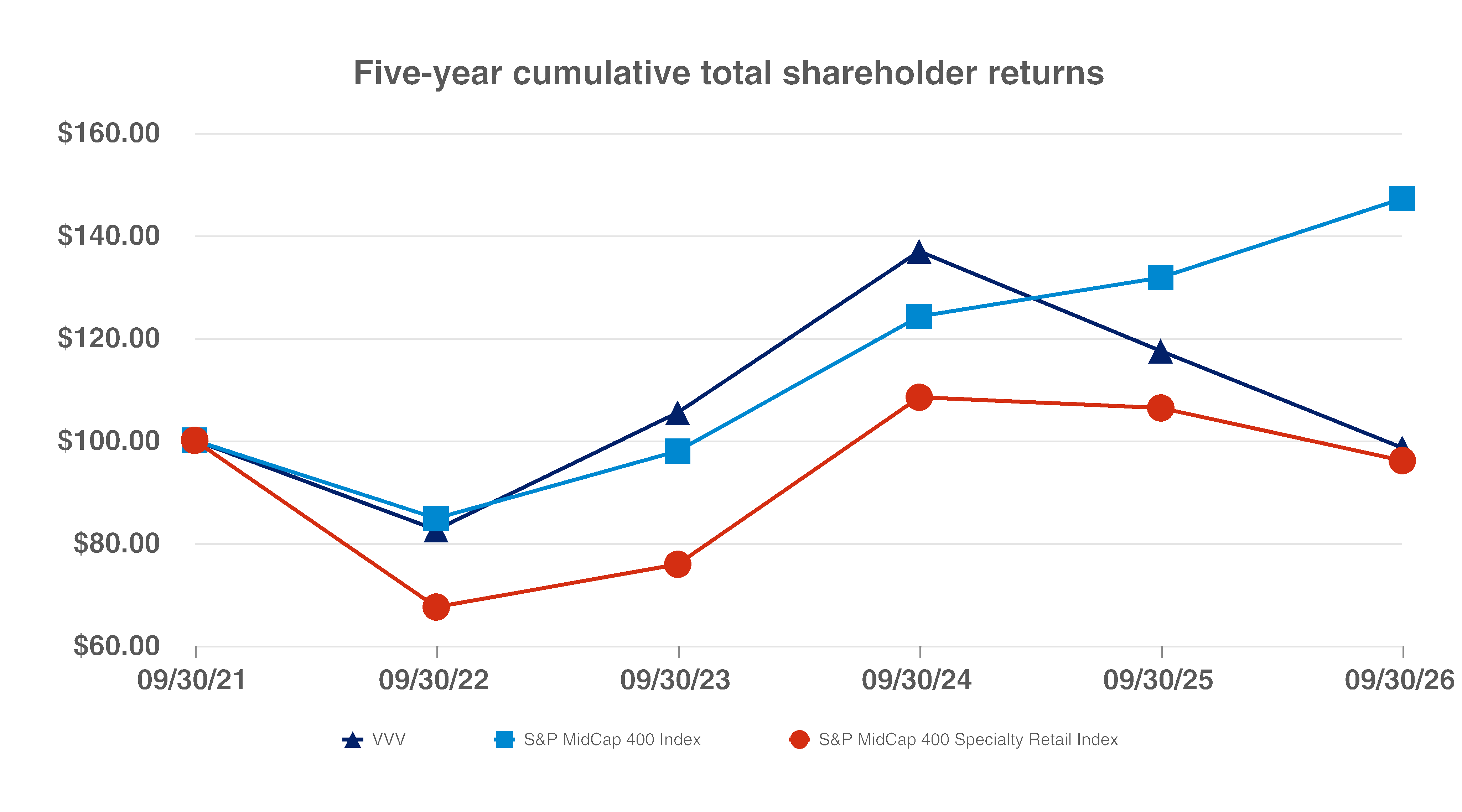
29
| Years ended September 30 | |||||
|---|---|---|---|---|---|
| Cumulative total returns | 2022 | 2023 | 2024 | 2025 | 2026 |
| Valvoline Inc. | $82.52 | $105.40 | $136.81 | $117.39 | $98.53 |
| S&P MidCap 400 Index | $84.75 | $97.90 | $124.12 | $131.72 | $147.12 |
| S&P MidCap 400 Specialty Retail Index | $67.49 | $75.77 | $108.39 | $106.29 | $96.01 |
Purchases of Company common stock
Valvoline has returned value to shareholders through share repurchases, the timing and amount of which will be at
the discretion of the Company and based on Valvoline’s liquidity, general business and market conditions, and other
factors, including alternative investment opportunities.
On July 30, 2024, the Board approved an authorization to repurchase up to $400 million of common stock with no
expiration date. The Company did not repurchase any shares of its common stock during fiscal 2026, as the
Company paused share repurchase activity following the announcement of the Breeze acquisition to accelerate
debt reduction and support its leverage objectives. On September 29, 2026, the Board approved an authorization to
repurchase an additional $175 million of its common stock, bringing the total remaining authorization to repurchase
at September 30, 2026 to $500.0 million of shares of common stock under the share repurchase program. The
Company expects to resume share repurchases in fiscal 2027.
ITEM 6. RESERVED
30
| Index to Management’s Discussion and Analysis of Financial Condition and Results of Operations | Page |
|---|---|
| Business Overview | 30 |
| Results of Operations - Consolidated Review | 34 |
| Financial Position, Liquidity and Capital Resources | 38 |
| New Accounting Pronouncements | 41 |
| Critical AccountingEstimates | 42 |
ITEM 7. MANAGEMENT’S DISCUSSION AND ANALYSIS OF
FINANCIAL CONDITION AND RESULTS OF OPERATIONS
The following discussion should be read in conjunction with the consolidated financial statements and the
accompanying Notes to Consolidated Financial Statements included in Item 8 of Part II of this Annual Report on
Form 10-K. Unless otherwise noted, disclosures herein relate solely to the Company’s continuing operations.
BUSINESS OVERVIEW AND PURPOSE
As the quick, easy, trusted leader in automotive preventive maintenance, Valvoline is creating shareholder value by
driving the full potential of its core business, delivering sustainable network growth, and continuing to innovate to
meet the evolving needs of customers and the car parc. With average customer ratings that indicate high levels of
service satisfaction, Valvoline and the Company’s franchisees simplify vehicle care so customers can do what
drives them. This includes approximately 15-minute stay-in-your-car oil changes; battery, bulb and wiper
replacements; tire rotations; and other manufacturer recommended maintenance services. The Company operates
and franchises more than 2,500 service center locations primarily through its Valvoline Instant Oil ChangeSM
(“VIOC”) and Valvoline Great Canadian Oil Change (“GCOC”) retail locations and supports nearly 240 locations
through its Express CareTM platform.
Valvoline's fiscal year ends on September 30 of each year.
RECENT DEVELOPMENTS
Breeze Autocare
On December 1, 2025, the Company acquired 100% of the equity interests in Breeze Autocare (“Breeze”) for total
cash consideration of $637.4 million, subject to certain customary post-closing adjustments. Breeze is a provider of
automotive quick lube and other preventive maintenance services operating predominantly under the Oil
ChangersSM brand with stores in California, Texas, and the Midwest. The acquisition initially included 204 service
center stores and aligns with the Company’s strategy to expand the store network in key markets. The Company
funded the Breeze acquisition with an amendment to its Senior Credit Agreement to add a seven-year $740.0
million term loan facility (the “Term Loan B”) commensurate with the closing of the transaction with excess proceeds
used to pay down outstanding debt.
Dispositions
Immediately following the Breeze acquisition, 45 of the acquired Breeze stores were sold in accordance with the
Federal Trade Commission (“FTC”) Decision and Order that required the disposal of certain acquired locations for
the Company to receive regulatory clearance to close the Breeze acquisition. The fair value of the net assets
divested was determined to be $90.0 million. As a result, the Company recognized a $57.9 million pre-tax loss on
sale within Other loss (income), net in the Consolidated Statements of Comprehensive Income in fiscal 2026.
Valvoline completed the sale of 10 company-operated service center stores to a franchisee during the first fiscal
quarter of 2026 and completed the sale of 39 company-operated service center stores to a new franchisee during
31
the first fiscal quarter of 2025. Valvoline recognized pre-tax gains on sale of $14.3 million and $73.9 million within
Other loss (income), net in the Consolidated Statements of Comprehensive Income related to these transactions
during fiscal 2026 and 2025, respectively. These transactions, together with executed development agreements are
expected to provide significant growth in the respective markets and deliver long-term value to shareholders. The
impact of these dispositions on year-over-year comparability of financial results is discussed further herein.
Financing Activities
During fiscal 2026, Valvoline completed refinancing transactions that included the issuance of $600.0 million
aggregate principal amount of Senior Notes due 2034 (the “2034 Notes”), repayment in full of the Company's Term
Loan A facility, and partial repayment of the Company's Term Loan B facility. The Company also amended its
Senior Credit Agreement to refinance the interest rates for the Term Loan B and to increase the capacity of the
revolving credit facility to $600.0 million. Through these refinancing transactions, the Company enhanced liquidity,
extended debt maturities, reduced interest rate risk, and improved covenants and Term Loan B borrowing costs.
Additional information regarding these refinancing transactions is included in Note 7 - Debt of the Notes to
Consolidated Financial Statements in Item 8 of Part II of this Annual Report on Form 10-K.
FISCAL 2026 OVERVIEW
Key operating highlights from continuing operations are presented below, each of which is discussed more fully in
this Annual Report on Form 10-K:
 |  |  |
| 21% | $4.1 billion | $431.7 million |
| Growth in Net revenues | System-wide store sales (a) | Cash flows from operations |
 |  |  |
| 2,517 | 20 years | 19.3% |
| System-wide stores (a) with 15.5% annual growth | of consecutive system-wide same-store sales growth (b) | Growth in adjusted EBITDA (c) |
- Measures include Valvoline franchisees, which are independent legal entities. Valvoline does not consolidate the results of operations of its franchisees.
- Valvoline determines SSS growth as the year-over-year change in net revenues of U.S. VIOC system-wide same stores with same stores defined as those that have been in operation within the system for at least 12 full months. Beginning in fiscal 2026, SSS also includes mobile service net revenues in markets that leverage store marketing channels.
- Represents a non-GAAP measure. Refer to “Use of Non-GAAP Measures” for additional details.
32
Summarized below are Valvoline's trends in the results of its continuing operations Net revenues, Income from
continuing operations, and Adjusted EBITDA over the last five fiscal years:
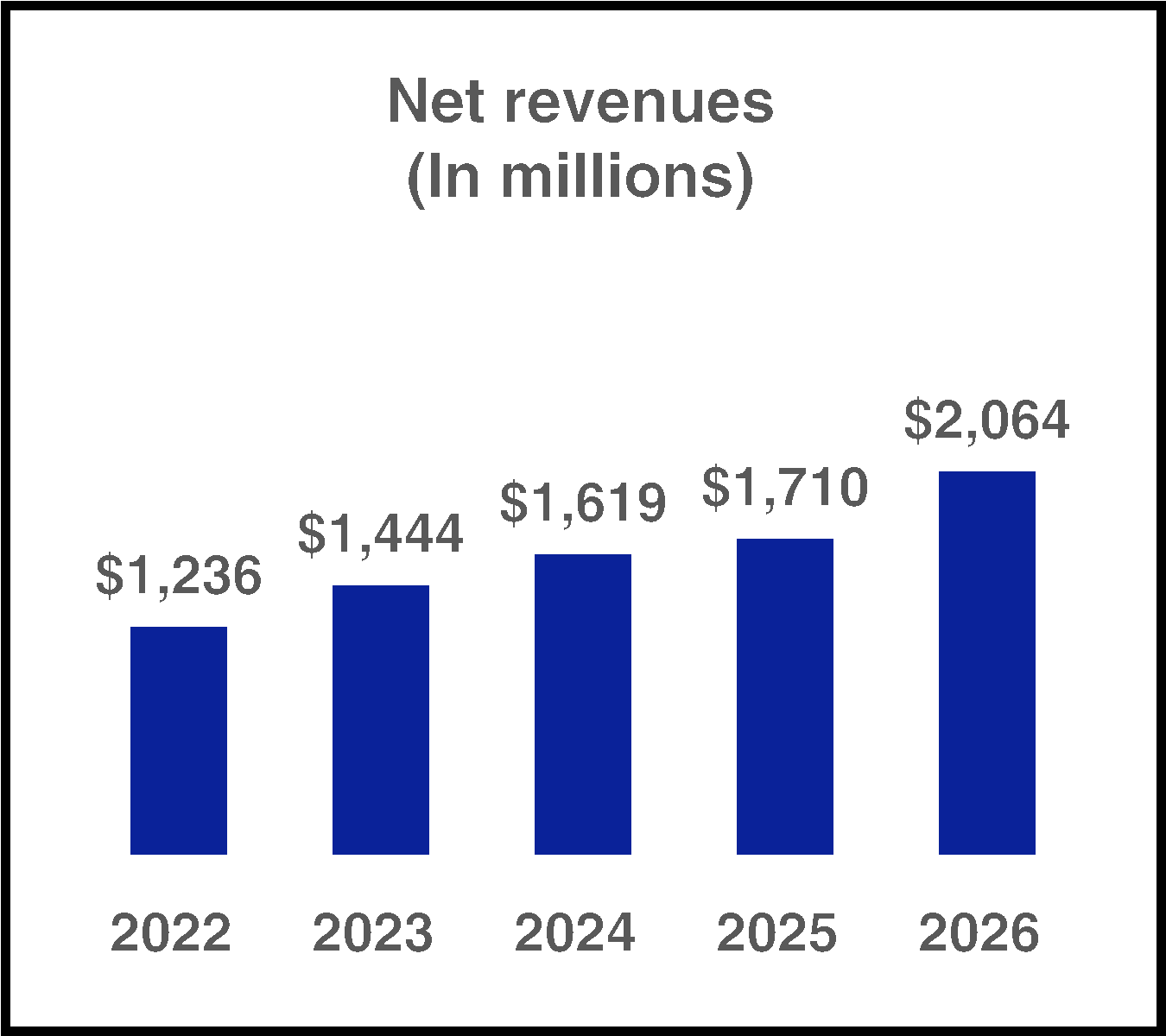
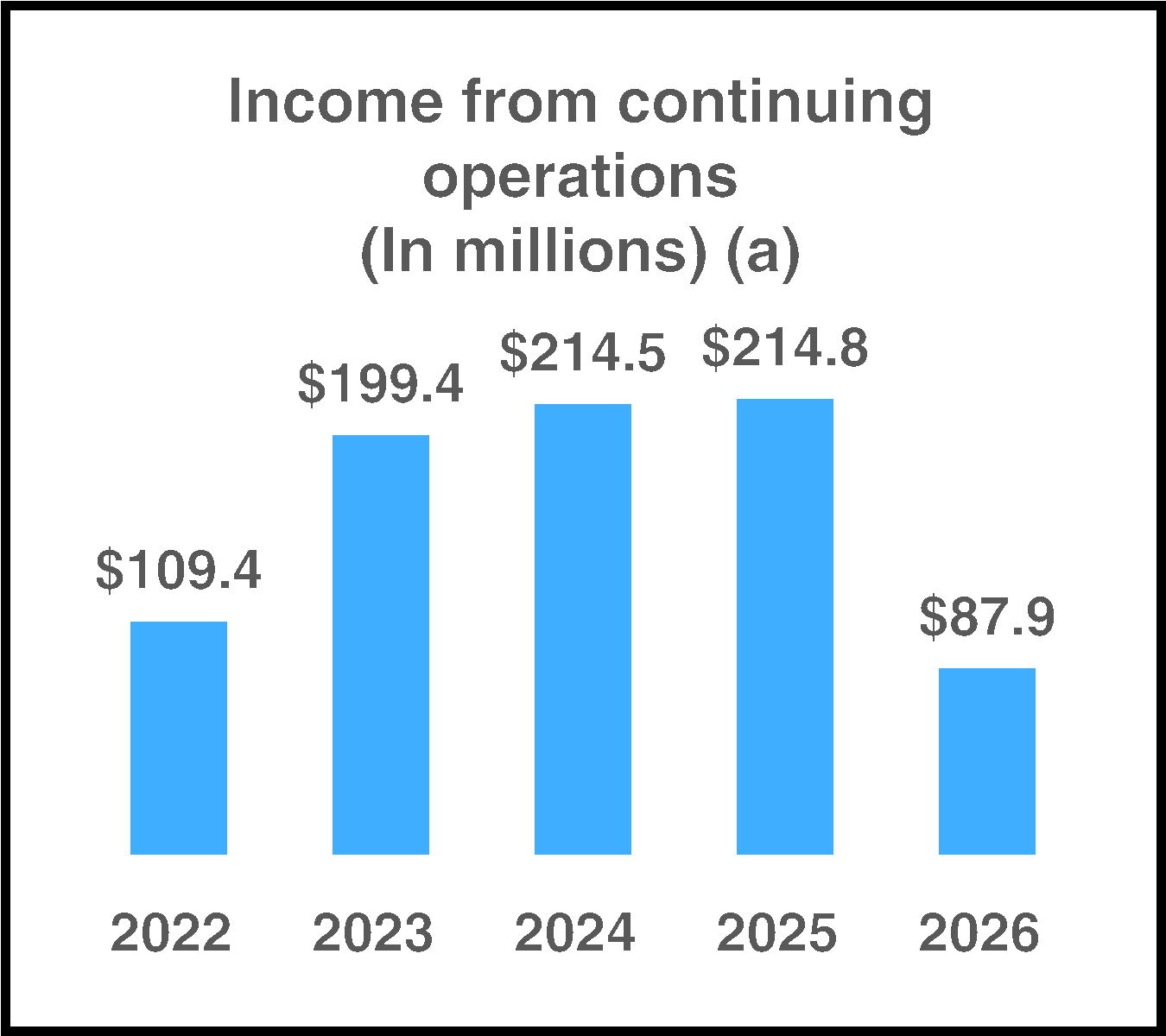
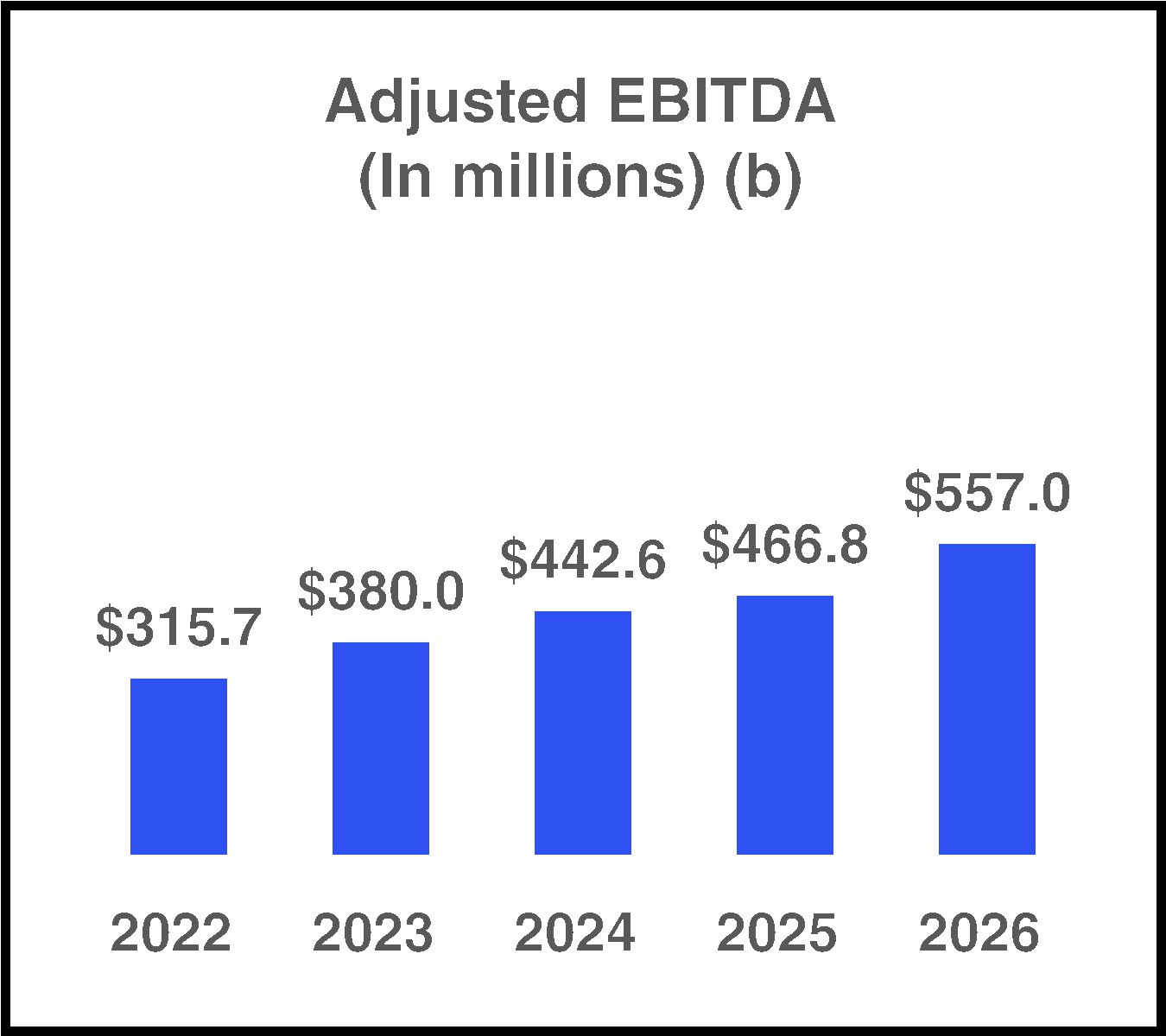
(a)Includes the effects of certain unusual, infrequent or non-operational activity not directly attributable to the underlying business, which
management believes impacts the comparability of operational results between periods (“key items,” as further described below).
(b)Adjusted EBITDA is a non-GAAP measure, further described and defined within the “Use of Non-GAAP Measures” section below. Also refer
to the “Continuing operations EBITDA and Adjusted EBITDA” section within “Results of Operations” below for a reconciliation of income
from continuing operations to Adjusted EBITDA for each fiscal year presented.
Net revenues and Adjusted EBITDA trends have continued to increase over the past five fiscal years largely driven
by strong system-wide same-store sales (“SSS”) growth, which benefited from higher average ticket, continued non-
oil change penetration and increased transactions, in addition to acquisitions and overall store expansion. Income
from continuing operations decreased for fiscal 2026 compared to the prior years primarily due to differences in
store disposition activity between periods, with the Company recognizing a loss in the current fiscal year related to
the FTC-required divestiture of 45 Breeze stores compared to gains on store dispositions in the prior fiscal years.
Prior to fiscal 2026, income from continuing operations had followed an upward trend driven by strong top-line
performance. The lower fiscal 2022 results were primarily driven by a loss due to the remeasurement of pension
and other postretirement plans, as well as higher separation-related expenses in connection with the planning and
evaluation of the separation of the Company’s businesses that ultimately culminated in the sale of Global Products.
Results for Fiscal 2025 compared to Fiscal 2024
For comparisons of Valvoline's consolidated results of operations and cash flows for the fiscal years ended
September 30, 2025 to September 30, 2024, refer to Item 7 of Part II of the Annual Report on Form 10-K for the
fiscal year ended September 30, 2025, filed with the Securities and Exchange Commission on November 21, 2025.
Use of Non-GAAP Measures
To aid in the understanding of Valvoline’s ongoing business performance, certain items within this document are
presented on an adjusted, non-GAAP basis. These non-GAAP measures have limitations as analytical tools and
should not be considered in isolation from, as an alternative to, or as more meaningful than, the financial statements
presented in accordance with U.S. GAAP. The financial results presented in accordance with U.S. GAAP and
reconciliations of non-GAAP measures included within this Annual Report on Form 10-K should be carefully
evaluated.
The following are the non-GAAP measures management has included and how management defines them:
•EBITDA - income from continuing operations, plus income tax expense/benefit, net interest and other
financing expenses, and depreciation and amortization;
•Adjusted EBITDA - EBITDA adjusted for the impacts of certain unusual, infrequent or non-operational
activity not directly attributable to the underlying business, which management believes impacts the
comparability of operational results between periods ("key items," as further described below);
•Adjusted EBITDA margin - adjusted EBITDA divided by net revenues;
33
•Free cash flow - cash flows from operating activities less total capital expenditures, comprised of growth
and maintenance, further described below;
•Free cash flow excluding growth capital expenditures - cash flows from operating activities less
maintenance capital expenditures; and
•Net debt - total debt less cash and cash equivalents.
Non-GAAP measures include adjustments from results based on U.S. GAAP that management believes enable
comparison of certain financial trends and results between periods and provide a useful supplemental presentation
of Valvoline's operating performance that allows for transparency with respect to key metrics used by management
in operating the business and measuring performance. The manner used to compute non-GAAP information used
by management may differ from the methods used by other companies and may not be comparable. For a
reconciliation of the most comparable U.S. GAAP measures to the non-GAAP measures, refer to the “Results of
Operations” and “Financial Position, Liquidity and Capital Resources” sections below.
Management believes EBITDA measures provide a meaningful supplemental presentation of Valvoline’s operating
performance between periods on a comparable basis due to the depreciable assets associated with the nature of
the Company’s operations as well as income tax and interest costs related to Valvoline’s tax and capital structures,
respectively. Adjusted EBITDA measures enable comparison of financial trends and results between periods where
certain items may not be reflective of the Company’s underlying and ongoing operating performance or vary
independent of business performance.
Management uses free cash flow and free cash flow excluding growth capital expenditures as additional non-GAAP
metrics of cash flow generation. By including capital expenditures, management is able to provide an indication of
the ongoing cash being generated that is ultimately available for both debt and equity holders as well as other
investment opportunities. Free cash flow includes the impact of capital expenditures, providing a supplemental view
of cash generation. Free cash flow excluding growth capital expenditures includes maintenance capital
expenditures, which are uses of cash that are necessary to maintain the Company's existing business operations,
including its retail service center store network, service portfolio, and support functions. Free cash flow excluding
growth capital expenditures provides a supplemental view of cash flow generation before investments in growth
capital, which expand future business operations, including the opening or expansion of retail service center stores
and service capabilities. Free cash flow and free cash flow excluding growth capital expenditures have certain
limitations, including that they do not reflect adjustments for certain non-discretionary cash expenditures, such as
mandatory debt repayments.
Management uses net debt as a measure to monitor the Company’s overall liquidity, financial flexibility, and capital
structure. Management believes net debt provides useful information because it reflects the amount of debt
obligations that would remain if all available cash and cash equivalents were used to pay down outstanding
borrowings.
The non-GAAP measures used by management exclude key items. Key items are often related to legacy matters or
market-driven events considered by management to not be reflective of the ongoing operating performance. Key
items may consist of adjustments related to: legacy businesses, including the separation from Valvoline's former
parent company, the sale of the former Global Products reportable segment, and the associated impacts of related
activity and indemnities; non-service pension and other postretirement plan activity; restructuring-related matters,
including organizational restructuring plans, significant acquisitions or divestitures, debt extinguishment and
modification, and tax reform legislation; in addition to other matters that management considers non-operational,
infrequent or unusual in nature.
Details with respect to the description and composition of key items recognized during the respective periods
presented herein are set forth below in the “Continuing operations EBITDA and Adjusted EBITDA” section of
“Results of Operations” that follows.
Key Business Measures
Valvoline tracks its operating performance and manages its business using certain key measures, including system-
wide, company-operated and franchised store counts and system-wide SSS and store sales. Management believes
34
these measures are useful in evaluating and understanding Valvoline's operating performance and should be
considered as supplements to, not substitutes for, Valvoline's net revenues and operating income, as determined in
accordance with U.S. GAAP.
Net revenues are influenced by the number of service center stores and the business performance of those stores.
Stores are considered open upon acquisition or opening for business. Temporary store closings remain in the
respective store counts with only permanent store closures reflected in the activity and end of period store counts.
SSS is defined as net revenues of U.S. VIOC system-wide stores that have been in operation for at least 12 full
months within the system. Beginning in fiscal 2026, SSS also includes mobile service net revenues in markets that
leverage store marketing channels.
Net revenues consist of sales at company-operated stores, in addition to royalties and other fees from independent
franchised and Express Care stores. Although Valvoline does not recognize store-level sales from franchised stores
as net revenues in its Consolidated Statements of Comprehensive Income, management believes system-wide and
franchised SSS comparisons, store counts, and total system-wide store sales are useful to assess market position
relative to competitors and overall store and operating performance.
RESULTS OF OPERATIONS
The following summarizes the results of the Company’s continuing operations for the years ended September 30:
| 2026 vs. 2025 | ||||
|---|---|---|---|---|
| (In millions) | 2026 | 2025 | $ | % |
| Net revenues | $2,064.3 | $1,710.3 | $354.0 | 20.7% |
| Gross profit | $770.0 | $658.5 | $111.5 | 16.9% |
| Gross profit margin | 37.3% | 38.5% | (120) bps | |
| Net operating expenses | $481.5 | $268.6 | $212.9 | 79.3% |
| Percentage of net revenues | 23.3% | 15.7% | 760 bps | |
| Operating income | $288.5 | $389.9 | $(101.4) | (26.0)% |
| Operating margin | 14.0% | 22.8% | (880) bps | |
| Income from continuing operations | $87.9 | $214.8 | $(126.9) | (59.1)% |
| EBITDA (a) | $424.1 | $485.7 | $(61.6) | (12.7)% |
| Adjusted EBITDA (a) | $557.0 | $466.8 | $90.2 | 19.3% |
| Adjusted EBITDA margin (a) | 27.0% | 27.3% | (30) bps | |
(a)Refer to “Use of Non-GAAP Measures” and “Continuing operations EBITDA and Adjusted EBITDA” for management’s definitions of the
metrics presented above and reconciliation to the corresponding GAAP measures, where applicable.
Fiscal 2026 marked the 20th consecutive year for system-wide SSS growth and the addition of 337 net new stores,
bringing the system to 2,517 stores. The table below highlights the growth over the last year:
| (In millions, except store count) | Fiscal year 2026 | Growth vs. | |
|---|---|---|---|
| 2025 | |||
| System-wide store sales (a) | $4,067.5 | 17.8% | |
| System-wide store count (a) | 2,517 | 15.5% | |
| Years ended September 30 | |||
| 2026 | 2025 | ||
| System-wide SSS growth (a) | 7.9% | 6.1% | |
| (a) | Measures include Valvoline franchisees, which are independent legal entities. Valvoline does not consolidate the results of operations of its franchisees. Refer to the “Key Business Measures” section above for additional details on these key business measures, including management’s definitions. | ||
35
Net revenues
Net revenues increased $354.0 million, or 20.7%, over the prior year period primarily attributable to network growth
of 337 net new system-wide stores, including contributions from the Breeze acquisition and other store openings.
System-wide SSS increased 7.9%, supported by higher average ticket from pricing actions, ongoing
premiumization, and non-oil change service penetration, along with modest growth in transactions. These increases
were partially offset by lower Net revenues resulting from disposition activity. The following reconciles the year-over-
year changes in Net revenues:
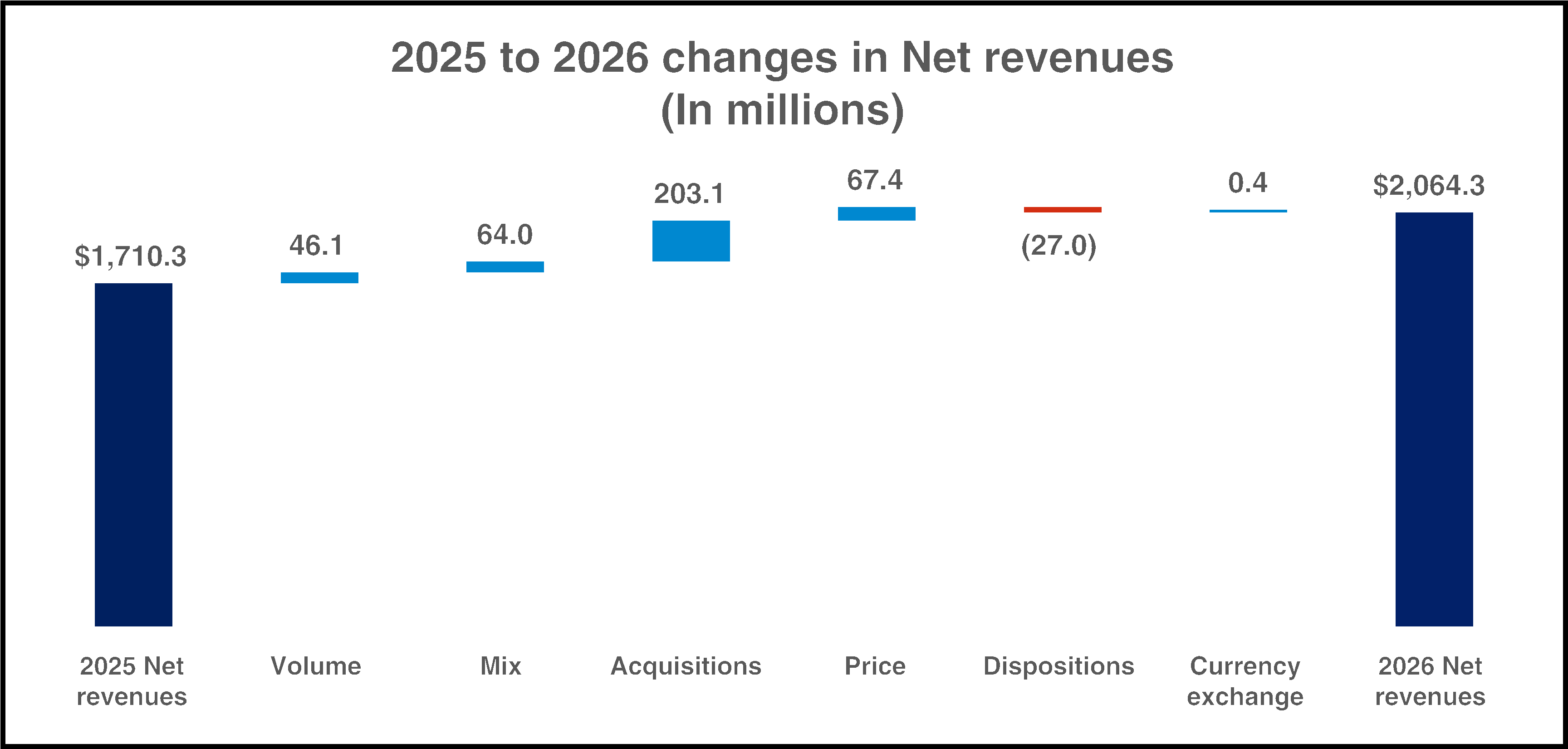
Gross profit
Gross profit improved $111.5 million, or 16.9%, year-over-year. The improvement was primarily driven by favorable
service mix, volume growth, including contributions from acquired stores, and pricing. These increases were
partially offset by product costs and higher costs associated with supporting network expansion, including labor,
occupancy, depreciation, and other service delivery expenses. The following reconciles the year-over-year changes
in gross profit:
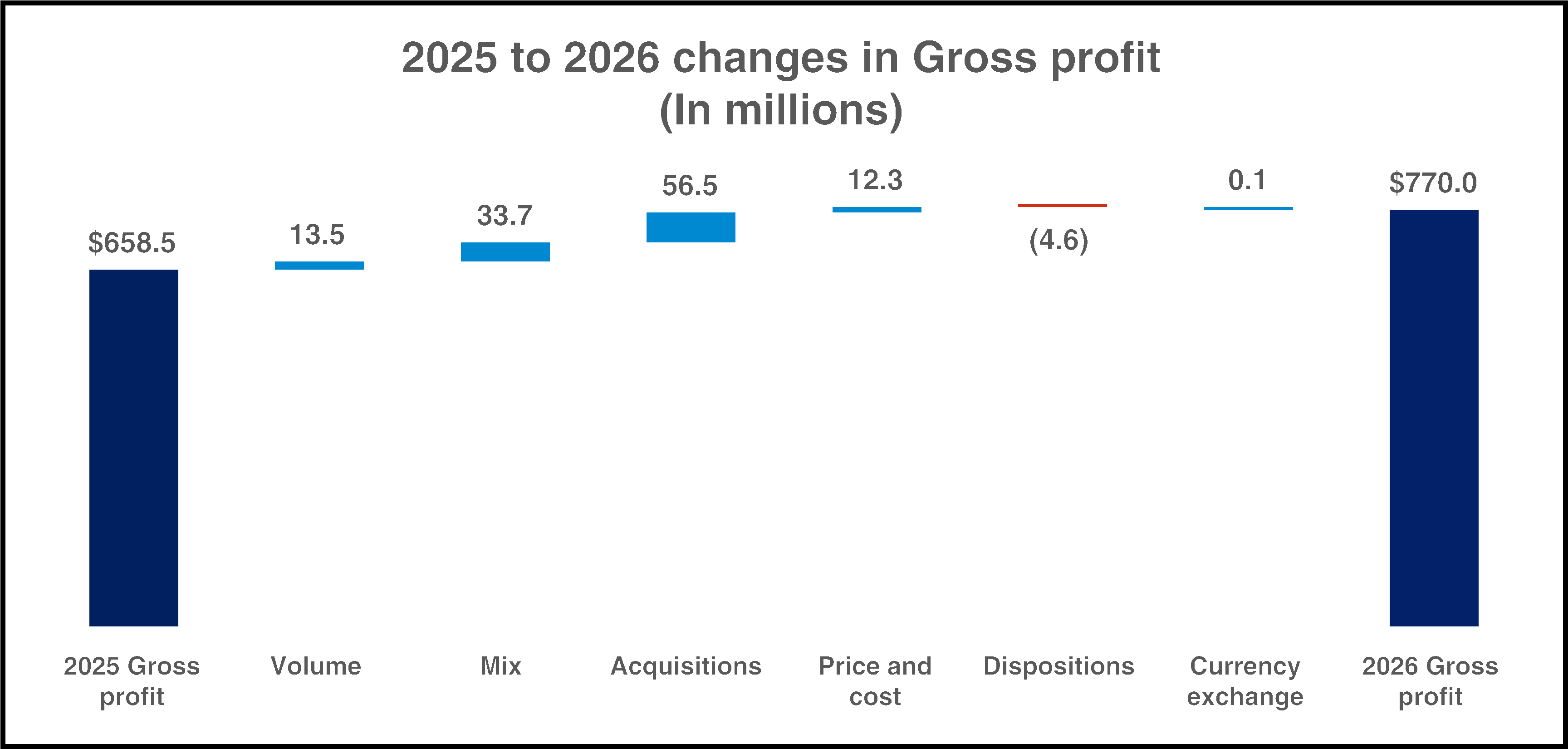
The gross profit margin rate of 37.3% declined 120 bps compared to the prior year rate of 38.5% due to higher
material costs and store operating expenses associated with network growth and the impact of recent dispositions.
36
During fiscal 2026, industry supply conditions tightened for certain lubricant products, largely due to the Middle East
conflict, and the Company leveraged its scale, supplier relationships, and pricing actions to maintain product
availability and support profitability. The Company currently expects lubricant costs to remain elevated in the near
term and continues to actively manage the environment through pricing, procurement, and operational initiatives.
Net operating expenses
Details of the components of Net operating expenses are summarized below for the years ended September 30:
| Variance | ||||
|---|---|---|---|---|
| (In millions) | 2026 | 2025 | $ | % |
| Selling, general and administrative expenses | $410.9 | $339.5 | $71.4 | 21.0% |
| Net legacy and separation-related expenses | 25.8 | 1.4 | 24.4 | 1,742.9% |
| Other loss (income), net | 44.8 | (72.3) | 117.1 | (162.0)% |
| Net operating expenses | $481.5 | $268.6 | $212.9 | 79.3% |
Selling, general and administrative (“SG&A”) expenses increased $71.4 million compared to the prior year period.
The increase reflects continued investments to scale the business and support long-term growth, including
incremental expenses from the current year Breeze acquisition. The primary contributors were talent, outside
services, advertising, technology, and depreciation and amortization, which combined to increase expense by $42.6
million. Additionally, investment and divestiture activity, namely the acquisition of Breeze, increased SG&A by $28.1
million, primarily related to consulting fees and professional services to support legal, regulatory, diligence and
integration efforts.
Net legacy and separation-related expenses increased $24.4 million compared to the prior year period, primarily
due to an increase in the estimated reimbursement for a contractual indemnity obligation related to a separation
agreement with Ashland Global Holdings Inc. (“Ashland”).
Other loss (income), net was unfavorable by $117.1 million compared to the prior year, reflecting differences in the
Company’s store disposition activity between periods. A $57.9 million pre-tax loss was recognized in fiscal 2026 on
the FTC-required divestiture of 45 Breeze stores immediately following the Breeze acquisition. In addition, the
Company recognized a $14.3 million gain on the sale of 10 company-operated stores in the current year period,
compared to a $73.9 million gain on the sale of 39 stores in the prior year period.
Net pension and other postretirement plan expenses
Net pension and other postretirement plan expenses decreased $10.6 million from the prior year, primarily due to a
loss on pension and other postretirement plan remeasurement of $17.9 million in the current year compared to a
loss of $26.6 million in the prior year. The year-over-year decrease in the remeasurement loss reflected a more
favorable impact from higher discount rates in fiscal 2026, partially offset by higher current year losses associated
with lower-than-expected returns on plan assets compared to the prior year.
Net interest and other financing expenses
Net interest and other financing expenses increased $39.5 million during fiscal 2026 primarily driven by higher
recurring interest expense of $32.3 million, largely attributable to the addition of the Term Loan B to fund the Breeze
acquisition.
37
Income tax expense
The following table summarizes Income tax expense and the effective tax rate during the years ended September
30:
| (In millions) | 2026 | 2025 |
|---|---|---|
| Income tax expense | $74.1 | $77.5 |
| Effective tax rate percentage | 45.7% | 26.5% |
The higher effective tax rate in fiscal 2026 was primarily due to nondeductible items associated with the Breeze
acquisition and the immediate FTC-required divestiture of 45 acquired stores. The divestiture pre-tax loss did not
result in a corresponding tax benefit because a portion of the loss related to nondeductible goodwill, which
contributed $17.6 million of income tax expense. Additionally, certain acquisition-related transaction costs were
nondeductible for tax purposes, increasing income tax expense by $2.3 million during fiscal 2026.
Loss from discontinued operations, net of tax
Loss from discontinued operations, net of tax for the years ended September 30 are as follows:
| (In millions) | 2026 | 2025 |
|---|---|---|
| Loss from discontinued operations, net of tax | $(2.0) | $(4.1) |
Loss from discontinued operations, net of tax decreased $2.1 million compared to the prior year period, reflecting a
reduced level of post-sale activity as separation-related matters continue to wind down following the divestiture of
the former Global Products business, with remaining activity largely limited to post-closing tax matters and
indemnities.
Continuing operations EBITDA and Adjusted EBITDA
The following reconciles Income from continuing operations to EBITDA and Adjusted EBITDA for the years ended
September 30:
| (In millions) | 2026 | 2025 | 2024 | 2023 | 2022 |
|---|---|---|---|---|---|
| Income from continuing operations | $87.9 | $214.8 | $214.5 | $199.4 | $109.4 |
| Income tax expense | 74.1 | 77.5 | 69.1 | 37.1 | 34.7 |
| Net interest and other financing expenses | 113.5 | 74.0 | 71.9 | 38.3 | 69.3 |
| Depreciation and amortization | 148.6 | 119.4 | 105.9 | 88.8 | 71.4 |
| EBITDA from continuing operations (a) | 424.1 | 485.7 | 461.4 | 363.6 | 284.8 |
| Net pension and other postretirement plan expenses (income) (b) | 13.0 | 23.6 | 11.7 | (27.6) | 6.9 |
| Net legacy and separation-related expenses (income) (c) | 26.5 | 1.4 | (0.7) | 32.8 | 20.5 |
| Information technology transition and material weakness remediation costs (d) | 19.3 | 11.5 | 10.4 | 3.0 | 2.6 |
| Investment and divestiture-related costs (income) (e) | 74.1 | (55.4) | (40.2) | 1.1 | — |
| Suspended operations (f) | — | — | — | 7.1 | 0.9 |
| Adjusted EBITDA from continuing operations (a) | $557.0 | $466.8 | $442.6 | $380.0 | $315.7 |
(a)EBITDA from continuing operations is defined as income from continuing operations, plus income tax expense, net interest and other
financing expenses, and depreciation and amortization attributable to continuing operations. Adjusted EBITDA from continuing operations is
EBITDA adjusted for key items attributable to continuing operations.
(b)Includes several elements impacted by changes in plan assets and obligations that are primarily driven by the debt and equity markets,
including remeasurement gains and losses, when applicable; and recurring non-service pension and other postretirement net periodic
activity, which consists of interest cost, expected return on plan assets and amortization of prior service credits. Management considers
these elements to be more reflective of changes in current conditions in global markets (in particular, interest rates), outside the operational
performance of the business, and are also legacy amounts that are not directly related to the underlying business and do not have an
38
impact on the compensation and benefits provided to eligible employees for current service. Refer to Note 9 in the Notes to Consolidated
Financial Statements in Item 8 of Part II in this Annual Report on Form 10-K for further details.
(c)Activity associated with legacy businesses, including the separation from Valvoline’s former parent company and its former Global Products
reportable segment. This activity includes the recognition of and adjustments to indemnity obligations to its former parent company; certain
legal, financial, professional advisory and consulting fees; and other expenses incurred by the continuing operations in connection with and
directly related to these separation transactions and legacy matters. This incremental activity directly attributable to legacy matters and
separation transactions is not considered reflective of the underlying operating performance of the Company’s continuing operations. During
fiscal 2023, the Company recognized $25.7 million of pre-tax expense to reflect its increased estimated indemnity obligation which also
resulted in an income tax benefit of $29.0 million to reflect the release of valuation allowances in connection with the amendment of the Tax
Matters Agreement with Valvoline’s former parent company.
(d)Consists of expenses incurred directly related to the Company’s information technology transitions, primarily efforts related to implementing
stand-alone enterprise resource planning and human resource information systems that generally began in fiscal 2023 following the sale of
the former Global Products reportable segment. These expenses include data conversion, training, redundant expenses incurred from
duplicative technology platforms, and temporary support, which includes consulting fees and professional services to support certain
enhanced manual procedures and material weakness remediation efforts, including adjustments resulting from process changes
implemented in remediating the material weakness. These incremental costs are directly associated with technology transitions and material
weakness remediation efforts and are not considered to be reflective of the ongoing expenses of operating the Company’s technology
platforms and control environment following the remediation of the material weakness.
(e)Consists of activity directly associated with specific significant acquisitions, investments and divestitures, including professional and
consulting fees for legal and advisory services, in addition to gains or losses recognized upon disposition, temporary financing costs directly
associated with transactions, certain acquisition-related incentive compensation costs, amortization of Breeze acquired intangible assets,
and expense recognized to adjust the carrying values of related assets determined to be impaired. This activity is not considered to be
reflective of the underlying operating performance of the Company’s ongoing continuing operations.
(f)Represents the results of a former Global Products business where operations were suspended during fiscal 2022. This business was not
included in the sale of the Global Products business in March 2023. It was classified as held for sale and impaired as of September 30,
2023, and subsequently sold during the first fiscal quarter of 2024. These results are not indicative of the operating performance of the
Company’s ongoing continuing operations.
Adjusted EBITDA increased $90.2 million, or 19.3%, for the year ended September 30, 2026 compared to the prior
year. The increase was primarily driven by gross profit growth and strong revenue performance, including higher
volumes, favorable pricing and service mix, as well as contributions from the Breeze acquisition. These benefits
more than offset the impacts of dispositions and higher SG&A expenses to support growth.
FINANCIAL POSITION, LIQUIDITY AND CAPITAL RESOURCES
Overview
The Company closely manages its liquidity and capital resources. Valvoline’s liquidity requirements depend on key
variables, including the level of investment needed to support business strategies, the performance of the business,
capital expenditures, borrowing arrangements, and working capital management. Capital expenditures, acquisitions,
and share repurchases are components of the Company’s cash flow and capital management strategy, which to a
large extent, can be adjusted in response to economic and other changes in the business environment. The
Company has a disciplined approach to capital allocation, which focuses on investing in key priorities that support
Valvoline’s business and growth strategies and returning capital to shareholders, while funding ongoing operations.
Continuing operations cash flows
Valvoline’s continuing operations cash flows as reflected in the Consolidated Statements of Cash Flows are
summarized as follows for the years ended September 30:
| (In millions) | 2026 | 2025 |
|---|---|---|
| Cash provided by (used in): | ||
| Operating activities | $431.7 | $307.1 |
| Investing activities | $(828.9) | $(201.1) |
| Financing activities | $509.1 | $(112.9) |
Operating activities
Cash flows provided by operating activities increased $124.6 million from the prior year period primarily driven by
$92.0 million of higher cash earnings and, to a lesser extent, lower spend on cloud computing implementation in the
current year period.
39
Investing activities
The increase in cash flows used in investing activities of $627.8 million was primarily due to $599.2 million higher
net cash consideration paid for acquisitions, mainly related to the Breeze acquisition. In addition, the Company
received $57.4 million lower proceeds from the sale of operations during the current year compared to proceeds
received from disposition activity in the prior year. These increases were partially offset by $31.2 million of lower
capital expenditures, primarily due to decreased growth capital expenditures.
Financing activities
Cash flows provided by financing activities increased $622.0 million from the prior year substantially driven by an
increase in net borrowings, inclusive of payments for debt issuance costs, of $550.9 million. The current year
activity is driven by the proceeds from the issuances of the Term Loan B and the 2034 Notes, partially offset by the
repayment of the Term Loan A and prepayments on the Term Loan B, and net repayments on the revolving credit
facility (“Revolver”) balance. In addition, the Company did not repurchase any shares of its common stock during
fiscal 2026 as the Company accelerated debt repayment following the Term Loan B, which resulted in less cash
used in financing activities of $76.8 million compared to the prior year.
Continuing operations free cash flow
The following table sets forth free cash flow and free cash flow excluding growth capital expenditures reconciled to
cash flows from operating activities. As previously noted, these free cash flow measures have certain limitations,
including that they do not reflect adjustments for certain non-discretionary cash expenditures, such as mandatory
debt repayments. Refer to “Use of Non-GAAP Measures” within this Item 7 for additional information regarding
these non-GAAP measures.
| (In millions) | 2026 | 2025 |
|---|---|---|
| Cash flows provided by operating activities | $431.7 | $307.1 |
| Less: Maintenance capital expenditures | (61.8) | (66.1) |
| Free cash flow excluding growth capital expenditures | 369.9 | 241.0 |
| Less: Growth capital expenditures | (166.2) | (193.1) |
| Free cash flow | $203.7 | $47.9 |
The increase in free cash flow from continuing operations over the prior year was due to higher cash flows provided
by operating activities as described above, as well as decreased capital expenditures in the current period. The
decrease in capital expenditures compared to the prior year was primarily due to lower growth capital expenditures
driven by a reduction in new construction spend, partially attributable to the use of finance lease arrangements for
certain store equipment that otherwise would have been purchased with cash.
Debt
The following table summarizes Valvoline’s continuing operations debt as of September 30:
| (In millions) | 2026 | 2025 |
|---|---|---|
| 2031 Notes | $535.0 | $535.0 |
| 2034 Notes | 600.0 | — |
| Term Loan A | — | 415.6 |
| Term Loan B | 500.0 | — |
| Revolver | — | 130.0 |
| Debt issuance costs and discounts | (21.0) | (6.6) |
| Total debt | 1,614.0 | 1,074.0 |
| Current portion of long-term debt | — | 23.8 |
| Long-term debt | $1,614.0 | $1,050.2 |
40
In December 2025, Valvoline amended its Senior Credit Agreement commensurate with closing the acquisition of
Breeze to add a seven-year $740.0 million term loan facility. In June 2026, the Company further amended the
Senior Credit Agreement to lower borrowing costs on the Term Loan B. In August 2026, Valvoline further amended
the Senior Credit Agreement to increase the capacity of the Revolver to $600.0 million and to extend the maturity to
August 2031.
During fiscal 2026, Valvoline used a substantial portion of the net proceeds from the Term Loan B to fund the
Breeze acquisition and the remaining proceeds were used to pay down the outstanding balance on the Revolver. In
August 2026, Valvoline issued $600.0 million aggregate principal amount of 6.125% senior unsecured notes due
August 15, 2034 (the “2034 Notes”). Using cash and cash equivalents on hand and a portion of the net proceeds
from the 2034 Notes, Valvoline paid the remaining $397.8 million outstanding balance of the Term Loan A and
prepaid $238.2 million of the Term Loan B. Valvoline recognized a $5.2 million loss on extinguishment of debt within
Net interest and other financing expenses in the Consolidated Statements of Comprehensive Income for the year
ended September 30, 2026.
Approximately 69% of Valvoline's outstanding borrowings as of September 30, 2026 had fixed rates, with the
remainder bearing variable interest rates. As of September 30, 2026, Valvoline was in compliance with all
covenants of its debt obligations and had borrowing capacity remaining of $596.2 million, net of outstanding letters
of credit. Refer to Note 7 of the Notes to Consolidated Financial Statements included in Item 8 of Part II of this
Annual Report on Form 10-K for additional details regarding the Company’s debt instruments.
Material cash requirements and other commitments
The Company's material cash requirements of the continuing operations include the following contractual
obligations and commitments as of September 30, 2026:
| (In millions) | Total | Less than 1 year | 1-3 years | 3-5 years | 5 years and more |
|---|---|---|---|---|---|
| Long-term debt | $1,635.0 | $— | $— | $535.0 | $1,100.0 |
| Interest payments (a) | 569.3 | 83.9 | 169.7 | 169.6 | 146.1 |
| Operating lease obligations | 572.7 | 66.7 | 123.0 | 107.3 | 275.7 |
| Finance lease obligations | 502.8 | 40.0 | 80.8 | 81.5 | 300.5 |
| Employee benefit obligations (b) | 70.2 | 8.6 | 18.5 | 15.2 | 27.9 |
| Total | $3,350.0 | $199.2 | $392.0 | $908.6 | $1,850.2 |
(a)Includes interest on both variable and fixed rate debt, assuming no prepayments. Variable interest rates have been assumed to remain
constant through payment at the rates that existed as of September 30, 2026.
(b)Includes projected benefit payments through fiscal 2036 for Valvoline’s unfunded benefit plans. Excludes benefit payments from pension
plan trust funds.
The Company has guaranteed future payments related to certain leases assigned in connection with divesting retail
stores and the Global Products business. Valvoline is obligated to perform if the buyers of the divested businesses
default on the leases, which have remaining terms ranging from 6 months to 30 years. The undiscounted maximum
potential future payments under the lease guarantees were $91.0 million as of September 30, 2026. In addition, the
Company guarantees certain outstanding franchisee debt obligations that have remaining terms ranging from 2
months to 4 years and total $12.8 million as of September 30, 2026. The Company has not recorded a liability for
these guarantees as the likelihood of making future payments is not considered probable.
Obligations to former parent company
Liabilities due to Ashland, which primarily represent estimated indemnity obligations under agreements entered into
in connection with Valvoline’s separation from Ashland, were $48.4 million as of September 30, 2026. In October
2026, the Company reached an agreement in principle to settle an indemnity obligation for approximately $43.8
million. The Company expects to finalize the settlement and make the payment in early calendar year 2027. For
additional information, refer to Note 14 of the Notes to Consolidated Financial Statements in Item 8 of Part II of this
Annual Report on Form 10-K.
41
Fiscal 2027 capital expenditures
Valvoline is currently forecasting approximately $245 million to $265 million of capital expenditures for fiscal 2027,
funded primarily from operating cash flows.
Pension and other postretirement plan obligations
The Company makes cash and non-cash contributions and benefit payments for its pension and other
postretirement plans. During fiscal 2026, the Company made $12.5 million in benefit payments for its non-qualified
pension and other postretirement plans, consisting of $5.0 million of cash payments and $7.5 million of non-cash
payments. Based on current data and assumptions, the Company does not anticipate the need to satisfy any
minimum funding requirements to its qualified pension plans in the near term. Refer to Note 9 of the Notes to
Consolidated Financial Statements in Item 8 of Part II of this Annual Report on Form 10-K for additional information
regarding the Company's U.S. pension and other postretirement plans.
Share repurchases
In July 2024, the Board approved a share repurchase authorization of $400.0 million (the “2024 Share Repurchase
Authorization”), which has no expiration date. During the year ended September 30, 2026, the Company did not
repurchase any shares of its common stock. In September 2026, the Board approved an increase to the amount
remaining available for repurchases of common stock under the 2024 Share Repurchase Authorization by $175.0
million, bringing the total remaining authorization to $500.0 million, all of which is available for repurchase at
September 30, 2026.
The timing and amount of any repurchases of common stock will be solely at the discretion of the Company and are
subject to general business and market conditions, as well as other factors. The share repurchase authorization is
part of a broader capital allocation framework to deliver value to shareholders by first, driving profitable growth in the
business, organically and through acquisitions and franchise development; second, maintaining a healthy balance
sheet; and third, continuing to return excess capital to shareholders.
Following the announcement of the Breeze acquisition, the Company paused share repurchase activity to
accelerate debt reduction and support its leverage objectives. Since the acquisition, the Company has made
substantial progress in reducing its net debt to adjusted EBITDA leverage ratio, and expects to resume share
repurchases in fiscal 2027 pursuant to the 2024 Share Repurchase Authorization, subject to market conditions.
Summary
Valvoline had cash and cash equivalents of $163.0 million, operating cash flows from continuing operations of
$431.7 million, total debt of $1,614.0 million, and remaining borrowing capacity of $596.2 million under its Revolver
as of September 30, 2026. Valvoline’s ability to continue to generate positive cash flows from operations depends
on general economic conditions and the competitive environment in the industry, and is subject to the business and
other risk factors described in Item 1A of Part I of this Annual Report on Form 10-K.
Management believes that the Company has sufficient liquidity based on its current cash, cash equivalents, cash
generated from business operations and existing financing to meet its pension and other postretirement plan, debt
servicing, tax-related and other material cash and operating requirements for the next twelve months.
NEW ACCOUNTING PRONOUNCEMENTS
For a discussion and analysis of recently issued and adopted accounting pronouncements and the impact on
Valvoline, refer to Note 2 of the Notes to Consolidated Financial Statements in Item 8 of Part II of this Annual
Report on Form 10-K.
42
CRITICAL ACCOUNTING ESTIMATES
The preparation of Valvoline’s consolidated financial statements in conformity with U.S. GAAP requires
management to make estimates and assumptions that affect the reported amounts of assets, liabilities, revenues
and expenses, and the disclosures of contingent matters. Significant items that are subject to such estimates and
assumptions include, but are not limited to, employee benefit obligations and business combinations and intangible
assets.
Although management bases its estimates on historical experience and various other assumptions that are believed
to be reasonable under the circumstances, actual results could differ significantly from the estimates under different
assumptions or conditions. Valvoline’s significant accounting policies are discussed in Note 2 of the Notes to
Consolidated Financial Statements in Item 8 of Part II of this Annual Report on Form 10-K. The Company believes
the accounting estimates listed below are the most critical to aid in fully understanding and evaluating the reported
financial results, and require the most difficult, subjective, or complex judgments, resulting from the need to make
estimates about the effects of matters that are inherently uncertain.
43
Employee benefit obligations
| Description | Judgments and uncertainties | Effect if actual results differ from assumptions |
| Valvoline sponsors defined benefit pension and other postretirement plans in the U.S. As of September 30, 2026, Valvoline’s net unfunded pension and other postretirement plan liabilities included in the Consolidated Balance Sheet totaled $154.3 million. Total pension and other postretirement net periodic benefit expense recognized in fiscal 2026 was $13.0 million, inclusive of a $17.9 million remeasurement loss. Valvoline recognizes the change in the fair value of plan assets and the net actuarial gains and losses calculated using updated actuarial assumptions as of the measurement date, which for Valvoline is September 30, and when a plan qualifies for an interim remeasurement. Refer to Note 9 of the Notes to Consolidated Financial Statements included in Item 8 of Part II of this Annual Report on Form 10-K for additional information regarding the Company’s pension and other postretirement plans. | The Company’s pension and other postretirement benefit costs and obligations are dependent on actuarial valuations and various assumptions that attempt to anticipate future events and are used in calculating the expense and liabilities relating to these plans. These assumptions include estimates and judgments the Company makes about discount rates and mortality, among others. Significant assumptions the Company must review and set annually and at each measurement date related to its pension and other postretirement benefit obligations are described further below.The fair value of plan assets represents the current market value of assets held by irrevocable trust funds for the sole benefit of participants. Valvoline’s pension plans hold a variety of investments designed to diversify risk. Plan assets are invested in equity securities, government and agency securities, corporate debt, and other non-traditional assets such as hedge funds. The pension plan assets are subject to valuation risk and generated an actual weighted-average loss of 3.74% in fiscal 2026 primarily driven by the market performance of the qualified pension plan assets. This reflects the Company’s investment strategy to hedge changes in liabilities from movements in discount rates with investments of a matched duration that provide offsetting returns aligned with changes in interest rates. Target asset allocation percentages as of September 30, 2026 for the qualified pension plans were 70% fixed income and 30% equity investments. The qualified pension plans are managed by professional investment managers that operate under investment management contracts that include specific investment guidelines, requiring among other actions, adequate diversification and prudent use of risk management practices such as portfolio constraints relating to established benchmarks. | Though management considers current market conditions and other relevant factors in establishing these assumptions and year-end values, the actuarial assumptions used and ultimate asset values may differ materially from current results due to changing market and economic conditions, longer or shorter life spans of participants, and differences between the actual and expected long-term return on plan assets. These differences may result in a significant impact to the amount of pension or other postretirement benefits cost recorded or that may be recorded. Changes in assumptions or asset values may have a significant effect on the measurement of expense or income. |
44
Actuarial assumptions
Significant assumptions the Company must review and set annually and at each measurement date related to its
pension and other postretirement benefit obligations are:
•Discount rate — Reflects the rates at which benefits could effectively be settled and is based on current
investment yields of high-quality corporate bonds. Consistent with historical practice, the Company uses an
actuarially developed full yield curve approach, the above mean yield curve, to match the timing of cash
flows of expected future benefit payments from the plans by applying specific spot rates along the yield
curve to determine the assumed discount rate. Valvoline’s fiscal 2026 expense, excluding actuarial gains
and losses, for pension plans was determined using the spot discount rates as of the beginning of the fiscal
year. The interest cost discount rates for fiscal 2026 pension and other postretirement plans were 4.75%
and 4.71%, respectively. The weighted-average discount rate at the end of fiscal 2026 was 6.35% for the
pension plans and 6.23% for the postretirement health and life plans.
The following table illustrates the estimated impact on hypothetical pension and other postretirement
expense that would have resulted from a one percentage point change in discount rates in isolation of
impacts on other significant assumptions in the years ended September 30:
| (In millions) | 2026 | 2025 | |
|---|---|---|---|
| Increase in pension and other postretirement plan expense - 1.00% decrease in discount rates: | |||
| Pension benefits | |||
| Increase in benefit obligation | $97.0 | $129.8 | |
| Increased return on plan assets (a) | (94.2) | (125.8) | |
| Estimated hypothetical increase in expense | 2.8 | 4.0 | |
| Other postretirement benefits | |||
| Increase in benefit obligation | 1.5 | 1.7 | |
| Total estimated hypothetical increase in expense | $4.3 | $5.7 | |
| (a) | The qualified pension plans employ an investing strategy to match the duration of their obligation and investments. These plans represent approximately 96% of Valvoline’s total gross pension plan obligation as of September 30, 2026 and 2025. This strategy hedges approximately 100% of the movement in liabilities related to changes in discount rates as of September 30, 2026 and 2025. Therefore, when discount rates change, asset returns generally mirror the impacts, minimizing the net impact to the consolidated financial statements. This estimated impact does not include increased returns of other plan assets that may also benefit from increased interest rates. | ||
•Mortality — The mortality assumption for Valvoline's pension and other postretirement plans utilizes the
Society of Actuaries PRI-2012 mortality base tables and the MP-2021 mortality improvement scale as
released by the SOA Retirement Plans Experience Committee. Valvoline believes this mortality
improvement scale provides a reasonable assessment of current mortality trends and an appropriate
estimate of future mortality projections.
Other assumptions, including the healthcare cost trend rate, do not have a significant impact on Valvoline's pension
and other postretirement benefit plan costs and obligations based upon current plan provisions that have generally
frozen benefits and limited costs.
45
Business combinations and intangible assets
| Description | Judgments and uncertainties | Effect if actual results differ from assumptions |
| On December 1, 2025, the Company acquired 100% of the equity interests in Breeze Autocare (“Breeze”) for total cash consideration of $637.4 million. Breeze is a provider of automotive quick lube and other preventive maintenance services operating predominantly under the Oil ChangersSM brand with stores in California, Texas, and the Midwest. The acquisition initially included 204 service center stores. The Company also completed multiple other acquisitions during fiscal 2026 for an aggregate purchase price of $31.4 million. The Company allocates the purchase price of an acquired business to its identifiable assets acquired and liabilities assumed at the acquisition date based upon their estimated fair values. The excess of the fair value of purchase consideration over the fair value of these assets acquired and liabilities assumed is recorded as goodwill. If the fair value of the assets acquired and liabilities assumed exceeds the purchase price consideration, a bargain purchase gain is recorded.Goodwill is tested at the reporting unit level for impairment on an annual basis during the fourth fiscal quarter as of July 1 or more frequently if certain events occur indicating that the carrying value of goodwill may be impaired. At the time of the Company’s annual impairment assessment, Valvoline consisted of a single reporting unit, Retail Services. The Company’s gross amortizable intangible assets and accumulated amortization were $196.5 million and $107.2 million, respectively, as of September 30, 2026. Other intangible assets are evaluated for impairment whenever events or changes in circumstances indicate the carrying amount may not be recoverable. Various factors are considered in determining whether a trigger requiring impairment assessment has occurred, such as, but not limited to, changes in the expected use of the assets, technology or development of alternative assets, economic conditions, operating performance, and expected future cash flows. | Purchase price allocations contain uncertainties because they require management to make significant estimates and assumptions and to apply judgment to estimate the fair value of assets acquired and liabilities assumed, particularly with respect to intangible assets.Management estimates the fair value of assets acquired and liabilities assumed based on quoted market prices, the carrying value of the acquired assets and widely accepted valuation techniques, including discounted cash flows and market multiple analyses.Critical estimates in valuing intangible assets include, but are not limited to, estimates about: expected future cash flows from customers, including revenue and operating expenses; royalty and customer attrition rates; proprietary technology obsolescence curve; the acquired company's brand awareness and market position; the market awareness of the acquired company's branded technology solutions and services; assumptions about the period of time the brands will continue to be valuable; as well as discount rates. The Company's estimates of fair value are based upon reasonable assumptions, but are inherently uncertain and unpredictable. Assumptions may be incomplete or inaccurate, and unanticipated events and circumstances may occur. | If actual results are materially different than the assumptions used to determine fair value of the assets acquired and liabilities assumed through a business combination, or the useful lives of the acquired intangible assets, it is possible that adjustments to the carrying values of such assets and liabilities will have a material impact on the Company's financial position and results of operations. Furthermore, if actual results are not consistent with estimates or assumptions, the Company may be exposed to an impairment charge that could materially adversely impact its consolidated financial position and results of operations.There were no impairments to intangible assets recognized by the Company during fiscal 2026 or 2025. Though no qualitative factors were present that indicated the existence of a potential impairment, Valvoline performed a quantitative impairment assessment of goodwill during fiscal 2026 and determined that its reporting unit had a fair value that was in excess of its carrying value. Valvoline elected to perform a qualitative assessment in fiscal 2025, which indicated that it was more likely than not that the fair value of the reporting unit was in excess of the carrying amount. |
46
ITEM 7A. QUANTITATIVE AND QUALITATIVE DISCLOSURES
ABOUT MARKET RISK
Valvoline is exposed to market risks arising from adverse changes in:
•Inflation and changing prices;
•Interest rates;
•Credit risk; and
•Currency exchange rates.
These market risks are described further below. In addition, refer to Item 1A of Part I in this Annual Report on Form
10-K for additional discussion of these and other risks.
Inflation and changing prices
The cost of materials and labor used in Valvoline’s automotive preventive maintenance services are affected by
cost inflation and global commodity prices that could expose Valvoline to risks in its results. Fiscal 2026, 2025, and
2024 all experienced high rates of inflation and, during fiscal 2026, supply constraints related to the conflict in the
Middle East increased finished lubricant costs. Valvoline mitigates these risks primarily through pricing actions and
contracts with its independent operators are generally indexed to changes in material prices. However, Valvoline
may not always be able to raise prices in response to increased costs or may experience delays in doing so, as its
ability to pass through costs depends largely on market conditions.
Interest rate risk
The Company is subject to interest rate risk in relation to its variable-rate debt. Approximately 69% of the
Company’s outstanding borrowings as of September 30, 2026 carried fixed rates. A hypothetical 100 basis point
change in variable interest rates would impact the Company’s interest expense and pre-tax earnings by $5.0 million
for the year ended September 30, 2026.
The Company is also exposed to market risk related to changes in interest rates and investment returns, which
affect the value of pension and other postretirement plan assets and obligations. The pension plans hold a variety of
investments designed to diversify risk, protect against declines in interest rates, and achieve an adequate net
investment return to provide for future benefit payments to its participants. These investments are subject to
variability that can be caused by fluctuations in general economic conditions. The investment strategy is also
designed to mitigate interest rate risk by aligning a portion of plan assets with the interest rate sensitivity to the
pension obligations, such that the impact of interest rate movements on plan obligations is generally expected to be
partially offset by corresponding changes in plan assets. However, the net impact of interest rate movements can
affect pension and other postretirement activity recognized in the Consolidated Statements of Comprehensive
Income as well as the funded status of the plans, which in turn may drive requirements to make contributions to the
plans. Pension and other postretirement plans were underfunded by $154.3 million at September 30, 2026 as the
projected benefit obligation exceeded the fair value of plan assets.
Credit risk
The Company is potentially subject to concentrations of credit risk on financial instruments for its cash and cash
equivalents. Credit risk includes the risk of nonperformance by counterparties, and the maximum potential loss may
exceed the amount recognized within the Consolidated Balance Sheets. Exposure to credit risk is managed by
selecting highly rated and diversified financial institutions as counterparties to transactions and monitoring
procedures. As of September 30, 2026, there was not a significant concentration of credit risk related to financial
instruments.
Currency exchange risk
Substantially all of Valvoline’s business and results of its continuing operations occur within the U.S., resulting in
limited exposure to the effects of currency exchange. The impacts from currency exchange have not been material
to Valvoline’s continuing operations, and the Company will continue to monitor its exposure to determine if changes
in its business and operations may warrant undertaking strategies to minimize currency exchange risk.
47
ITEM 8. FINANCIAL STATEMENTS AND SUPPLEMENTARY DATA
48
REPORT OF INDEPENDENT REGISTERED PUBLIC ACCOUNTING FIRM
To the Stockholders and the Board of Directors of Valvoline Inc.
Opinion on the Financial Statements
We have audited the accompanying consolidated balance sheets of Valvoline Inc. and consolidated subsidiaries
(the Company) as of September 30, 2026 and 2025, the related consolidated statements of comprehensive income,
stockholders’ equity and cash flows for each of the three years in the period ended September 30, 2026, and the
related notes and financial statement schedule listed in the Index at Item 15(a) (collectively referred to as the
“consolidated financial statements”). In our opinion, the consolidated financial statements present fairly, in all
material respects, the financial position of the Company at September 30, 2026 and 2025, and the results of its
operations and its cash flows for each of the three years in the period ended September 30, 2026, in conformity with
U.S. generally accepted accounting principles.
We also have audited, in accordance with the standards of the Public Company Accounting Oversight Board
(United States) (PCAOB), the Company's internal control over financial reporting as of September 30, 2026, based
on criteria established in Internal Control—Integrated Framework issued by the Committee of Sponsoring
Organizations of the Treadway Commission (2013 framework), and our report dated November 19, 2026 expressed
an unqualified opinion thereon.
Basis for Opinion
These financial statements are the responsibility of the Company's management. Our responsibility is to express an
opinion on the Company’s financial statements based on our audits. We are a public accounting firm registered with
the PCAOB and are required to be independent with respect to the Company in accordance with the U.S. federal
securities laws and the applicable rules and regulations of the Securities and Exchange Commission and the
PCAOB.
We conducted our audits in accordance with the standards of the PCAOB. Those standards require that we plan
and perform the audit to obtain reasonable assurance about whether the financial statements are free of material
misstatement, whether due to error or fraud. Our audits included performing procedures to assess the risks of
material misstatement of the financial statements, whether due to error or fraud, and performing procedures that
respond to those risks. Such procedures included examining, on a test basis, evidence regarding the amounts and
disclosures in the financial statements. Our audits also included evaluating the accounting principles used and
significant estimates made by management, as well as evaluating the overall presentation of the financial
statements. We believe that our audits provide a reasonable basis for our opinion.
Critical Audit Matter
The critical audit matter communicated below is a matter arising from the current period audit of the financial
statements that was communicated or required to be communicated to the audit committee and that: (1) relates to
accounts or disclosures that are material to the financial statements and (2) involved our especially challenging,
subjective or complex judgments. The communication of the critical audit matter does not alter in any way our
opinion on the consolidated financial statements, taken as a whole, and we are not, by communicating the critical
audit matter below, providing a separate opinion on the critical audit matter or on the account or disclosure to which
it relates.
49
Accounting for defined benefit pension obligation
| Description of the Matter | At September 30, 2026, the Company’s aggregate defined benefit pension obligation was $1,329.2 million and exceeded the fair value of pension plan assets of $1,198.3 million, resulting in an unfunded status of $130.9 million. As disclosed in Note 9 of the consolidated financial statements, the Company recognizes the change in the net actuarial gains and losses annually in the fourth quarter of each fiscal year and whenever a plan is determined to qualify for a remeasurement to reflect the updated actuarial assumptions. The remaining components of pension benefit costs are recorded ratably throughout the fiscal year.Auditing the valuation of the defined benefit pension obligation was complex due to the judgmental nature of certain of the actuarial assumptions, specifically, the discount rate and mortality rate, used in the measurement process. These assumptions have a significant effect on the defined benefit pension obligation. |
| How We Addressed the Matter in Our Audit | We obtained an understanding, evaluated the design and tested the operating effectiveness of controls over the Company’s process to value the defined benefit pension obligation. We tested controls over management’s review of the significant actuarial assumptions, as described above, and the completeness and accuracy of the data provided to the actuary.To test the defined benefit pension obligation, we performed audit procedures that included, among others, evaluating the methodology used, testing the significant actuarial assumptions, as described above, and testing the completeness and accuracy of the underlying data used by management, including participant data. In addition, we involved our actuarial specialists to assist with our procedures. We compared the significant actuarial assumptions, as described above, used by management to its historical accounting practices and evaluated the change in the defined benefit pension obligation from the prior year. For example, the discount rate reflects the rates at which benefits could effectively be settled and is based on current investment yields of high-quality corporate bonds. The Company uses an actuarially-developed full yield curve approach in establishing its discount rate. We evaluated management’s methodology for determining the discount rate that reflects the maturity and duration of the benefit payments. We evaluated whether the yield curve used by the Company was within a reasonable range. To evaluate the mortality rate, we assessed whether the information was consistent with publicly available information, whether the mortality tables utilized were appropriate, and whether any market data adjusted for entity-specific adjustments were applied. |
/s/ Ernst & Young LLP
We have served as the Company’s auditor since 2016.
Louisville, Kentucky
November 19, 2026
50
| Valvoline Inc. and Consolidated Subsidiaries | |||
| Consolidated Statements of Comprehensive Income | |||
| Years ended September 30 | |||
| (In millions, except per share amounts) | 2026 | 2025 | 2024 |
| Net revenues | $2,064.3 | $1,710.3 | $1,619.0 |
| Cost of sales | 1,294.3 | 1,051.8 | 1,000.2 |
| Gross profit | 770.0 | 658.5 | 618.8 |
| Selling, general and administrative expenses | 410.9 | 339.5 | 295.8 |
| Net legacy and separation-related expenses (income) | 25.8 | 1.4 | (0.7) |
| Other loss (income), net | 44.8 | (72.3) | (43.5) |
| Operating income | 288.5 | 389.9 | 367.2 |
| Net pension and other postretirement plan expenses | 13.0 | 23.6 | 11.7 |
| Net interest and other financing expenses | 113.5 | 74.0 | 71.9 |
| Income before income taxes | 162.0 | 292.3 | 283.6 |
| Income tax expense | 74.1 | 77.5 | 69.1 |
| Income from continuing operations | 87.9 | 214.8 | 214.5 |
| Loss from discontinued operations, net of tax | (2.0) | (4.1) | (3.0) |
| Net income | $85.9 | $210.7 | $211.5 |
| NET EARNINGS PER SHARE | |||
| Basic earnings (loss) per share | |||
| Continuing operations | $0.69 | $1.68 | $1.65 |
| Discontinued operations | (0.02) | (0.03) | (0.02) |
| Basic earnings per share | $0.67 | $1.65 | $1.63 |
| Diluted earnings (loss) per share | |||
| Continuing operations | $0.69 | $1.67 | $1.63 |
| Discontinued operations | (0.02) | (0.03) | (0.02) |
| Diluted earnings per share | $0.67 | $1.64 | $1.61 |
| WEIGHTED AVERAGE COMMON SHARES OUTSTANDING | |||
| Basic | 127.8 | 127.9 | 130.1 |
| Diluted | 128.3 | 128.6 | 131.0 |
| COMPREHENSIVE INCOME | |||
| Net income | $85.9 | $210.7 | $211.5 |
| Other comprehensive (loss) income, net of tax | |||
| Currency translation adjustments | (2.5) | (3.0) | 4.2 |
| Amortization of pension and other postretirement plan prior service credits | (1.7) | (1.7) | (1.7) |
| Unrealized loss on cash flow hedges | — | — | (5.8) |
| Other comprehensive loss | (4.2) | (4.7) | (3.3) |
| Comprehensive income | $81.7 | $206.0 | $208.2 |
The accompanying Notes to Consolidated Financial Statements are an integral part of these Consolidated Financial Statements.
51
| Valvoline Inc. and Consolidated Subsidiaries | ||
| Consolidated Balance Sheets | ||
| As of September 30 | ||
| (In millions, except per share amounts) | 2026 | 2025 |
| Assets | ||
| Current assets | ||
| Cash and cash equivalents | $163.0 | $51.6 |
| Receivables, net | 103.0 | 89.6 |
| Inventories, net | 53.9 | 42.6 |
| Prepaid expenses and other current assets | 75.3 | 59.9 |
| Total current assets | 395.2 | 243.7 |
| Noncurrent assets | ||
| Property, plant and equipment, net | 1,342.0 | 1,134.6 |
| Operating lease assets | 405.2 | 331.8 |
| Goodwill and intangibles, net | 1,285.3 | 740.5 |
| Other noncurrent assets | 178.3 | 219.8 |
| Total noncurrent assets | 3,210.8 | 2,426.7 |
| Total assets | $3,606.0 | $2,670.4 |
| Liabilities and Stockholders’ Equity | ||
| Current liabilities | ||
| Current portion of long-term debt | $— | $23.8 |
| Trade and other payables | 179.6 | 118.9 |
| Accrued expenses and other liabilities | 261.0 | 204.7 |
| Total current liabilities | 440.6 | 347.4 |
| Noncurrent liabilities | ||
| Long-term debt | 1,614.0 | 1,050.2 |
| Employee benefit obligations | 143.2 | 187.5 |
| Deferred tax liabilities | 145.0 | 117.0 |
| Operating lease liabilities | 381.8 | 315.3 |
| Other noncurrent liabilities | 454.2 | 314.5 |
| Total noncurrent liabilities | 2,738.2 | 1,984.5 |
| Commitments and contingencies | ||
| Stockholders' Equity | ||
| Preferred stock, no par value, 40 shares authorized; no shares issued and outstanding | — | — |
| Common stock, par value $0.01 per share, 400.0 shares authorized, 127.6 and 127.1 shares issued and outstanding at September 30, 2026 and 2025, respectively | 1.3 | 1.3 |
| Paid-in capital | 65.4 | 58.4 |
| Retained earnings | 359.5 | 273.6 |
| Accumulated other comprehensive income | 1.0 | 5.2 |
| Stockholders' equity | 427.2 | 338.5 |
| Total liabilities and stockholders’ equity | $3,606.0 | $2,670.4 |
The accompanying Notes to Consolidated Financial Statements are an integral part of these Consolidated Financial Statements.
52
| Valvoline Inc. and Consolidated Subsidiaries | |||
| Consolidated Statements of Cash Flows | |||
| Years ended September 30 | |||
| (In millions) | 2026 | 2025 | 2024 |
| Cash flows from operating activities | |||
| Net income | $85.9 | $210.7 | $211.5 |
| Adjustments to reconcile net income to cash flows from operating activities: | |||
| Loss from discontinued operations | 2.0 | 4.1 | 3.0 |
| Loss on extinguishment of debt | 5.7 | — | 5.1 |
| Loss (gain) on sale of operations | 43.6 | (71.1) | (41.8) |
| Depreciation and amortization | 148.6 | 119.4 | 105.9 |
| Deferred income taxes | 58.2 | 38.3 | 23.5 |
| Loss (gain) on pension and other postretirement plan remeasurements | 17.9 | 26.6 | (2.4) |
| Stock-based compensation expense | 11.1 | 10.5 | 12.0 |
| Other, net | 6.5 | 3.6 | (0.1) |
| Change in assets and liabilities | |||
| Receivables | — | (3.1) | (0.9) |
| Inventories | (7.8) | (5.4) | (7.7) |
| Payables and accrued liabilities | 53.9 | 3.3 | (6.4) |
| Other assets and liabilities | 6.1 | (29.8) | (18.8) |
| Operating cash flows from continuing operations | 431.7 | 307.1 | 282.9 |
| Operating cash flows from discontinued operations | 0.1 | (9.9) | (17.8) |
| Total cash provided by operating activities | 431.8 | 297.2 | 265.1 |
| Cash flows from investing activities | |||
| Additions to property, plant and equipment | (228.0) | (259.2) | (224.4) |
| Acquisitions, net of cash acquired | (664.2) | (65.0) | (52.7) |
| Proceeds from sale of operations | 63.6 | 121.0 | 71.5 |
| Issuances of notes receivable | (20.1) | (24.2) | (13.6) |
| Repayments of notes receivable | 20.8 | 21.2 | 9.7 |
| Proceeds from investments | — | 6.0 | 350.0 |
| Other investing activities, net | (1.0) | (0.9) | (3.7) |
| Total cash (used in) provided by investing activities | (828.9) | (201.1) | 136.8 |
| Cash flows from financing activities | |||
| Proceeds from borrowings | 1,355.0 | 85.0 | 200.0 |
| Payments of debt issuance costs and discounts | (24.3) | (2.0) | — |
| Repayments on borrowings | (800.6) | (103.8) | (698.8) |
| Repurchases of common stock, including excise tax payments | — | (76.8) | (226.8) |
| Payment of finance lease obligations | (16.8) | (12.2) | (12.0) |
| Other financing activities, net | (4.2) | (3.1) | (8.7) |
| Total cash provided by (used in) financing activities | 509.1 | (112.9) | (746.3) |
| Effect of currency exchange rate changes on cash, cash equivalents and restricted cash | (0.6) | (0.3) | — |
| Increase (decrease) in cash, cash equivalents and restricted cash | 111.4 | (17.1) | (344.4) |
| Cash, cash equivalents and restricted cash - beginning of year | 51.6 | 68.7 | 413.1 |
| Cash, cash equivalents and restricted cash - end of year | $163.0 | $51.6 | $68.7 |
| Supplemental disclosures | |||
| Interest paid | $86.1 | $56.1 | $78.2 |
The accompanying Notes to Consolidated Financial Statements are an integral part of these Consolidated Financial Statements.
53
| Valvoline Inc. and Consolidated Subsidiaries | ||||||
| Consolidated Statements of Stockholders’ Equity | ||||||
| Paid-in capital | Retained earnings | Accumulated other comprehensive income | Totals | |||
| Common stock | ||||||
| (In millions, except per share amounts) | Shares | Amount | ||||
| Balance at September 30, 2023 | 134.8 | $1.3 | $48.0 | $140.7 | $13.2 | $203.2 |
| Net income | — | — | — | 211.5 | — | 211.5 |
| Stock-based compensation, net of issuances | 0.4 | — | 3.2 | — | — | 3.2 |
| Repurchases of common stock | (6.7) | — | — | (229.0) | — | (229.0) |
| Other comprehensive loss, net of tax | — | — | — | — | (3.3) | (3.3) |
| Balance at September 30, 2024 | 128.5 | 1.3 | 51.2 | 123.2 | 9.9 | 185.6 |
| Net income | — | — | — | 210.7 | — | 210.7 |
| Stock-based compensation, net of issuances | 0.2 | — | 7.2 | — | — | 7.2 |
| Repurchases of common stock | (1.6) | — | — | (60.3) | — | (60.3) |
| Other comprehensive loss, net of tax | — | — | — | — | (4.7) | (4.7) |
| Balance at September 30, 2025 | 127.1 | 1.3 | 58.4 | 273.6 | 5.2 | 338.5 |
| Net income | — | — | — | 85.9 | — | 85.9 |
| Stock-based compensation, net of issuances | 0.5 | — | 7.0 | — | — | 7.0 |
| Other comprehensive loss, net of tax | — | — | — | — | (4.2) | (4.2) |
| Balance at September 30, 2026 | 127.6 | $1.3 | $65.4 | $359.5 | $1.0 | $427.2 |
The accompanying Notes to Consolidated Financial Statements are an integral part of these Consolidated Financial Statements.
54
Valvoline Inc. and Consolidated Subsidiaries
Notes to Consolidated Financial Statements
NOTE 1 – DESCRIPTION OF BUSINESS AND BASIS OF PRESENTATION
Description of business
Valvoline Inc. (“Valvoline” or the “Company”) is a leader in automotive preventive maintenance delivering
convenient and trusted services in its retail stores throughout the United States (“U.S.”) and Canada. The Company
operates and franchises more than 2,500 service center locations primarily through its Valvoline Instant Oil
ChangeSM (“VIOC”) and Valvoline Great Canadian Oil Change (“GCOC”) retail locations and supports nearly 240
locations through its Express CareTM platform.
As the quick, easy, trusted leader in automotive preventive maintenance, Valvoline is creating shareholder value by
driving the full potential of its core business, delivering sustainable network growth, and continuing to innovate to
meet the evolving needs of customers and the car parc. With average customer ratings that indicate high levels of
service satisfaction, Valvoline and the Company’s franchisees simplify vehicle care so customers can do what
drives them. This includes approximately 15-minute stay-in-your-car oil changes; battery, bulb and wiper
replacements; tire rotations; and other manufacturer recommended maintenance services. Valvoline has
consistently adapted to address changing technologies and customer needs and is well positioned to service
evolving vehicle maintenance needs with its growing network of stores.
Sale of Global Products business
On March 1, 2023, Valvoline completed the sale of its former Global Products reportable segment (“Global
Products”), now doing business as Valvoline Global Operations (“VGO”), to Aramco Overseas Company B.V. The
operating results and cash flows associated with and directly attributed to the Global Products disposal group are
reflected as discontinued operations within these consolidated financial statements. Unless otherwise noted,
disclosures within these remaining Notes to Consolidated Financial Statements relate solely to the Company's
continuing operations. In connection with the sale of Global Products, Valvoline entered into a long-term supply
agreement for the purchase of substantially all lubricant and certain ancillary products for its stores from VGO.
Basis of presentation and consolidation
The accompanying consolidated financial statements have been prepared in accordance with accounting principles
generally accepted in the United States of America (“U.S. GAAP”) and Securities and Exchange Commission
(“SEC”) regulations. The financial statements are presented on a consolidated basis for all periods presented and
include the operations of the Company and its majority-owned and controlled subsidiaries. All intercompany
transactions and balances have been eliminated in consolidation.
Certain prior period amounts have been reclassified in the accompanying consolidated financial statements and
notes thereto to conform to the current period presentation.
NOTE 2 – SIGNIFICANT ACCOUNTING POLICIES
Valvoline’s significant accounting policies, which conform to U.S. GAAP and are applied on a consistent basis in all
periods presented, except when otherwise disclosed, are described below.
Use of estimates, risks and uncertainties
The preparation of the consolidated financial statements in conformity with U.S. GAAP requires management to
make estimates and judgments that affect the reported amounts of assets, liabilities, revenues and expenses, and
the disclosures of contingent matters. Although management bases its estimates on historical experience and
various other assumptions that are believed to be reasonable under the circumstances, actual results could differ
significantly from the estimates under different assumptions or conditions.
55
Cash and cash equivalents
All short-term, highly liquid investments having original maturities of three months or less are considered to be cash
equivalents.
Receivables and allowance for credit losses
The majority of Valvoline’s sales are tendered at the point of service in its retail stores, and its receivables are
generally limited to those with its fleet customers and independent store operators, in addition to credit card
receivables. Payment terms vary by customer and are generally 30 to 60 days after service delivery. Valvoline
recognizes a receivable within its Consolidated Balance Sheets once control is transferred, typically upon the
completion of services, at which point its right to consideration becomes unconditional and only the passage of time
is required before payment of that consideration is due. As the majority of the Company’s performance obligations
are satisfied at a point in time and customers typically do not make material payments in advance, nor does
Valvoline generally have a right to consideration in advance of control transfer, the Company has no contract assets
or material contract liabilities.
Valvoline recognizes credit losses following the current expected credit loss model, which results in the immediate
recognition of losses that are expected to occur over the life of the financial instruments, principally trade and other
receivables. Allowances are maintained to estimate expected lifetime credit losses that are based on a broad range
of reasonable and supportable information and factors, including the length of time receivables are past due, the
financial health of its customers, macroeconomic conditions, and historical collection experience. If the financial
condition of its customers deteriorates or other circumstances occur that result in an impairment of customers’
ability to make payments, the Company records additional allowances as needed. The Company writes off
uncollectible receivables against the allowance when collection efforts have been exhausted and/or any legal action
taken by the Company has concluded.
Inventories
Inventories are comprised of purchased finished goods that are carried at the lower of cost or net realizable value
using the weighted average cost method. The Company regularly reviews inventory quantities on hand and the
estimated utilization of inventory. Excess and obsolete reserves are established when inventory is estimated to not
be usable based on forecasts, demand, life cycle, or utility.
Property, plant and equipment
Property, plant and equipment is recorded at cost and is depreciated using the straight-line method over the
estimated useful lives of the assets. Buildings generally have useful lives of 7 to 20 years and machinery and
equipment typically have 5 to 7-year useful lives, dependent on the nature and utility of the assets. Building and
leasehold improvements are depreciated over the shorter of their estimated useful lives or the period from the date
the assets are placed in service to the end of the lease term, as appropriate. Depreciation expense is recognized in
Cost of sales or Selling, general and administrative expenses within the Consolidated Statements of
Comprehensive Income based on the function the underlying asset supports. Property, plant and equipment is
relieved of the cost and related accumulated depreciation when assets are disposed of or otherwise retired. Gains
or losses on the dispositions of property, plant and equipment are included in the Consolidated Statements of
Comprehensive Income and generally reported in Other loss (income), net.
Property, plant and equipment carrying values are evaluated for recoverability at the lowest level of identifiable cash
flows when impairment indicators are present. Such indicators could include, among other factors, operating losses,
unused capacity, market value declines and technological obsolescence. Recorded values of asset groups of long-
lived assets that are not expected to be recovered through undiscounted future net cash flows are written down to
fair value, which generally is determined from estimated discounted future net cash flows (assets held for use) or
net realizable value (assets held for sale).
56
Cloud computing arrangements
The Company periodically enters into cloud computing arrangements to access and use third-party software in
support of its operations. The Company assesses its cloud computing arrangements to determine whether the
contract is a service contract or conveys a software license. For cloud computing arrangements that are a service
contract, the Company capitalizes implementation costs incurred during the application development stage and
includes the balances in Prepaid expenses and other current assets and Other noncurrent assets, classified based
on expected amortization in the next 12 months. Once the asset is ready for its intended use, the capitalized
implementation costs are amortized as expense on a straight-line basis over the term of the service contract, which
includes renewal periods that are reasonably certain to be exercised.
As of September 30, 2026 and 2025, the Company had capitalized implementation costs, net of amortization, of
$32.0 million and $37.5 million, respectively, included in Other noncurrent assets within the Consolidated Balance
Sheets. The balances included in Prepaid expenses and other current assets were not material. Amortization
expense for the implementation costs was $7.3 million, $6.6 million and $4.2 million for fiscal 2026, 2025 and 2024,
respectively, and is included in Selling, general and administrative expenses within the Consolidated Statements of
Comprehensive Income.
Leases
Certain of the properties Valvoline utilizes, including its retail service center stores, offices, and storage facilities, in
addition to certain equipment, are leased. Valvoline determines if an arrangement contains a lease at inception
primarily based on whether or not the Company has the right to control the asset during the contract period. For all
agreements where it is determined that a lease exists, the related lease assets and liabilities are recognized within
the Consolidated Balance Sheets as either operating or finance leases at the commencement date.
The lease liability is measured based on the present value of future payments over the lease term, and the right-of-
use asset is measured as the lease liability, adjusted for prepaid lease payments, lease incentives, initial direct
costs (e.g., commissions), and favorable or unfavorable lease terms relative to market terms for leases assumed in
a business combination. Valvoline's leases generally have terms ranging from 5 to 20 years, and leases with an
initial term of 12 months or less are included in the measurement of its right-of-use asset and lease liability
balances. The lease term includes options to extend or terminate the lease when it is reasonably certain that the
option will be exercised.
Fixed rental payments, including variable payments based on a rate or index, are included in the determination of
the lease liability. Many leases also require the payment of taxes, insurance, operating expenses, and maintenance.
In instances where these other components are fixed, they are included in the measurement of the lease liability
due to Valvoline's election to combine lease and non-lease components and account for them as a single
component. Otherwise, these components are recognized along with other variable lease payments in the
Consolidated Statements of Comprehensive Income in the period in which the obligation for those payments is
incurred.
As most leases do not provide the rate implicit in the lease, the Company estimates its incremental borrowing rate
to best approximate the rate of interest that Valvoline would have to pay to borrow on a collateralized basis over a
similar term an amount equal to the lease payments in a similar economic environment. Valvoline applies the
incremental borrowing rate to groups of leases with similar lease terms in determining the present value of future
payments. In determining the incremental borrowing rate, the Company considers information available at the
commencement date, including lease term, interest rate yields for specific interest rate environments and the
Company's credit spread.
Lessor arrangements
Valvoline is the lessor in arrangements to sublease and lease certain properties and equipment. Sublease income
is recognized in Selling, general and administrative expenses within the Company’s Consolidated Statements of
Comprehensive Income.
If a lease is classified as a sales-type lease, the carrying amount of the asset is derecognized from Property, plant
and equipment, net, and a net investment in the lease is recorded. The net investment in the lease is measured at
57
commencement date as the sum of fixed lease consideration under the agreement. Selling profit or loss arising from
a sales-type lease is recorded at lease commencement and presented on a gross basis. Net investments in sales-
type leases, which are reported primarily in Other noncurrent assets within the Consolidated Balance Sheets, were
$22.8 million and $21.2 million as of September 30, 2026 and 2025, respectively.
Business combinations
The Company accounts for business combinations using the acquisition method of accounting. Accordingly, the
assets acquired and liabilities assumed are recognized at their acquisition date fair values, with any excess of the
consideration transferred over the estimated fair values of the identifiable net assets acquired recorded as goodwill.
Recognized goodwill is assigned to the reporting unit that is expected to benefit from the synergies of the
acquisition. These fair value determinations require judgment and may involve the use of significant estimates and
assumptions. The fair values are preliminary for up to one year from the date of acquisition as they may be subject
to measurement period adjustments if new information is obtained about facts and circumstances that existed as of
the acquisition date. Transaction costs associated with business combinations are expensed as incurred.
The operating results of all acquired entities are included within the consolidated operating results of the Company
from the date of each respective acquisition.
Goodwill and other intangible assets
Valvoline evaluates goodwill for impairment annually as of July 1 or when events and circumstances indicate an
impairment may have occurred by monitoring for the existence of potential impairment indicators throughout the
fiscal year. This assessment consists of evaluating a reporting unit’s fair value compared to its carrying value.
Reporting units may be operating segments as a whole or an operation one level below an operating segment,
referred to as a component. The Company’s process for establishing reporting units involves identifying operating
segments or components thereof that constitute businesses for which discrete financial information is available and
is regularly reviewed by segment management. Components that are deemed economically similar are aggregated
into one reporting unit. The Company determined that it has one reporting unit in fiscal 2026.
In evaluating goodwill for impairment, Valvoline has the option to first perform a qualitative assessment to determine
whether further impairment testing is necessary or to perform a quantitative assessment by comparing the fair value
of a reporting unit to its carrying amount, including goodwill. Under the qualitative assessment, the Company is not
required to calculate the fair value of a reporting unit unless the entity determines that it is more likely than not that
its fair value is less than its carrying amount. Qualitative factors considered include macroeconomic conditions,
industry and market conditions, cost factors, and overall financial performance, among others.
Under the quantitative assessment, if the fair value of a reporting unit is less than its carrying amount, then the
amount of the impairment loss, if any, is measured as the excess of the carrying value of the reporting unit’s
goodwill over its fair value, not to exceed the total goodwill allocated to the reporting unit. Fair values of the
reporting units are estimated using a weighted methodology considering the output from both the income and
market approaches. The income approach incorporates the use of a discounted cash flow (“DCF”) analysis. A
number of significant assumptions and estimates are involved in the application of the DCF model, including future
net operating cash flows, weighted average cost of capital, and terminal values. The market approach is performed
using the Market Capitalization Method utilizing the Company’s stock price to derive fair value and the Guideline
Public Companies method based on earnings multiple data. The Company performs a reconciliation between its
market capitalization and the estimated weighted average fair value of its reporting unit, including consideration of a
control premium.
Valvoline elected to perform a quantitative assessment on its goodwill during fiscal 2026 and determined that the
fair value of the Company's reporting unit exceeded its carrying value and no impairment existed.
Acquired finite-lived intangible assets principally consist of certain trademarks and trade names, reacquired
franchise rights, and customer relationships. Intangible assets acquired in an asset acquisition are carried at cost,
less accumulated amortization. For intangible assets acquired in a business combination, the estimated fair values
of the assets acquired are used to establish the carrying values, which are determined using assumptions from the
perspective of a market participant and generally an income approach. These intangible assets are amortized on a
straight-line basis over their estimated useful lives. Valvoline evaluates finite-lived intangible assets for impairment
58
whenever events or changes in circumstances indicate the carrying amount of an asset may not be recoverable.
Finite-lived intangible assets not expected to be recovered through the undiscounted cash flows they are expected
to generate are considered impaired. When impairment is identified, the asset’s carrying value is written down to its
current fair value, typically determined based on discounted future cash flows.
Pension and other postretirement plans
Valvoline sponsors defined benefit pension and other postretirement plans in the U.S. The Company's U.S. pension
plans are closed to new participants and the accrual of pension benefits has been frozen since September 30,
2016. Valvoline also sponsors retiree healthcare and life insurance plans for certain qualifying participants with
amendments effective in fiscal 2017 to limit annual per capita costs.
Valvoline recognizes the funded status of each applicable plan within the Consolidated Balance Sheets whereby
each unfunded plan is recognized as a liability and each funded plan is recognized as either an asset or liability
based on its funded status. The funded status is measured as the difference between the fair value of plan assets
and the benefit obligation. Changes in the fair value of plan assets and net actuarial gains or losses are recognized
upon remeasurement as of September 30, the annual measurement date, and whenever a remeasurement is
triggered. The remaining components of pension and other postretirement benefits income or expense are recorded
ratably throughout the year.
The fair value of plan assets represents the current market value of assets held by irrevocable trust funds for the
sole benefit of participants, and the benefit obligation is the actuarial present value of the benefits expected to be
paid upon retirement, death, or other distributable event based on estimates. These valuations reflect the terms of
the plans and use participant-specific information such as compensation, age and years of service, as well as
certain key assumptions that require significant judgment, including, but not limited to, estimates of discount rates
and mortality rates. Actuarial gains and losses may be related to actual results that differ from assumptions as well
as changes in assumptions, which may occur each year. All components of net periodic benefit income or costs are
recognized below operating income within Net pension and other postretirement plan expenses in the Consolidated
Statements of Comprehensive Income.
Commitments and contingencies
Liabilities for loss contingencies arising from claims, assessments, litigation, fines, penalties and other sources are
recorded when it is probable that a liability has been incurred and the amount of the loss can be reasonably
estimated. Legal costs such as outside counsel fees and expenses are charged to expense in the period incurred
and are recorded in Selling, general and administrative expenses in the Consolidated Statements of
Comprehensive Income.
The Company guarantees certain future payments related to certain leases and debt obligations. These guarantees
generally make the Company secondarily liable if the primary obligor does not fulfill its commitments. When the
likelihood of making future payments is considered probable, a liability is recorded for the estimated fair value of the
guarantees at the time they are issued and reduced over time as the underlying obligations are satisfied or expire.
Revenue recognition
Revenue is recognized for the amount that reflects the consideration the Company expects to be entitled to receive
based on when control of the promised good or service is transferred to the customer. Revenue recognition is
evaluated through the following five steps: (i) identification of the contract(s) with a customer; (ii) identification of the
performance obligation(s) in the contract(s); (iii) determination of the transaction price; (iv) allocation of the
transaction price to the performance obligation(s) in the contract(s); and (v) recognition of revenue when or as a
performance obligation is satisfied.
Nature of services
Valvoline generates all revenues from contracts with customers, primarily as a result of delivery of automotive
maintenance services through the following two principal activities: (i) company-operated service center operations
and (ii) independent service center operations. Valvoline’s revenues from delivering preventive vehicle maintenance
59
and related services are from end consumers, independent franchisees and operators, and other end customers,
including fleet managers and others that require service solutions to address light and medium-duty vehicles.
Valvoline's net revenues are predominantly derived at a point in time with approximately 95% recognized either
through services delivered at company-operated service centers or fees for arranging product supply to
independent store operators. The remainder of the Company's sales generally relate to fees, including royalties,
transferred over time. The following table summarizes Valvoline's sales by timing of revenue recognized for the
fiscal years ended September 30:
| (In millions) | 2026 | 2025 | 2024 |
|---|---|---|---|
| Net revenues transferred at a point in time | $1,965.5 | $1,622.4 | $1,543.0 |
| Franchise revenues transferred over time | 98.8 | 87.9 | 76.0 |
| Net revenues | $2,064.3 | $1,710.3 | $1,619.0 |
Below is a summary of the key considerations for Valvoline's material revenue-generating activities:
Company-operated service center operations
Performance obligations related to company-operated service center operations primarily include the delivery of
automotive preventive maintenance services. These performance obligations are distinct and are delivered
simultaneously at a point in time. Accordingly, sales from company-operated service center operations are
recognized at the completion of service delivery upon the transfer of control and benefits from the performance
obligations to the customer, which generally coincides with the tender of payment at the point of sale.
Independent service center operations
The primary performance obligations related to independent service center operations include arrangement of
product supply and the license of intellectual property, which provides access to the Valvoline brand and proprietary
information to operate service center stores over the term of a franchise agreement. Other franchise performance
obligations do not result in material revenue. Each performance obligation is distinct, and franchisees generally
receive and consume the benefits provided by the Company’s performance over the course of the franchise
agreement, which typically ranges from 10 to 15 years. Billings and payments occur monthly. Variable consideration
is not disclosed as remaining performance obligations qualify for the sales-based royalty and usage-based
exemptions.
Royalties and franchise fees
In exchange for the license of Valvoline intellectual property, franchisees generally remit initial fees upon renewal or
store opening and royalties at a contractual rate of the applicable service center store sales over the term of the
franchise agreement. The license provides access to the intellectual property over the term of the franchise
agreements and is considered a right-to-access license of symbolic intellectual property as substantially all of its
utility is derived from association with the Company’s past and ongoing activities. The license granted to operate
each franchised service center store is the predominant item to which the royalties relate and represents a distinct
performance obligation which is recognized over time as the underlying sales occur, as this is the most appropriate
measure of progress toward complete satisfaction of the performance obligation.
Valvoline receives development fees from franchisees in exchange for exclusive rights to territory development
arrangements. In exchange for these fees, the Company provides its franchisees with assistance in identifying
potential sites and targets within designated territories, in addition to operational support for new service center
stores. The Company defers these fees as a contract liability and recognizes them as revenue on a straight-line
basis over the term of the underlying agreements. All upfront fees from franchisees and the related contract
liabilities are not material to any periods presented herein.
Valvoline also administers an advertising fund that franchisees contribute to as specified in their franchise
agreements. The contributions are used to support marketing and promotional activities intended to benefit
franchised service centers. Valvoline controls the advertising activities and is responsible for execution. These
60
revenues and expenses are reported on a gross basis in the Consolidated Statements of Comprehensive Income
and are not material to any periods presented therein.
Product fees
Valvoline is the agent in arranging product supply for its independent operators as the Company has no control of
the products prior to transfer to the customer. Accordingly, revenue is recognized on a net basis for the fees
charged for this service. The Company determines the point in time at which service delivery occurs and the
performance obligation is satisfied by considering when the customer has the ability to direct the use of and obtain
substantially all of the remaining benefits of the product, which generally coincides with the transfer of title and risk
of loss from the supplier to the independent operators at the point of delivery.
Revenue disaggregation
The following table summarizes net revenues by category for the years ended September 30:
| (In millions) | 2026 | 2025 | 2024 |
|---|---|---|---|
| Oil changes and related fees | $1,529.6 | $1,247.3 | $1,188.7 |
| Non-oil changes and related fees | 428.9 | 368.4 | 350.1 |
| Franchise fees and other | 105.8 | 94.6 | 80.2 |
| Total | $2,064.3 | $1,710.3 | $1,619.0 |
The following presents net revenues by geographic area where services are delivered for the years ended
September 30:
| (In millions) | 2026 | 2025 | 2024 |
|---|---|---|---|
| United States | $2,009.9 | $1,657.1 | $1,571.8 |
| Non-U.S. | 54.4 | 53.2 | 47.2 |
| Total | $2,064.3 | $1,710.3 | $1,619.0 |
Valvoline did not have a single customer that represented 10% or more of consolidated net revenues in fiscal 2026,
2025 or 2024.
Variable consideration
The nature of Valvoline’s transactions with its customers often gives rise to variable consideration consisting of
customer discounts, incentives or rebates. The Company determines transaction price as the amount of
consideration it expects to be entitled to in exchange for fulfilling the performance obligations, including variable
consideration to the extent it is probable that a significant future reversal will not occur. Variable consideration is
recorded as a reduction of the transaction price at the time of sale and is primarily estimated utilizing the most likely
amount method that is expected to be earned as the Company is able to estimate the anticipated discounts within a
sufficiently narrow range of possible outcomes based on its extensive historical experience with certain customers
and similar programs. Variable consideration is reassessed at each reporting date and adjustments are made, when
necessary.
The reduction of revenues due to customer incentives was $278.4 million, $238.9 million, and $222.6 million in the
Consolidated Statements of Comprehensive Income for the years ended September 30, 2026, 2025, and 2024,
respectively. Discounts provided to customers generally apply at the time of service, and as a result, balance sheet
reserves are not material.
Allocation of transaction price
In each contract with multiple performance obligations, Valvoline allocates the transaction price, including variable
consideration, to each performance obligation on a relative standalone selling price basis, which is generally
61
determined based on the directly observable data of the Company’s standalone sales of the performance
obligations in similar circumstances to similar customers. The amount allocated to each performance obligation is
recognized as revenue commensurate with the transfer of control to the customer.
The Company excludes taxes collected from customers from sales, which are reflected in accrued expenses until
remitted to the appropriate governmental authority. Incremental direct costs of obtaining a contract, primarily sales
commissions, are expensed when incurred due to the short-term nature of individual contracts, which would result in
amortization periods of one year or less. These costs are not material and are recorded within Selling, general and
administrative expenses in the Consolidated Statements of Comprehensive Income.
Expense recognition
Cost of sales are expensed as incurred and include product and materials, labor and benefits, and other service
delivery costs, including store operating, occupancy, and depreciation expenses; certain milestone-related product
costs are recorded when achievement is probable and the amount is reasonably estimable. Selling, general and
administrative expenses are recognized as incurred and include sales and marketing costs, advertising, customer
support, and other corporate and administrative costs. Advertising costs were $87.8 million in fiscal 2026,
$74.3 million in fiscal 2025 and $69.4 million in fiscal 2024.
Stock-based compensation
The Company grants stock appreciation rights (“SARs”) and nonvested stock based awards to certain employees
principally in the form of restricted stock units and performance share units. The Company measures stock-based
compensation cost at the grant date based on the fair value of the award. The expense is recognized, net of actual
forfeitures, over the requisite service period.
The fair value of SARs is estimated on the date of grant using the Black-Scholes option pricing model. The fair
value of restricted stock units is determined based on the closing price of Valvoline’s common stock on the date of
grant. The fair value of performance share units, which include financial and market performance conditions, is
determined using a Monte Carlo simulation valuation model. Compensation cost for performance share units is
recognized at fair value over the requisite service period based on the probability of achievement of the financial
performance conditions.
Income taxes
Income tax expense is provided based on income before income taxes. The Company estimates its tax expense
based on current tax laws in the statutory jurisdictions in which it operates. These estimates include judgments
about the recognition and realization of deferred tax assets and liabilities resulting from the expected future tax
consequences of events that have been included in the financial statements. Under this method, deferred tax
assets and liabilities are determined based on the difference between the financial statement carrying amounts and
tax bases of assets and liabilities using enacted tax rates in effect for the year in which the differences are expected
to be recovered or settled. As changes in tax laws or rates occur, deferred tax assets and liabilities are adjusted in
the period changes are enacted through income tax expense. Valvoline records valuation allowances related to its
deferred income tax assets when it is more likely than not that some portion or all of the deferred income tax assets
will not be realized.
The Company recognizes the tax benefit from an uncertain tax position only if it is more likely than not that the tax
position will be sustained on examination by the taxing authorities based on the technical merits of the position. The
tax benefits recognized in the consolidated financial statements from such a position are measured based on the
largest benefit that has a greater than fifty percent likelihood of being sustained upon examination by authorities.
Interest and penalties related to unrecognized tax benefits are recognized as part of the provision for income taxes
and are accrued beginning in the period that such interest and penalties would be applicable under relevant tax law
and until such time that the related tax benefits are recognized. Interest and penalties were not material to any of
the periods presented herein.
Once the consolidated income tax provision is computed, the tax effect of pre-tax income from continuing
operations is determined without consideration of the current year pre-tax income or loss from other financial
statement components, including discontinued operations. The portion of total income tax that remains after the
attribution of tax to continuing operations is allocated to the remaining components.
62
Interest rate swap agreements
Valvoline’s derivative instruments historically consisted of interest rate swap agreements, which matured in fiscal
2024 and were utilized to manage exposure to interest rate risk by converting floating rate debt to a fixed rate for
the term of the swap agreements, reducing the impact of interest rate changes on future interest expense. These
agreements involved the receipt of floating rate amounts in exchange for fixed rate interest payments over the life of
the agreement without an exchange of the underlying principal amount.
Valvoline's interest rate swap agreements were designated as cash flow hedges with effectiveness of the hedges
assessed at inception and quarterly thereafter. To the extent the hedging relationship was highly effective, the
unrealized gains or losses on the swaps were recorded in Accumulated other comprehensive income and
reclassified into earnings within Net interest and other financing expenses when the payments occurred. The
Company classified its cash flows related to interest rate swap agreements as operating activities in the
Consolidated Statements of Cash Flows.
Fair value measurements
Fair value is defined as an exit price, representing an amount that would be received to sell an asset or the amount
paid to transfer a liability in an orderly transaction between market participants at the measurement date. As such,
fair value is a market-based measurement determined based on assumptions that market participants would use in
pricing an asset or liability. As a basis for considering such assumptions, the accounting guidance prioritizes the
inputs used to measure fair value into the following three-tier fair value hierarchy for which an instrument’s
classification within the fair value hierarchy is based upon the lowest level of input that is significant to the
instrument’s fair value measurement:
•Level 1 - Observable inputs such as unadjusted quoted prices in active markets for identical assets or
liabilities.
•Level 2 - Inputs other than quoted prices included in Level 1 that are observable for the asset or liability,
either directly or indirectly. These include quoted prices for similar assets or liabilities in active markets and
quoted prices for identical or similar assets or liabilities in markets that are not active.
•Level 3 - Unobservable inputs for the asset or liability for which there is little, if any, market activity at the
measurement date. Unobservable inputs reflect Valvoline's assumptions about what market participants
would use to price the asset or liability. The inputs are developed based on the best information available in
the circumstances, which may include the Company's own financial data, such as internally developed
pricing models, DCF methodologies, as well as instruments for which the fair value determination requires
significant management judgment.
Certain investments which measure fair value using the net asset value (“NAV”) per share practical expedient are
not classified within the fair value hierarchy and are separately disclosed.
Valvoline measures its financial assets and financial liabilities at fair value based on one or more of the following
three valuation techniques:
•Market approach: Prices and other relevant information generated by market transactions involving
identical or comparable assets or liabilities
•Cost approach: Amount that would be required to replace the service capacity of an asset (replacement
cost)
•Income approach: Techniques to convert future amounts to a single present amount based upon market
expectations (including present value techniques, option pricing and excess earnings models)
The Company generally uses a market approach, when practicable, in valuing financial instruments. In certain
instances, when observable market data is lacking, the Company uses valuation techniques consistent with the
income approach whereby future cash flows are converted to a single discounted amount. The Company uses
multiple sources of pricing as well as trading and other market data in its process of reporting fair values.
63
The fair values of accounts receivables and accounts payable approximate their carrying values due to the relatively
short-term nature of the instruments. Valvoline's notes receivable consist of fixed and variable-rate interest term
loans extended to franchisees to provide financial assistance. These notes bear interest at rates comparable with
the market rates for similar instruments, and accordingly, their carrying amounts approximate fair value.
The methods described above may produce a fair value that may not be indicative of net realizable value or
reflective of future fair values. Furthermore, while the Company believes its valuation methods are appropriate and
consistent with other market participants, the use of different methodologies or assumptions to determine the fair
value of certain financial instruments could result in a different fair value measurement.
Currency translation
Operations outside the United States are measured generally using the local currency as the functional
currency. Upon consolidation, the results of operations of the subsidiaries and affiliates whose functional currency is
other than the U.S. dollar are translated into U.S. dollars at the average exchange rates for the year while assets
and liabilities are translated at year-end exchange rates. Adjustments to translate assets and liabilities into U.S.
dollars are recorded in the Stockholders’ Equity section of the Consolidated Balance Sheets as a component of
Accumulated other comprehensive income and are included in net earnings only upon sale or substantial liquidation
of the underlying non-U.S. subsidiary or affiliated company.
Earnings per share
Basic earnings per share (“EPS”) is calculated by dividing net income by the weighted-average number of common
shares outstanding during the reported period. Diluted EPS is calculated similar to basic EPS, except that the
weighted-average number of shares outstanding includes the number of shares that would have been outstanding
had potentially dilutive common shares been issued. Potentially dilutive securities include stock appreciation rights
and nonvested stock-based awards. Nonvested market and performance-based share awards are included in the
weighted-average diluted shares outstanding each period if established market or performance criteria have been
met at the end of the respective periods.
Share repurchases
Shares that are repurchased are retired and returned to the status of authorized, unissued shares. The excess of
the repurchase price over the par value of shares acquired, along with costs to complete share repurchases, are
recognized in Retained earnings within the Consolidated Statements of Stockholders’ Equity. Cash paid to complete
share repurchases is reported as financing cash outflows within the Consolidated Statements of Cash Flows. Excise
taxes paid for share repurchases were $0.5 million during fiscal 2026 and $16.4 million during fiscal 2025, with none
paid during fiscal 2024. During the second quarter of fiscal 2025, Valvoline paused share repurchase activity
following the Breeze Autocare acquisition announcement and did not repurchase shares during fiscal 2026.
Held for sale and discontinued operations
The Company classifies assets and liabilities as held for sale when management commits to a plan to sell and
completion is expected within one year. Assets and liabilities held for sale are presented separately within the
Consolidated Balance Sheets and measured at the lower of carrying value or fair value less estimated costs to sell.
Depreciation and amortization are suspended while assets are classified as held for sale.
A business is reported as discontinued operations when its disposition represents a strategic shift with a major
effect on Valvoline’s operations or financial results. Results of discontinued operations are reported net of tax and
include any gain or loss on sale or remeasurement, along with direct transaction costs.
64
Recent accounting pronouncements
The following standards relevant to Valvoline were either issued or are expected to have a meaningful impact on
Valvoline in future periods.
Recently adopted
In December 2023, the Financial Accounting Standards Board (“FASB”) issued guidance which enhances income
tax disclosure requirements to include additional disaggregation within the effective tax rate reconciliation and
income taxes paid. Valvoline adopted this guidance retrospectively with its fiscal 2026 annual financial statements.
Adoption resulted in enhanced income tax disclosures with no impact to its results of operations, cash flows, or
financial condition.
Issued but not yet adopted
In November 2024, the FASB issued guidance which requires enhanced disclosure of specified categories of
expenses (e.g., purchases of inventory, employee compensation, depreciation and amortization) included in certain
expense captions presented on the face of the consolidated statement of comprehensive income. This guidance will
be effective for Valvoline beginning with its fiscal 2028 Form 10-K and interim periods beginning in fiscal 2029, with
early adoption permitted, in addition to either prospective or retrospective application. The Company is currently
evaluating this guidance to determine its adoption approach and the impact on the presentation and disclosure of its
consolidated statement of comprehensive income. The Company anticipates its processes will be enhanced to
address the disaggregation and disclosure requirements, though it does not expect adoption to impact its overall
results of operations.
In September 2025, the FASB issued new guidance related to accounting for internal-use software costs. The new
standard removes references to software development project stages, making the guidance easier to apply and
neutral across different software development methods. The update is effective for fiscal years beginning after
December 15, 2027, including interim periods within those years. Early adoption is permitted and the guidance can
be applied on a prospective transition approach, a retrospective transition approach, or a modified transition
approach that is based on the status of the project and whether software costs were capitalized before the date of
adoption. Valvoline does not expect the adoption of this guidance to have a material impact on its consolidated
financial statements.
NOTE 3 – FAIR VALUE MEASUREMENTS
Recurring fair value measurements
The Company’s financial assets and liabilities accounted for at fair value on a recurring basis are summarized below
by level within the fair value hierarchy:
| As of September 30, 2026 | |||||
|---|---|---|---|---|---|
| (In millions) | Total | Level 1 | Level 2 | Level 3 | NAV (a) |
| Cash and cash equivalents | |||||
| Money market funds | $0.9 | $0.9 | $— | $— | $— |
| Time deposits | 2.1 | — | 2.1 | — | — |
| Other noncurrent assets | |||||
| Non-qualified trust funds | 2.8 | — | — | — | 2.8 |
| Deferred compensation investments | 21.2 | 21.2 | — | — | — |
| Total assets at fair value | $27.0 | $22.1 | $2.1 | $— | $2.8 |
| Other noncurrent liabilities | |||||
| Deferred compensation obligations | 20.0 | — | — | — | 20.0 |
| Total liabilities at fair value | $20.0 | $— | $— | $— | $20.0 |
65
| As of September 30, 2025 | |||||
|---|---|---|---|---|---|
| (In millions) | Total | Level 1 | Level 2 | Level 3 | NAV (a) |
| Cash and cash equivalents | |||||
| Money market funds | $0.8 | $0.8 | $— | $— | $— |
| Time deposits | 2.6 | — | 2.6 | — | — |
| Other noncurrent assets | |||||
| Non-qualified trust funds | 2.2 | — | — | — | 2.2 |
| Deferred compensation investments | 19.2 | 19.2 | — | — | — |
| Total assets at fair value | $24.8 | $20.0 | $2.6 | $— | $2.2 |
| Other noncurrent liabilities | |||||
| Deferred compensation obligations | 20.4 | — | — | — | 20.4 |
| Total liabilities at fair value | $20.4 | $— | $— | $— | $20.4 |
(a)Funds measured at fair value using the NAV per share practical expedient have not been classified in the fair value hierarchy.
Money market funds
Money market funds trade in an active market and are valued using quoted market prices, which are Level 1 inputs.
Time deposits
Time deposits are balances held with financial institutions at face value plus accrued interest, which approximates
fair value and are categorized as Level 2.
Non-qualified trust funds
The Company maintains a non-qualified trust that is used to fund benefit payments for certain of its U.S. non-
qualified pension plans. This trust is invested in mutual funds which are measured at fair value using the NAV per
share practical expedient. There were no significant redemption restrictions or unfunded commitments on these
mutual fund investments as of September 30, 2026 or 2025. Gains and losses related to these investments are
immediately recognized within Selling, general and administrative expenses in the Consolidated Statements of
Comprehensive Income and were not material in any period presented herein.
Deferred compensation investments
The Company maintains an investment fund that is primarily comprised of mutual funds traded in active markets
and valued using quoted (unadjusted) prices, which are Level 1 inputs. Gains and losses related to these
investments are immediately recognized in the Consolidated Statements of Comprehensive Income within Selling,
general and administrative expenses and were not material in any period presented herein.
Deferred compensation obligations
The Company has an unfunded deferred compensation plan that is valued based on the underlying participant-
directed investments. The fair value of underlying investments in collective trust funds is determined using the NAV
provided by the administrator of the fund as a practical expedient. The NAV is determined by each fund’s trustee
based upon the fair value of the underlying assets owned by the fund, less its liabilities, divided by outstanding
units. There were no significant redemption restrictions or unfunded commitments on these investments as of
September 30, 2026 or 2025. Changes in fair values are recognized in the Consolidated Statements of
Comprehensive Income within Selling, general and administrative expenses and were not material in any periods
presented herein.
66
Fair value of long-term debt
Long-term debt is reported in the Consolidated Balance Sheets at carrying value, rather than fair value, and is
therefore excluded from the disclosure above of financial assets and liabilities measured at fair value within the
consolidated financial statements on a recurring basis. The fair values of the Company's outstanding fixed rate
senior notes shown in the table below are based on recent trading values, which are considered Level 2 inputs
within the fair value hierarchy.
| September 30, 2026 | September 30, 2025 | |||||
| (In millions) | Fair value | Carrying value (a) | Unamortized discounts and issuance costs | Fair value | Carrying value (a) | Unamortized discounts and issuance costs |
| 2031 Notes | $473.1 | $531.7 | $(3.3) | $491.0 | $531.0 | $(4.0) |
| 2034 Notes | $570.9 | $592.2 | $(7.8) | $— | $— | $— |
(a)Carrying values shown are net of unamortized discounts and issuance costs.
Refer to Note 7 for details of these notes as well as Valvoline's other debt instruments that have variable interest
rates with carrying amounts that approximate fair value.
NOTE 4 – ACQUISITIONS AND DISPOSITIONS
Store acquisitions
The transactions summarized herein were accounted for as business combinations and the operating results of all
acquired entities are included within the consolidated operating results of the Company from the date of each
respective acquisition. The Company’s acquisitions are accounted for such that the assets acquired and liabilities
assumed are recognized at their acquisition date fair values, with any excess of the consideration transferred over
the estimated fair values of the identifiable net assets acquired recorded as goodwill. The fair values are preliminary
for up to one year from the date of acquisition as they may be subject to measurement period adjustments if new
information is obtained about facts and circumstances that existed as of the acquisition date.
Breeze Autocare
On December 1, 2025, the Company acquired 100% of the equity interests in Breeze Autocare (“Breeze”) for total
cash consideration of $637.4 million. Breeze is a provider of automotive quick lube and other preventive
maintenance services operating predominantly under the Oil ChangersSM brand with stores in California, Texas, and
the Midwest. The acquisition initially included 204 service center stores and aligns with the Company’s strategy to
expand the store network in key markets. The Company funded the Breeze acquisition with an amendment to its
Senior Credit Agreement to add a seven-year $740.0 million term loan facility (the “Term Loan B”) commensurate
with the closing of the transaction with excess proceeds used to pay down outstanding debt. Refer to Note 7 for
further discussion regarding the Term Loan B.
Fair values were determined by a third-party valuation firm that utilized management inputs, estimates, and
assumptions through a combination of recognized valuation methodologies including the income, market and cost
approaches. Property, plant, and equipment acquired was valued using a combination of cost and market
approaches. Lease assets and liabilities and identifiable intangible assets were valued using an income approach,
and the held for sale disposal group fair value was estimated using a market approach. Each of these approaches
utilized unobservable Level 3 inputs, including valuation multiples from comparable transactions (market approach),
replacement cost (cost approach), and estimates of future cash flows (income approach). Management ultimately
oversees the third-party valuation firm to ensure that the transaction-specific assumptions are appropriate for the
Company.
67
The purchase consideration was allocated to the identifiable assets acquired and liabilities assumed based on their
respective preliminary acquisition date fair values with the excess of the purchase consideration recognized as
goodwill as shown below:
| (In millions) | Breeze acquisition (a) |
|---|---|
| Cash | $4.6 |
| Receivables | 14.2 |
| Inventories | 4.0 |
| Other current assets | 2.2 |
| Property, plant and equipment (b) | 75.1 |
| Operating lease assets | 72.9 |
| Goodwill (c) | 519.0 |
| Intangible assets (d) | |
| Customer relationships | 11.0 |
| Trademarks and trade names | 8.0 |
| Other noncurrent assets | 0.4 |
| Net assets held for sale (e) | 90.0 |
| Trade and other payables | (7.8) |
| Accrued expenses and other liabilities | (14.5) |
| Other current liabilities (b) | (14.8) |
| Operating lease liabilities | (62.7) |
| Other noncurrent liabilities (b) | (64.2) |
| Total net assets acquired | $637.4 |
(a)Includes measurement period adjustments recorded through September 30, 2026.
(b)Includes finance lease assets in property, plant and equipment and finance lease liabilities in other current and noncurrent liabilities.
Finance lease assets acquired were $45.1 million and finance lease liabilities assumed were $3.9 million and $57.0 million in other current
and noncurrent liabilities, respectively.
(c)Goodwill is not deductible for income tax purposes and is assigned to the Company’s single reporting unit expected to benefit from the
synergies of the acquisition. Goodwill is primarily attributed to the operational synergies and potential growth expected to result in economic
benefits in the respective markets of the acquisition.
(d)Intangible assets acquired December 1, 2025 have a total weighted average amortization period of 10 years, including customer
relationships and trademarks and trade names, which have weighted average amortization periods of 15 years and 3 years, respectively.
(e)The disposal group met the criteria to be classified as held for sale and was measured as a unit of account at fair value less costs to sell as
of the acquisition date. Net assets held for sale were disposed of on December 1, 2025 in connection with the FTC-required divestiture, as
discussed in Dispositions — Breeze Disposal below, and are no longer held for sale as of September 30, 2026.
During fiscal 2026, the Company recorded net measurement period adjustments of $34.2 million, primarily a $34.4
million reduction in net deferred tax liabilities included within Other noncurrent liabilities on the Consolidated
Balance Sheets, with a corresponding offset to decrease goodwill. The adjustments to net deferred tax liabilities
primarily relate to the partial release of a valuation allowance on interest deduction carryforwards.
The Company incurred $17.2 million in third-party costs pertaining to the acquisition of Breeze, which are included
in Selling, general and administrative expenses in the Consolidated Statements of Comprehensive Income during
fiscal 2026. Net revenues and Net income from the Breeze acquisition included in the Company's results since
December 1, 2025, the date of the acquisition, are $171.1 million and $20.5 million, respectively.
The following table presents the unaudited pro forma information summarizing the combined results of operations
for Valvoline and Breeze, prepared as if the Breeze acquisition occurred on October 1, 2024:
| (In millions) | 2026 | 2025 |
|---|---|---|
| Net revenues | $2,098.3 | $1,904.0 |
| Net income | 171.5 | 115.7 |
These pro forma amounts are calculated after applying the Company's accounting policies and adjusting the results
to reflect the incremental amortization of acquired intangible assets and interest expense on acquisition-related
68
debt. Material nonrecurring adjustments, such as the $17.2 million in transaction costs and the $57.9 million pre-tax
loss on the sale of the divested locations have been included as if the Breeze acquisition had occurred on October
1, 2024. The pro forma net income amounts also incorporate adjustments to reflect the income tax effects of the pro
forma adjustments described above.
The unaudited pro forma information is presented for illustrative purposes only and is not necessarily indicative of
the results of operations that would have actually occurred had the acquisition been completed on the date
assumed, nor is it intended to project future results. The unaudited pro forma results exclude the impact of any cost
synergies or integration benefits.
Other acquisitions
Fiscal 2026
In addition to the Breeze acquisition during fiscal 2026, the Company acquired 28 service center stores in single
and multi-store transactions, including nine former Express Care stores and four former franchise locations
converted to company-operated service center stores, for an aggregate purchase price of $31.4 million. These
acquisitions expand Valvoline's retail presence in key North American markets and contributed to growing the
number of company-operated service center stores to 1,265 as of September 30, 2026.
Fiscal 2025
The Company completed multiple acquisitions for an aggregate purchase price of $65.5 million during the year
ended September 30, 2025. These acquisitions included 33 service center stores comprised of six former franchise
and three former Express Care locations that were converted to company-operated service center stores and 24
service center stores acquired in single and multi-store transactions. The Company also acquired NuWash, Inc.
(doing business as NuBrakes), which offers mobile automotive maintenance services including brake repair.
Fiscal 2024
The Company acquired 36 service center stores in single and multi-store transactions, including five former
franchise stores and two former Express Care locations that were converted to company-operated service center
stores, for an aggregate purchase price of $53.3 million during the year ended September 30, 2024.
69
Summary
The following table summarizes the aggregate cash consideration paid and the total assets acquired and liabilities
assumed, excluding the impact of the Breeze acquisition in fiscal 2026, for the years ended September 30:
| (In millions) | 2026 | 2025 | 2024 |
|---|---|---|---|
| Cash | $— | $0.3 | $— |
| Other current assets | 0.2 | 0.4 | 0.2 |
| Property, plant and equipment (a) | 2.3 | 6.4 | 5.0 |
| Operating lease assets | 8.5 | 13.5 | 23.2 |
| Goodwill (b) | 26.9 | 55.4 | 44.3 |
| Intangible assets (c) | |||
| Reacquired franchise rights (d) | 3.8 | 7.6 | 6.4 |
| Other | 0.1 | 0.8 | 0.5 |
| Other current liabilities | (0.6) | (0.8) | (0.1) |
| Operating lease liabilities | (8.0) | (13.5) | (23.2) |
| Other noncurrent liabilities (a) | (1.8) | (4.6) | (3.0) |
| Total net assets acquired | $31.4 | $65.5 | $53.3 |
| Non-cash consideration | — | (0.2) | (0.6) |
| Total cash consideration transferred | $31.4 | $65.3 | $52.7 |
(a)Includes finance lease assets in property, plant and equipment and finance lease liabilities in other current and noncurrent liabilities. During
the years ended September 30, 2026, 2025 and 2024, finance lease assets acquired were $2.0 million, $3.4 million and $3.1 million,
respectively; finance lease liabilities in other current liabilities were $0.1 million, $0.2 million and $0.1 million, respectively; and finance lease
liabilities in other noncurrent liabilities were $1.8 million, $3.2 million and $3.0 million, respectively.
(b)Goodwill is generally expected to be deductible for income tax purposes and is primarily attributed to the operational synergies and potential
growth expected to result in economic benefits in the respective markets of the acquisitions.
(c)Weighted average amortization period of intangible assets acquired is five years for fiscal 2026, ten years for fiscal 2025, and seven years
for fiscal 2024.
(d)Prior to the acquisition of former franchise service center stores, Valvoline licensed the right to operate franchised service centers, including
use of the Company’s trademarks and trade name. In connection with these acquisitions, Valvoline reacquired those rights and recognized
separate definite-lived reacquired franchise rights intangible assets, which are being amortized on a straight-line basis over the weighted
average remaining term of approximately five years for fiscal 2026, ten years for fiscal 2025, and seven years for fiscal 2024. The effective
settlement of these arrangements resulted in no settlement gain or loss as the contractual terms were at market.
The Company did not record any material measurement period adjustments and does not expect any material
changes to the preliminary purchase price allocations summarized above for acquisitions completed during the last
twelve months.
Dispositions
Breeze disposal
Immediately following the Breeze acquisition, 45 of the acquired Breeze stores were sold in accordance with the
Federal Trade Commission (“FTC”) Decision and Order that required the disposal of certain acquired locations for
the Company to receive regulatory clearance to close the Breeze acquisition. The Company determined that these
stores represented a disposal group and met the held-for-sale criteria as of the acquisition date; therefore, the
Company measured the disposal group at fair value less costs to sell as a single unit of account, which was
determined to be $90.0 million.
The Company determined that this disposal transaction was not orderly and the sale proceeds did not represent fair
value of the disposal group due to the regulatory compulsion imposed by the FTC to sell the 45 stores under a
compressed timeline, including FTC approval of the buyer and purchase agreement, and insufficient market
exposure for the Company to conduct customary marketing activities for the sale of such stores. Accordingly, the
fair value was estimated using a market approach, specifically the guideline merged and acquired company
method, based on valuation multiples observed in comparable quick lube retail transactions. The selected valuation
multiple reflected market participant assumptions and was adjusted for differences in scale, absence of brand and
70
intellectual property, and other operational characteristics of the divested stores relative to the comparable
transactions. The non-recurring fair value measurement of the disposal group has been categorized as Level 3 due
to the unobservable inputs utilized in the valuation.
The table below shows the components of the pre-tax loss on sale included within Other loss (income), net in the
Consolidated Statements of Comprehensive Income for fiscal 2026.
| (In millions) | |
|---|---|
| Sale proceeds received | $32.1 |
| Less: Carrying amount of disposal group (a) | 90.0 |
| Pre-tax loss | $(57.9) |
(a)Carrying amount of disposal group at disposition represents fair value less costs to sell. Costs to sell were de minimis and waived as
immaterial for further consideration.
Other dispositions
Fiscal 2026
Valvoline completed the sale of 10 company-operated service center stores to a franchisee and recognized a pre-
tax gain on sale of $14.3 million within Other loss (income), net in the Consolidated Statements of Comprehensive
Income during the year ended September 30, 2026.
Fiscal 2025
The Company completed the sale of 39 company-operated service center stores to a new franchisee and
recognized a pre-tax gain on sale of $73.9 million within Other loss (income), net in the Consolidated Statements of
Comprehensive Income during the year ended September 30, 2025.
Fiscal 2024
The Company completed two refranchising transactions to sell 28 company-operated service center stores to
franchisees and recognized a pre-tax gain on sale of $41.8 million within Other loss (income), net in the
Consolidated Statements of Comprehensive Income related to these transactions during the year ended
September 30, 2024.
During the year ended September 30, 2024, Valvoline completed the sale of a former Global Products business
whose operations were suspended in fiscal 2022. This business was not included in the Global Products disposal
group and upon completion of the sale in fiscal 2024, Valvoline derecognized net liabilities of $3.9 million, which
included a cumulative translation loss attributable to the business.
71
NOTE 5 – LEASE COMMITMENTS
Lessee arrangements
The following table presents the Company's lease balances as of September 30:
| (In millions) | Location in Consolidated Balance Sheets | 2026 | 2025 |
|---|---|---|---|
| Assets | |||
| Operating lease assets | Operating lease assets | $405.2 | $331.8 |
| Finance lease assets | Property, plant and equipment, net | 390.5 | 291.2 |
| Amortization of finance lease assets | Property, plant and equipment, net | (102.9) | (79.3) |
| Total leased assets | $692.8 | $543.7 | |
| Liabilities | |||
| Current | |||
| Operating lease liabilities | Accrued expenses and other liabilities | $44.2 | $33.6 |
| Finance lease liabilities | Accrued expenses and other liabilities | 20.8 | 15.2 |
| Noncurrent | |||
| Operating lease liabilities | Operating lease liabilities | 381.8 | 315.3 |
| Finance lease liabilities | Other noncurrent liabilities | 330.3 | 229.3 |
| Total lease liabilities | $777.1 | $593.4 |
The following table presents the components of total lease costs for the years ended September 30:
| (In millions) | Location in Consolidated Statements of Comprehensive Income | 2026 | 2025 | 2024 |
|---|---|---|---|---|
| Operating lease cost | Cost of sales and Selling, general and administrative expenses | $68.8 | $50.3 | $45.8 |
| Finance lease costs: | ||||
| Amortization of lease assets | Cost of sales | 23.8 | 17.7 | 17.4 |
| Interest on lease liabilities | Net interest and other financing expenses | 17.5 | 11.6 | 11.1 |
| Variable lease cost | Cost of sales and Selling, general and administrative expenses | 3.7 | 3.2 | 3.7 |
| Sublease income | Selling, general and administrative expenses | (11.1) | (10.4) | (9.3) |
| Total lease cost | $102.7 | $72.4 | $68.7 |
72
Other information related to the Company's leases for the years ended September 30 is as follows:
| (In millions) | 2026 | 2025 | 2024 |
|---|---|---|---|
| Cash paid for amounts included in the measurement of lease liabilities: | |||
| Operating cash flows from operating leases (a) | $63.2 | $47.3 | $43.1 |
| Operating cash flows from finance leases | $17.5 | $11.6 | $11.1 |
| Financing cash flows from finance leases | $16.8 | $12.2 | $12.0 |
| Lease assets obtained in exchange for lease obligations: | |||
| Operating leases | $53.0 | $69.1 | $63.4 |
| Finance leases | $74.5 | $36.4 | $22.4 |
(a)Included within the change in Other assets and liabilities within the Consolidated Statements of Cash Flows offset by noncash operating
lease asset amortization and liability accretion.
The following table reconciles the undiscounted cash flows for the next five fiscal years ended September 30 and
thereafter to the operating and finance lease liabilities recorded within the Consolidated Balance Sheet as of
September 30, 2026:
| (In millions) | Operating leases | Finance leases |
|---|---|---|
| 2027 | $66.7 | $40.0 |
| 2028 | 63.7 | 40.5 |
| 2029 | 59.3 | 40.3 |
| 2030 | 55.1 | 40.4 |
| 2031 | 52.2 | 41.1 |
| Thereafter | 275.7 | 300.5 |
| Total future lease payments | 572.7 | 502.8 |
| Imputed interest | 146.7 | 151.7 |
| Present value of lease liabilities | $426.0 | $351.1 |
As of September 30, 2026, Valvoline has additional leases primarily related to its retail service center stores that
have not yet commenced with approximately $67.8 million in undiscounted future lease payments that are not
included in the table above. These leases are expected to commence over the next twelve months and generally
have lease terms of 15 years.
The weighted average remaining lease terms and discount rates as of September 30, 2026 were:
| Operating leases | Finance leases | |
|---|---|---|
| Weighted average remaining lease term (in years) | 10.1 | 12.5 |
| Weighted average discount rate | 5.7% | 5.8% |
73
NOTE 6 – INTANGIBLE ASSETS
Goodwill
The following summarizes the changes in the carrying amount of goodwill during fiscal 2026 and 2025:
| (In millions) | |
| Balance as of September 30, 2024 | $615.3 |
| Acquisitions (a) | 55.6 |
| Currency translation | (1.5) |
| Dispositions | (11.4) |
| Balance as of September 30, 2025 | 658.0 |
| Acquisitions (a) | 542.5 |
| Currency translation | (1.1) |
| Dispositions | (3.4) |
| Balance as of September 30, 2026 | $1,196.0 |
| (a) Includes measurement period adjustments when applicable, including an adjustment to reduce goodwill of $3.4 million during fiscal 2026 for an acquisition that closed during fiscal 2025. | |
Other intangible assets
Valvoline’s purchased intangible assets were specifically identified when acquired, have finite lives, and are
reported in Goodwill and intangibles, net within the Consolidated Balance Sheets. The following summarizes the
gross carrying amounts and accumulated amortization of the Company’s intangible assets as of September 30:
| (In millions) | 2026 | 2025 | ||||
|---|---|---|---|---|---|---|
| Gross carrying amount | Accumulated amortization | Net carrying amount | Gross carrying amount | Accumulated amortization | Net carrying amount | |
| Definite-lived intangible assets | ||||||
| Trademarks and trade names | $37.5 | $(16.5) | $21.0 | $29.5 | $(12.7) | $16.8 |
| Reacquired franchise rights | 126.0 | (74.2) | 51.8 | 122.3 | (63.9) | 58.4 |
| Customer relationships | 25.4 | (9.8) | 15.6 | 14.7 | (8.5) | 6.2 |
| Other intangible assets | 7.6 | (6.7) | 0.9 | 7.4 | (6.3) | 1.1 |
| Total definite-lived intangible assets | $196.5 | $(107.2) | $89.3 | $173.9 | $(91.4) | $82.5 |
Amortization expense was $16.0 million, $14.5 million, and $16.7 million for the years ended September 30, 2026,
2025, and 2024, respectively. Estimated amortization expense for the Company's current intangible assets for the
fiscal years ended September 30 is as follows:
| (In millions) | Estimated | ||||
|---|---|---|---|---|---|
| 2027 | 2028 | 2029 | 2030 | 2031 | |
| Amortization expense | $16.2 | $16.1 | $13.8 | $12.2 | $9.6 |
74
NOTE 7 – DEBT
The following table summarizes Valvoline’s debt as of September 30:
| (In millions) | 2026 | 2025 |
|---|---|---|
| 2034 Notes | $600.0 | $— |
| 2031 Notes | 535.0 | 535.0 |
| Term Loan A | — | 415.6 |
| Term Loan B | 500.0 | — |
| Revolver | — | 130.0 |
| Debt issuance costs and discounts | (21.0) | (6.6) |
| Total debt | 1,614.0 | 1,074.0 |
| Current portion of long-term debt | — | 23.8 |
| Long-term debt | $1,614.0 | $1,050.2 |
Interest expense on long-term debt was $93.7 million, $61.9 million, and $74.3 million, in fiscal 2026, 2025, and
2024, respectively.
Senior Notes
The Company’s outstanding fixed rate senior notes as of September 30, 2026 consist of 6.125% senior unsecured
notes due 2034 with an aggregate principal amount of $600.0 million (the “2034 Notes”) and 3.625% senior
unsecured notes due 2031 with an aggregate principal amount of $535.0 million (the “2031 Notes” and collectively
with the 2034 Notes, the “Senior Notes”). The Senior Notes are subject to customary events of default for similar
debt securities, which if triggered may accelerate payment of principal and accrued but unpaid interest. If a change
of control repurchase event occurs, Valvoline may be required to offer to purchase the Senior Notes from the
holders thereof. The Senior Notes are not otherwise required to be repaid prior to maturity, although they may be
redeemed at the option of Valvoline at any time prior to maturity in the manner specified in the governing
indentures.
2034 Notes
In August 2026, Valvoline issued the 2034 Notes in a private offering for net proceeds of $594.0 million, after
deducting a $6.0 million initial purchasers’ discount. The Company used a portion of the net proceeds to prepay
principal balances under the Senior Credit Agreement (as described in the “Summary of activity” section below).
Senior Credit Agreement
Key terms and conditions
In December 2025, Valvoline amended its Senior Credit Agreement commensurate with closing the acquisition of
Breeze to add a seven-year $740.0 million term loan facility (the “Term Loan B”) and, in June 2026, amended it to
reprice the Term Loan B. In August 2026, Valvoline further amended the Senior Credit Agreement to increase the
capacity of the revolving credit facility (the “Revolver”) to $600.0 million, including a $100.0 million sublimit for letters
of credit, and to extend the maturity date to August 2031.
Amounts outstanding under the Senior Credit Agreement may be prepaid at any time, and from time to time, in
whole or in part, subject to a 1.000% premium for certain repricing transactions occurring within the six-month
period following the June 2026 amendment. Under the amended Senior Credit Agreement, the Company is required
to make an annual mandatory prepayment of the Term Loan B in an amount equal to 50% (or such lesser amount
determined by the Company’s consolidated net leverage ratio) of excess cash flow, as defined in the Senior Credit
Agreement, for the preceding fiscal year. There was no excess cash flow mandatory prepayment obligation for fiscal
2026.
75
Under the amended agreement, at Valvoline’s option, amounts outstanding under the Term Loan B bear interest at
either the adjusted term Secured Overnight Financing Rate (“SOFR”) plus 1.750% per year or the base rate plus
0.750% per year. Amounts under the Revolver bear interest at either adjusted term SOFR plus an applicable
margin ranging from 1.250% to 1.875% per year or the base rate plus an applicable margin ranging from 0.250% to
0.875% per year, in each case based upon Valvoline’s consolidated net leverage ratio.
Summary of activity
During fiscal 2026, Valvoline used a portion of the net proceeds from the Term Loan B to fund the Breeze
acquisition and the remaining proceeds were used to pay down the outstanding balance on the Revolver. Further,
using cash and cash equivalents on hand and a portion of the net proceeds from the issuance of the 2034 Notes,
Valvoline prepaid $397.8 million to satisfy the remaining outstanding balance on the Term Loan A and prepaid
$238.2 million of the outstanding balance of Term Loan B. The prepayment satisfied all remaining scheduled
quarterly amortization payments under the Term Loan B. Valvoline recognized a $5.2 million loss on extinguishment
of debt within Net interest and other financing expenses in the Consolidated Statements of Comprehensive Income
for the year ended September 30, 2026.
The effective interest rate for the Term Loan B was 5.651% as of September 30, 2026. The effective interest rates
for the Term Loan A and Revolver were 6.040% and 6.000%, respectively, as of September 30, 2025.
As of September 30, 2026, the total borrowing capacity remaining under the Revolver was $596.2 million due to a
reduction of $3.8 million for outstanding letters of credit.
Covenants and guarantees
The Company is required to satisfy certain covenants pursuant to its long-term borrowings. These covenants
contain customary limitations, including limitations on liens, additional indebtedness, investments, restricted
payments, asset sales, mergers, and affiliate transactions. The maintenance of financial covenants as of the end of
each fiscal quarter is required under the Senior Credit Agreement, including: (i) a maximum consolidated net
leverage ratio, which is calculated as net debt divided by Adjusted EBITDA and starts at 5.00:1.00 stepping down to
4.50:1.00 over the term of the agreement and contains flexibility to increase the maximum by 0.50:1.00 following a
material acquisition, and (ii) a minimum interest coverage ratio of 3.00:1.00, which is calculated as Adjusted
EBITDA divided by net interest expense, in each case as such terms are defined in the Senior Credit Agreement.
Cross-default provisions also exist between certain debt instruments. As of September 30, 2026 and 2025, the
Company was in compliance with all debt covenants.
Valvoline’s existing and future subsidiaries (other than certain immaterial subsidiaries, joint ventures, special
purpose financing subsidiaries, regulated subsidiaries, non-U.S. subsidiaries and certain other subsidiaries)
guarantee obligations under the Senior Credit Agreement, which is also secured by a first-priority security interest in
substantially all the personal property assets and certain real property assets of Valvoline and the guarantors,
including all or a portion of the equity interests of certain of Valvoline’s domestic subsidiaries. Valvoline's
subsidiaries that guarantee obligations under its Senior Credit Agreement also guarantee the Senior Notes.
76
Long-term debt maturities
The future maturities of debt outstanding as of September 30, 2026, excluding debt issuance costs and discounts,
are as follows:
| (In millions) | |
| Years ending September 30 | |
| 2027 | $— |
| 2028 | — |
| 2029 | — |
| 2030 | — |
| 2031 | 535.0 |
| Thereafter | 1,100.0 |
| Total | $1,635.0 |
Lease and franchisee guarantees
The Company has guaranteed future payments related to certain leases assigned in connection with divesting retail
stores and the Global Products business. Valvoline is obligated to perform if the buyers of the divested businesses
default on the leases, which have remaining terms ranging from six months to 30 years. The undiscounted
maximum potential future payments under the lease guarantees were $91.0 million as of September 30, 2026. In
addition, the Company guarantees certain outstanding franchisee debt obligations that have remaining terms
ranging from two months to four years and total $12.8 million as of September 30, 2026. The Company has not
recorded a liability for these guarantees as the likelihood of making future payments is not considered probable.
NOTE 8 – INCOME TAXES
Components of income tax expense
Income tax expense consisted of the following for the years ended September 30:
| (In millions) | 2026 | 2025 | 2024 |
|---|---|---|---|
| Current | |||
| Federal | $2.7 | $24.5 | $34.7 |
| State | 10.3 | 11.7 | 8.3 |
| Non-U.S. | 2.9 | 3.0 | 2.6 |
| 15.9 | 39.2 | 45.6 | |
| Deferred | |||
| Federal | 52.6 | 31.5 | 20.8 |
| State | 5.7 | 5.8 | 2.7 |
| Non-U.S. | (0.1) | 1.0 | — |
| 58.2 | 38.3 | 23.5 | |
| Income tax expense | $74.1 | $77.5 | $69.1 |
77
The following presents pre-tax income and the principal components of the reconciliation between the effective tax
rate and the U.S. federal statutory income tax rate in effect for the years ended September 30:
| (In millions) | 2026 | 2025 | 2024 |
|---|---|---|---|
| Income (loss) before income taxes | |||
| United States | $154.1 | $281.4 | $286.5 |
| Non-U.S. | 7.9 | 10.9 | (2.9) |
| Total income before income taxes | $162.0 | $292.3 | $283.6 |
| 2026 | 2025 | 2024 | ||||
|---|---|---|---|---|---|---|
| (In millions) | Income tax expense (benefit) | Income tax rate | Income tax expense (benefit) | Income tax rate | Income tax expense (benefit) | Income tax rate |
| Income taxes computed at U.S. statutory rate | $34.0 | 21.0% | $61.4 | 21.0% | $59.6 | 21.0% |
| State and local income tax, net of federal income tax effect (a) | 13.9 | 8.6% | 15.0 | 5.1% | 8.6 | 3.0% |
| Nontaxable or nondeductible items: | ||||||
| Nondeductible executive compensation | 1.2 | 0.7% | 1.8 | 0.6% | 3.3 | 1.2% |
| Breeze divestiture | 17.6 | 10.9% | — | —% | — | —% |
| Nondeductible transaction costs | 2.3 | 1.4% | — | —% | — | —% |
| Nondeductible contractual settlement costs | 4.2 | 2.5% | — | —% | — | —% |
| Other nondeductible items | (0.2) | (0.1)% | 0.1 | —% | (1.0) | (0.3)% |
| Other items | 1.1 | 0.7% | (0.8) | (0.2)% | (1.4) | (0.5)% |
| Total | $74.1 | 45.7% | $77.5 | 26.5% | $69.1 | 24.4% |
(a)The following states comprised the majority (greater than 50 percent) of the state and local income tax effect, net of federal income tax
effect: Texas, California, Minnesota, and Michigan in fiscal 2026; Illinois, New York, Minnesota, Texas, California, and Georgia in fiscal
2025; and California, Minnesota, Texas, Tennessee, and New York in fiscal 2024.
The effective tax rate increased in fiscal 2026 primarily due to nondeductible items associated with the Breeze
acquisition and the immediate FTC-required divestiture of 45 acquired stores. The divestiture pre-tax loss did not
result in a corresponding tax benefit because a portion of the loss related to nondeductible goodwill, which
contributed $17.6 million of income tax expense. Additionally, certain acquisition-related transaction costs were
nondeductible for tax purposes, increasing income tax expense by $2.3 million during fiscal 2026. The higher
effective tax rate in fiscal 2025 compared to fiscal 2024 primarily reflects more normalized activity, decreases in the
favorable impact of state income tax adjustments and valuation allowance activity.
Cash paid for income taxes
The following table summarizes cash paid for income taxes (net of refunds):
| (In millions) | 2026 | 2025 | 2024 |
|---|---|---|---|
| Federal | $9.0 | $30.6 | $19.7 |
| State and local | 10.4 | 2.2 | 10.7 |
| Non-U.S. | 4.0 | 3.0 | 0.9 |
| Total (a) | $23.4 | $35.8 | $31.3 |
(a)There were no income taxes paid to an individual state, local or non-U.S. jurisdiction that were material individually or in the aggregate and
in excess of 5% of total net income taxes paid.
78
Deferred taxes
A summary of the deferred tax assets and liabilities included in the Consolidated Balance Sheets as of September
30 is as follows:
| (In millions) | 2026 | 2025 |
|---|---|---|
| Deferred tax assets | ||
| U.S. net operating loss carryforwards | $2.9 | $3.2 |
| Non-U.S. net operating loss carryforwards (a) | 0.7 | 0.5 |
| State net operating loss carryforwards (b) | 8.5 | 5.7 |
| Employee benefit obligations | 38.7 | 37.6 |
| Compensation accruals | 17.8 | 16.6 |
| Operating lease liabilities | 163.0 | 123.3 |
| Interest expense carryforwards | 16.5 | 1.8 |
| Other | 12.0 | 12.7 |
| Valuation allowances (c) | (3.1) | (4.8) |
| Net deferred tax assets | 257.0 | 196.6 |
| Deferred tax liabilities | ||
| Goodwill and other intangibles | 49.6 | 33.6 |
| Property, plant and equipment | 238.0 | 196.0 |
| Operating lease assets | 114.4 | 84.0 |
| Total deferred tax liabilities | 402.0 | 313.6 |
| Total net deferred tax liabilities (d) | $(145.0) | $(117.0) |
(a)Gross non-U.S. net operating loss carryforwards of $2.5 million expire in fiscal years 2043 to 2045.
(b)Apportioned gross state net operating loss carryforwards of $146.4 million expire in fiscal years 2029 to 2049.
(c)Valuation allowances at September 30, 2026 primarily relate to nondeductible executive compensation and net operating loss carryforwards
that are not expected to be realized or realizable.
(d)Balances are presented in the Consolidated Balance Sheets based on the net position of each tax jurisdiction.
Prepaid income taxes of $26.9 million and $22.3 million are included in Prepaid expenses and other current assets
within the Consolidated Balance Sheets as of September 30, 2026 and 2025, respectively.
Unrecognized tax benefits
The aggregate changes in the balance of gross unrecognized tax benefits were as follows for the years ended
September 30:
| (In millions) | 2026 | 2025 | 2024 |
|---|---|---|---|
| Gross unrecognized tax benefits as of October 1 | $32.8 | $33.1 | $35.7 |
| Increases related to tax positions from prior years | 0.1 | — | 0.1 |
| Decreases related to tax positions from prior years | — | — | (2.1) |
| Increases related to tax positions taken during the current year | 2.0 | — | — |
| Lapses of statutes of limitation | (0.1) | (0.3) | (0.6) |
| Gross unrecognized tax benefits as of September 30 (a) | $34.8 | $32.8 | $33.1 |
(a)These unrecognized tax benefits would favorably impact the effective income tax rate, primarily for discontinued operations, if recognized.
Accruals for interest and penalties were $9.9 million and $6.5 million as of September 30, 2026 and 2025, respectively.
The Company's U.S. federal income tax returns remain open to examination from fiscal 2019 forward and Canada
from fiscal 2022 and forward. Fiscal years including and after 2019 remain open to examination by certain U.S.
state jurisdictions.
79
NOTE 9 – EMPLOYEE BENEFIT PLANS
Pension and other postretirement plans
The components of pension and other postretirement plans net periodic benefit costs (income) and the assumptions
used in this determination are summarized below for the years ended September 30:
| (In millions) | Pension benefits | Other postretirement benefits | ||||
|---|---|---|---|---|---|---|
| 2026 | 2025 | 2024 | 2026 | 2025 | 2024 | |
| Net periodic benefit costs (income) | ||||||
| Interest cost | $67.7 | $69.9 | $83.4 | $1.0 | $1.0 | $1.2 |
| Expected return on plan assets | (71.5) | (71.8) | (68.4) | — | — | — |
| Amortization of prior service costs (credits) | 0.1 | 0.1 | 0.1 | (2.2) | (2.2) | (2.2) |
| Actuarial loss (gain) | 16.4 | 26.2 | (5.1) | 1.5 | 0.4 | 2.7 |
| Net periodic benefit costs (income) | $12.7 | $24.4 | $10.0 | $0.3 | $(0.8) | $1.7 |
| Weighted-average plan assumptions | ||||||
| Discount rate for interest cost | 4.75% | 4.65% | 5.92% | 4.71% | 4.63% | 5.92% |
| Expected long-term rate of return on plan assets | 5.50% | 5.20% | 5.30% | N/A | N/A | N/A |
Valvoline recognizes the change in the fair value of plan assets and net actuarial gains and losses annually in the
fourth quarter of each fiscal year and whenever a plan is determined to qualify for remeasurement. These gains and
losses are reported within Net pension and other postretirement plan expenses in the Consolidated Statements of
Comprehensive Income and included a loss of $17.9 million and $26.6 million for the years ended September 30,
2026 and 2025, respectively, and a gain of $2.4 million for the year ended September 30, 2024.
The fiscal 2026 and fiscal 2025 losses were primarily attributed to lower-than-expected returns on plan assets,
partially offset by an increase in discount rates. The fiscal 2024 gain was primarily attributed to lower discount rates,
partially offset by higher-than-expected returns on plan assets.
The following table summarizes the net periodic benefit costs (income) and the amortization of prior service credits
recognized during the years ended September 30:
| (In millions) | Pension benefits | Other postretirement benefits | ||||
|---|---|---|---|---|---|---|
| 2026 | 2025 | 2024 | 2026 | 2025 | 2024 | |
| Amortization of prior service credits (costs) recognized in Accumulated other comprehensive income | $(0.1) | $(0.1) | $(0.1) | $2.2 | $2.2 | $2.2 |
| Net periodic benefit costs (income) | 12.7 | 24.4 | 10.0 | 0.3 | (0.8) | 1.7 |
| Total pre-tax amount recognized in Comprehensive income | $12.6 | $24.3 | $9.9 | $2.5 | $1.4 | $3.9 |
80
Obligations and funded status
Changes in benefit obligations and the fair value of plan assets, as well as key assumptions used to determine the
benefit obligations, and the amounts in the Consolidated Balance Sheets for the Company’s pension and other
postretirement plans are summarized below as of September 30:
| (In millions) | Pension benefits | Other postretirement benefits | ||
|---|---|---|---|---|
| 2026 | 2025 | 2026 | 2025 | |
| Change in benefit obligations | ||||
| Benefit obligations as of October 1 | $1,494.3 | $1,565.7 | $22.9 | $23.8 |
| Interest cost | 67.7 | 69.9 | 1.0 | 1.0 |
| Benefits paid | (130.3) | (129.4) | (2.0) | (2.3) |
| Actuarial (gain) loss | (100.3) | (11.9) | 1.5 | 0.4 |
| Transfers in | 1.7 | 1.2 | — | — |
| Settlements | (3.9) | (1.2) | — | — |
| Benefit obligations as of September 30 | $1,329.2 | $1,494.3 | $23.4 | $22.9 |
| Change in plan assets | ||||
| Fair value of plan assets as of October 1 | $1,365.5 | $1,452.9 | $— | $— |
| Actual return on plan assets | (45.2) | 33.7 | — | — |
| Employer contributions | 10.5 | 8.3 | 2.0 | 2.3 |
| Benefits paid | (130.3) | (129.4) | (2.0) | (2.3) |
| Settlements | (3.9) | (1.2) | — | — |
| Transfers in | 1.7 | 1.2 | — | — |
| Fair value of plan assets as of September 30 | $1,198.3 | $1,365.5 | $— | $— |
| Unfunded status of the plans as of September 30 | $130.9 | $128.8 | $23.4 | $22.9 |
| (In millions) | Pension benefits | Other postretirement benefits | ||
| 2026 | 2025 | 2026 | 2025 | |
| Amounts in the Consolidated Balance Sheets | ||||
| Noncurrent benefit assets (a) | $— | $44.9 | $— | $— |
| Current benefit liabilities (b) | 7.3 | 7.0 | 4.1 | 2.5 |
| Noncurrent benefit liabilities (c) | 123.6 | 166.7 | 19.3 | 20.4 |
| Total benefit liabilities | 130.9 | 173.7 | 23.4 | 22.9 |
| Net liabilities recognized | $130.9 | $128.8 | $23.4 | $22.9 |
| Balance in Accumulated other comprehensive loss | ||||
| Prior service cost (credit) | $0.9 | $1.0 | $(10.0) | $(12.2) |
| Weighted-average plan assumptions | ||||
| Discount rate | 6.35% | 5.22% | 6.23% | 5.14% |
| Healthcare cost trend rate (d) | N/A | N/A | 7.0% | 6.9% |
(a)Noncurrent benefit assets are recorded in Other noncurrent assets within the Consolidated Balance Sheets. Effective September 30, 2026,
the Company merged its two qualified U.S. pension plans into a single qualified pension plan, resulting in the previously overfunded plan’s
net asset position being combined with the net liability position of the continuing plan.
(b)Current benefit liabilities are recorded in Accrued expenses and other liabilities within the Consolidated Balance Sheets.
81
(c)Noncurrent benefit liabilities are recorded in Employee benefit obligations within the Consolidated Balance Sheets, and also includes $0.3
million and $0.4 million as of September 30, 2026 and 2025, respectively, for liabilities associated with a long-term disability benefit plan
sponsored by Valvoline.
(d)The assumed pre-65 health-care cost trend rate continues to be reduced to 4.5% in 2036 and thereafter.
Accumulated benefit obligation
The accumulated benefit obligation for all pension plans was $1.3 billion and $1.5 billion as of September 30, 2026
and 2025, respectively. Pension plans with projected and accumulated benefit obligations in excess of the fair value
of plan assets follows for the Company’s plans as of September 30:
| (In millions) | 2026 | 2025 | ||
|---|---|---|---|---|
| Benefit obligation | Plan assets | Benefit obligation | Plan assets | |
| Plans with projected and accumulated benefit obligations in excess of plan assets | $1,329.2 | $1,198.3 | $1,074.4 | $900.6 |
Plan assets
Pension plan asset investments and their level within the fair value hierarchy is summarized below as of:
| (In millions) | September 30, 2026 | ||||
|---|---|---|---|---|---|
| Total fair value | Level 1 | Level 2 | Level 3 | Assets measured at NAV | |
| Cash and cash equivalents | $2.8 | $2.8 | $— | $— | $— |
| U.S. government securities and futures | 118.9 | — | 118.9 | — | — |
| Other government securities | 38.1 | — | 38.1 | — | — |
| Corporate debt instruments | 762.9 | — | 762.9 | — | — |
| Private equity and hedge funds | 0.7 | — | — | — | 0.7 |
| Collective trust funds | 265.9 | — | 188.9 | — | 77.0 |
| Other investments | 9.0 | — | 9.0 | — | — |
| Total assets at fair value | $1,198.3 | $2.8 | $1,117.8 | $— | $77.7 |
| (In millions) | September 30, 2025 | ||||
|---|---|---|---|---|---|
| Total fair value | Level 1 | Level 2 | Level 3 | Assets measured at NAV | |
| Cash and cash equivalents | $24.9 | $24.9 | $— | $— | $— |
| U.S. government securities and futures | 85.0 | — | 85.0 | — | — |
| Other government securities | 41.3 | — | 41.3 | — | — |
| Corporate debt instruments | 1,002.3 | — | 1,002.3 | — | — |
| Private equity and hedge funds | 0.6 | — | — | — | 0.6 |
| Collective trust funds | 200.8 | — | — | — | 200.8 |
| Other investments | 10.6 | — | 10.6 | — | — |
| Total assets at fair value | $1,365.5 | $24.9 | $1,139.2 | $— | $201.4 |
Cash and cash equivalents
The carrying value of cash and cash equivalents approximates fair value.
82
Government securities
Government securities are valued based on Level 2 inputs, which include yields available for comparable securities
of issuers with similar credit ratings.
Corporate debt instruments
Corporate debt instruments are valued based on Level 2 inputs that are observable in the market or may be derived
principally from, or corroborated by, recently executed transactions, observable market data such as pricing for
similar securities, cash flow models with yield curves, counterparty credit ratings, and credit spreads applied using
the maturity and coupon interest rate terms of the debt instrument.
Private equity and hedge funds
Private equity and hedge funds primarily represent alternative investments not traded on an active market which are
valued at the NAV per share determined by the manager of the fund based on the fair value of the underlying net
assets owned by the fund divided by the number of shares or units outstanding.
Collective trust funds
Collective trust funds are comprised of a diversified portfolio of investments across various asset classes, including
U.S. and international equities, fixed-income securities, commodities and currencies. Certain collective trust funds
are valued based on observable market inputs and are classified as Level 2 within the fair value hierarchy. Those
collective trust funds that are not classified as Level 2 are valued using a NAV provided by the manager of each
fund, which is based on the underlying net assets owned by the fund, divided by the number of shares outstanding.
Other investments
Other investments are primarily comprised of swaps that are valued using closing market swap curves and market
derived inputs.
The following summarizes investments for which fair value is measured using the NAV per share practical expedient
as of September 30, 2026:
| (In millions) | Fair Value at NAV | Unfunded commitments | Redemption frequency (if currently eligible) | Redemption notice period |
| Relative value hedge funds | $0.1 | $— | None (a) | None (a) |
| Event driven hedge funds | 0.4 | — | None (a) | None (a) |
| Collective trust funds | 77.0 | — | Daily | Up to 3 days |
| Private equity | 0.2 | 1.6 | None (a) | None (a) |
| Totals | $77.7 | $1.6 |
(a)These hedge funds and private equity instruments are in the process of liquidation and the timing is unknown.
Investments and strategy
In developing an investment strategy for its defined benefit qualified pension plan, Valvoline considered the
following factors: the nature of the liabilities of the plans; the allocation of liabilities between active, deferred and
retired plan participants; the funded status of the plan; the applicable investment horizon; the respective size of the
plan; and historical and expected investment returns. Valvoline’s pension plan assets are managed by outside
investment managers, which are monitored against investment benchmark returns and Valvoline's established
investment strategy. Investment managers are selected based on an analysis of, among other things, their
investment process, historical investment results, frequency of management turnover, cost structure, and assets
under management. Assets are periodically reallocated between investment managers to optimize returns and
maintain an appropriate asset mix and diversification of investments.
83
The asset allocation for the plans is generally targeted as 70% fixed income securities and 30% equity-based
securities. Fixed income securities are liability matching assets that primarily include long duration, high grade
corporate debt obligations. Equity-based securities are return-seeking assets that include both traditional equities as
well as a mix of non-traditional assets such as hedge and commingled funds and private equity. Investment
managers may employ a limited use of futures or other derivatives to manage risk within the portfolio through
efficient exposure to markets. Valvoline’s qualified pension plan holds a variety of investments designed to diversify
risk and achieve an adequate net investment return to provide for future benefit payments to its participants.
The weighted-average asset allocations for Valvoline’s qualified pension plan by asset category follow:
| September 30, | |||
|---|---|---|---|
| Target | 2026 | 2025 | |
| Plan assets allocation | |||
| Equity securities | 11-31% | 15% | 7% |
| Debt securities | 60-80% | 85% | 92% |
| Other | 0-10% | 0% | 1% |
| Total | 100% | 100% | |
The basis for determining the expected long-term rate of return is a combination of future return assumptions for the
various asset classes in Valvoline’s investment portfolio based on active management, historical analysis of
previous returns, market indices, and a projection of inflation, net of plan expenses.
Funding and benefit payments
During fiscal 2027, Valvoline does not plan to contribute to its qualified pension plan. Contributions are not expected
to be material for the Company's non-qualified pension plans in fiscal 2027.
The following benefit payments, which reflect future service expectations, are projected to be paid in each of the
next five fiscal years ended September 30 and the five fiscal years thereafter in aggregate:
| (In millions) | Pension benefits | Other postretirement benefits |
|---|---|---|
| 2027 | $176.0 | $4.1 |
| 2028 | 133.9 | 2.9 |
| 2029 | 130.1 | 2.6 |
| 2030 | 126.8 | 2.4 |
| 2031 | 122.9 | 2.2 |
| 2032 - 2036 | 545.5 | 8.9 |
| Total | $1,235.2 | $23.1 |
Other plans
Defined contribution and other defined benefit plans
Valvoline sponsors certain defined contribution savings plans that provide matching contributions. Expense
associated with these plans was $16.4 million in fiscal 2026, $15.2 million in fiscal 2025 and $14.1 million in fiscal
2024.
84
NOTE 10 – LITIGATION, CLAIMS AND CONTINGENCIES
From time to time, Valvoline is party to lawsuits, claims and other legal proceedings that arise in the ordinary course
of business. The Company establishes liabilities for the outcome of such matters where losses are determined to be
probable and reasonably estimable. Where appropriate, the Company has recorded liabilities with respect to these
matters, which were not material for the periods presented as reflected in the consolidated financial statements
herein. There are certain claims and legal proceedings pending where loss is not determined to be probable or
reasonably estimable, and therefore, accruals have not been made. In addition, there are currently no matters for
which management believes a material loss is at least reasonably possible.
In all instances, management has assessed each matter based on current information available and made a
judgment concerning its potential outcome, giving due consideration to the amount and nature of the claim and the
probability of success. The Company believes it has established adequate accruals for liabilities that are probable
and reasonably estimable.
Although the ultimate resolution of these matters cannot be predicted with certainty and there can be no assurances
that the actual amounts required to satisfy liabilities from these matters will not exceed the amounts reflected in the
consolidated financial statements, based on information available at this time, it is the opinion of management that
such pending claims or proceedings will not have a material adverse effect on its consolidated financial statements.
NOTE 11 - EARNINGS PER SHARE
The following summarizes basic and diluted EPS for the years ended September 30:
| (In millions, except per share data) | 2026 | 2025 | 2024 |
|---|---|---|---|
| Numerator | |||
| Income from continuing operations | $87.9 | $214.8 | $214.5 |
| Loss from discontinued operations, net of tax | (2.0) | (4.1) | (3.0) |
| Net income | $85.9 | $210.7 | $211.5 |
| Denominator | |||
| Weighted average common shares outstanding | 127.8 | 127.9 | 130.1 |
| Effect of potentially dilutive securities (a) | 0.5 | 0.7 | 0.9 |
| Weighted average diluted shares outstanding | 128.3 | 128.6 | 131.0 |
| Basic earnings (loss) per share | |||
| Continuing operations | $0.69 | $1.68 | $1.65 |
| Discontinued operations | (0.02) | (0.03) | (0.02) |
| Basic earnings per share | $0.67 | $1.65 | $1.63 |
| Diluted earnings (loss) per share | |||
| Continuing operations | $0.69 | $1.67 | $1.63 |
| Discontinued operations | (0.02) | (0.03) | (0.02) |
| Diluted earnings per share | $0.67 | $1.64 | $1.61 |
(a)There were 0.5 million of outstanding securities, primarily SARs, not included in the computation of diluted EPS in the year ended
September 30, 2026 because the effect would have been antidilutive and 0.1 million for the years ended September 30, 2025 and 2024.
85
NOTE 12 - STOCKHOLDERS' EQUITY
Accumulated other comprehensive income
Changes in Accumulated other comprehensive income by component for fiscal years 2026 and 2025 were as
follows:
| (In millions) | Unamortized benefit plan credits | Currency translation adjustments | Accumulated other comprehensive income |
|---|---|---|---|
| Balance as of September 30, 2024 | $11.7 | $(1.8) | $9.9 |
| Other comprehensive loss before reclassification | — | (3.0) | (3.0) |
| Gain reclassified out of accumulated other comprehensive income | (2.1) | — | (2.1) |
| Tax benefit | 0.4 | — | 0.4 |
| Balance as of September 30, 2025 | 10.0 | (4.8) | 5.2 |
| Other comprehensive loss before reclassification | — | (2.5) | (2.5) |
| Gain reclassified out of accumulated other comprehensive income | (2.1) | — | (2.1) |
| Tax benefit | 0.4 | — | 0.4 |
| Balance as of September 30, 2026 | $8.3 | $(7.3) | $1.0 |
Amounts reclassified from Accumulated other comprehensive income follow for the years ended September 30:
| (in millions) | 2026 | 2025 | 2024 |
|---|---|---|---|
| Amortization of pension and other postretirement plan prior service credits (a) | $(2.1) | $(2.1) | $(2.1) |
| Business disposal (b) | — | — | 4.4 |
| Loss on hedging activity (c) | — | — | 2.3 |
| Tax effect of reclassifications | 0.4 | 0.4 | 2.5 |
| Total amounts reclassified, net of tax | $(1.7) | $(1.7) | $7.1 |
(a)Amortization of unrecognized prior service credits included in net periodic benefit income for pension and other postretirement plans was
reported in Net pension and other postretirement plan expenses within the Consolidated Statements of Comprehensive Income. The
Company releases the income tax effects from Accumulated other comprehensive income as benefit plan credits are amortized into
earnings.
(b)Reflects the realization of $4.4 million of currency translation losses included in the net assets held for sale, recognized upon recording an
impairment loss in connection with the classification of a former Global Products business as held for sale and realized upon the completion
of the sale in the first quarter of fiscal 2024.
(c)Represents the realization of losses from cash flow hedges reported in Net interest and other financing expenses within the Consolidated
Statements of Comprehensive Income.
86
NOTE 13 - REPORTABLE SEGMENT INFORMATION
The Chief Executive Officer serves as Valvoline’s Chief Operating Decision Maker (“CODM”). The CODM evaluates
financial performance and makes operating decisions, including the allocation of resources, based on financial data
presented on a consolidated basis as the Company has determined that it operates as a single reportable segment.
Income from continuing operations, as reported in the Consolidated Statements of Comprehensive Income, is the
primary measure used by the CODM to assess performance and guide operating decisions. In addition, the CODM
uses Income from continuing operations to identify underlying trends in business performance and to monitor actual
results against budget.
The following table presents the significant segment expenses and the Company’s measure of profit or loss:
| (In millions) | 2026 | 2025 | 2024 |
|---|---|---|---|
| Net revenues | $2,064.3 | $1,710.3 | $1,619.0 |
| Less: | |||
| Labor cost | 499.7 | 415.4 | 408.0 |
| Materials | 368.1 | 297.4 | 279.7 |
| Other service delivery costs | 426.5 | 339.0 | 312.5 |
| Advertising | 87.8 | 74.3 | 69.3 |
| Payroll and related costs | 156.0 | 123.6 | 107.9 |
| Other general and administrative | 167.1 | 141.6 | 118.6 |
| Other segment items (a) | 271.2 | 104.2 | 108.5 |
| Income from continuing operations | $87.9 | $214.8 | $214.5 |
(a)Other segment items primarily include items such as net legacy and separation-related expenses, other loss (income), net, net pension and
postretirement costs, net interest and other financing expense, and income tax expense, which are included in the Company’s Consolidated
Statements of Comprehensive Income.
NOTE 14 – SUPPLEMENTAL BALANCE SHEET INFORMATION
Cash and cash equivalents
The following table provides a reconciliation of cash, cash equivalents and restricted cash reported within the
Consolidated Balance Sheets to the totals shown within the Consolidated Statements of Cash Flows for the years
ended September 30:
| (In millions) | 2026 | 2025 | 2024 |
|---|---|---|---|
| Cash and cash equivalents - continuing operations | $163.0 | $51.6 | $68.3 |
| Restricted cash - continuing operations | — | — | 0.4 |
| Total cash, cash equivalents and restricted cash | $163.0 | $51.6 | $68.7 |
87
Accounts and other receivables
The following summarizes Valvoline’s accounts and other receivables in the Consolidated Balance Sheets as of
September 30:
| (In millions) | 2026 | 2025 |
|---|---|---|
| Current | ||
| Trade | $87.8 | $82.0 |
| Other | 8.7 | 1.6 |
| Notes receivable from franchisees | 7.8 | 8.5 |
| Receivables, gross | 104.3 | 92.1 |
| Allowance for credit losses | (1.3) | (2.5) |
| Receivables, net | $103.0 | $89.6 |
| Non-current (a) | ||
| Notes receivable | $— | $2.7 |
| Other | 4.7 | 4.4 |
| Noncurrent notes receivable, gross | 4.7 | 7.1 |
| Allowance for losses | (0.1) | (2.8) |
| Noncurrent notes receivable, net | $4.6 | $4.3 |
(a) Included in Other noncurrent assets within the Consolidated Balance Sheets.
Property, plant and equipment
The following table summarizes the various components of property, plant and equipment within the Consolidated
Balance Sheets as of September 30:
| (In millions) | 2026 | 2025 |
|---|---|---|
| Land | $244.9 | $178.6 |
| Buildings | 1,226.8 | 1,045.8 |
| Technology hardware and software | 164.9 | 147.1 |
| Machinery and equipment | 322.5 | 262.8 |
| Construction in progress | 66.0 | 72.7 |
| Total property, plant and equipment | 2,025.1 | 1,707.0 |
| Accumulated depreciation | (683.1) | (572.4) |
| Net property, plant and equipment | $1,342.0 | $1,134.6 |
Non-cash transactions, including finance leases, recognized within total property, plant and equipment were $106.7
million and $64.2 million during the years ended September 30, 2026 and 2025, respectively.
The following summarizes expense associated with property, plant and equipment recognized within the
Consolidated Statements of Comprehensive Income for the years ended September 30:
| (In millions) | 2026 | 2025 | 2024 |
|---|---|---|---|
| Depreciation (includes finance leases) | $132.6 | $104.9 | $89.2 |
88
Long-lived assets
The following presents long-lived assets comprised of net property, plant and equipment and operating lease assets
by geographic area in which the assets physically reside for the years ended September 30:
| Property, plant and equipment, net | Operating lease assets | |||
|---|---|---|---|---|
| (In millions) | 2026 | 2025 | 2026 | 2025 |
| United States | $1,292.3 | $1,084.1 | $390.3 | $316.1 |
| Non-U.S. | 49.7 | 50.5 | 14.9 | 15.7 |
| Total | $1,342.0 | $1,134.6 | $405.2 | $331.8 |
Accrued payroll expenses
Included in Accrued expenses and other liabilities within the Consolidated Balance Sheets were $19.2 million and
$20.5 million of accrued payroll expenses as of September 30, 2026 and 2025, respectively.
Obligations to former parent company
In connection with Valvoline’s separation from Ashland Global Holdings Inc. (“Ashland”) in fiscal 2017, the Company
entered into a separation agreement and certain other agreements with Ashland. Liabilities due to Ashland
represent estimated indemnity obligations under these agreements and were $48.4 million and $25.2 million as of
September 30, 2026 and 2025, respectively. These liabilities consist primarily of expected reimbursements for
contractual obligations transferred to the Company in connection with the separation. They are reflected within the
Consolidated Balance Sheets primarily as Accrued expenses and other liabilities based on the expected timing of
resolution.
During fiscal 2026, the Company recognized approximately $24.8 million of expense in Net legacy and separation-
related expenses (income) within the Consolidated Statements of Comprehensive Income related to an increase in
the estimated reimbursement for a contractual indemnity obligation. In October 2026, subsequent to fiscal year-end,
the Company reached an agreement in principle to settle this indemnity obligation for approximately $43.8 million,
which is included in liabilities due to Ashland as of September 30, 2026. The Company expects to finalize the
settlement and make the related payment in early calendar year 2027.
ITEM 9. CHANGES IN AND DISAGREEMENTS WITH
ACCOUNTANTS ON ACCOUNTING AND FINANCIAL DISCLOSURE
None.
89
ITEM 9A. CONTROLS AND PROCEDURES
Evaluation of disclosure controls and procedures
Valvoline’s Chief Executive Officer (“CEO”) and Chief Financial Officer (“CFO”), with assistance from management,
evaluated the effectiveness of the Company’s disclosure controls and procedures (as defined in Rules 13a-15(e)
and 15d-15(e) under the Securities Exchange Act of 1934, as amended (“Exchange Act”)), as of September 30,
2026 (the end of the period covered by this Annual Report). Based on this evaluation, the CEO and CFO concluded
that the Company’s disclosure controls and procedures were effective as of September 30, 2026. These controls
are designed to ensure that information required to be disclosed in the reports that are filed or submitted under the
Exchange Act is recorded, processed, summarized, and reported within the time periods specified in the rules and
forms of the Securities and Exchange Commission (“SEC”), and that such information is accumulated and
communicated to Valvoline’s management, including the CEO and CFO, to allow timely decisions regarding
required disclosure.
Management’s report on internal control over financial reporting
Valvoline’s management is responsible for establishing and maintaining adequate internal control over financial
reporting (as defined in Rules 13a-15(f) and 15d-15(f) under the Exchange Act). Management assessed the
effectiveness of the Company’s internal control over financial reporting as of September 30, 2026 using the criteria
established in Internal Control-Integrated Framework (2013) issued by the Committee of Sponsoring Organizations
of the Treadway Commission (“COSO”). Based on this assessment, management concluded that the Company’s
internal control over financial reporting was effective as of September 30, 2026. The Company’s internal control
over financial reporting is designed to provide reasonable assurance regarding the reliability of financial reporting
and the preparation of financial statements for external purposes in accordance with U.S. GAAP.
The Company completed the acquisition of Breeze Autocare (“Breeze”) on December 1, 2025 and is in the process
of integrating Breeze’s operations, control processes and information systems into the Company’s systems and
control environment. As permitted by applicable SEC staff guidance, management may exclude a recently acquired
business from the scope of its assessment of internal control over financial reporting for one year following the
acquisition. Accordingly, the Company excluded Breeze from the scope of management’s assessment of the
effectiveness of internal control over financial reporting as of September 30, 2026. Breeze’s operations, which are
included in the Company’s consolidated financial statements, represented approximately 8.3% of consolidated net
revenues for the year ended September 30, 2026 and approximately 18.7% of consolidated total assets as of
September 30, 2026, consisting principally of acquired intangible assets, including goodwill.
Remediation of previously reported material weakness in internal control over financial reporting
As previously disclosed in the Company’s Annual Reports on Form 10-K for the fiscal years ended September 30,
2024 and 2025, and in subsequent Quarterly Reports on Form 10-Q, management identified a material weakness in
internal control over financial reporting. A material weakness is a deficiency, or a combination of deficiencies, in
internal control over financial reporting, such that there is a reasonable possibility that a material misstatement of
the annual or interim financial statements will not be prevented or detected on a timely basis. The material
weakness was initially reported for the quarter ended March 31, 2024 following the January 1, 2024 implementation
of a new enterprise resource planning system and resulted from an aggregation of deficiencies involving ineffective
information technology general controls (“ITGCs”) and the design of certain business process controls.
Management made substantial progress on its remediation efforts during fiscal 2025, including remediating the
ITGC deficiencies. However, as of September 30, 2025, the material weakness continued to exist because of an
aggregation of the remaining deficiencies in the design of certain business process controls. The material weakness
did not result in any identified material misstatements of the consolidated financial statements.
During fiscal 2026, management, under the oversight of the Audit Committee of the Board of Directors, continued to
execute and enhance its remediation efforts and completed the design and implementation of controls addressing
the remaining business process control deficiencies that aggregated to the material weakness. These remediation
efforts included enhancing the design and documentation of business process controls, implementing additional
transaction-level controls, strengthening control governance and training, and completing management’s testing of
the relevant controls. These controls operated effectively for a sufficient period to allow management to test their
90
operating effectiveness. Based on these remediation efforts and the results of management’s testing, management
concluded that the material weakness was remediated and that its internal control over financial reporting was
effective as of September 30, 2026.
Valvoline’s independent registered public accounting firm, Ernst & Young LLP, has issued an audit report with
respect to the effectiveness of the Company’s internal control over financial reporting as of September 30, 2026,
which appears herein.
Changes in internal control over financial reporting
Other than the changes related to the remediation and Breeze integration efforts described above, there were no
changes in Valvoline’s internal control over financial reporting during the fiscal quarter ended September 30, 2026
that materially affected, or are reasonably likely to materially affect, Valvoline’s internal control over financial
reporting.
91
REPORT OF INDEPENDENT REGISTERED PUBLIC ACCOUNTING FIRM
To the Stockholders and the Board of Directors of Valvoline Inc.
Opinion on Internal Control Over Financial Reporting
We have audited Valvoline Inc. and consolidated subsidiaries’ internal control over financial reporting as of
September 30, 2026, based on criteria established in Internal Control—Integrated Framework issued by the
Committee of Sponsoring Organizations of the Treadway Commission (2013 framework) (the COSO criteria). In our
opinion, Valvoline Inc. and consolidated subsidiaries (the Company) maintained, in all material respects, effective
internal control over financial reporting as of September 30, 2026, based on the COSO criteria.
As indicated in the accompanying Management’s report on internal control over financial reporting, management’s
assessment of and conclusion on the effectiveness of internal control over financial reporting did not include the
internal controls of Breeze Autocare (“Breeze”), which is included in the 2026 consolidated financial statements of
the Company and constituted 18.7% of consolidated total assets as of September 30, 2026 and 8.3% of
consolidated net revenues for the year then ended. Our audit of internal control over financial reporting of the
Company also did not include an evaluation of the internal control over financial reporting of Breeze.
We also have audited, in accordance with the standards of the Public Company Accounting Oversight Board
(United States) (PCAOB), the consolidated balance sheets of the Company as of September 30, 2026 and 2025,
the related consolidated statements of comprehensive income, stockholders’ equity and cash flows for each of the
three years in the period ended September 30, 2026, and the related notes and financial statement schedule listed
in the Index at Item 15(a) and our report dated November 19, 2026 expressed an unqualified opinion thereon.
Basis for Opinion
The Company’s management is responsible for maintaining effective internal control over financial reporting and for
its assessment of the effectiveness of internal control over financial reporting included in the accompanying
Management’s report on internal control over financial reporting. Our responsibility is to express an opinion on the
Company’s internal control over financial reporting based on our audit. We are a public accounting firm registered
with the PCAOB and are required to be independent with respect to the Company in accordance with the U.S.
federal securities laws and the applicable rules and regulations of the Securities and Exchange Commission and
the PCAOB.
We conducted our audit in accordance with the standards of the PCAOB. Those standards require that we plan and
perform the audit to obtain reasonable assurance about whether effective internal control over financial reporting
was maintained in all material respects.
Our audit included obtaining an understanding of internal control over financial reporting, assessing the risk that a
material weakness exists, testing and evaluating the design and operating effectiveness of internal control based on
the assessed risk, and performing such other procedures as we considered necessary in the circumstances. We
believe that our audit provides a reasonable basis for our opinion.
Definition and Limitations of Internal Control Over Financial Reporting
A company’s internal control over financial reporting is a process designed to provide reasonable assurance
regarding the reliability of financial reporting and the preparation of financial statements for external purposes in
accordance with generally accepted accounting principles. A company’s internal control over financial reporting
includes those policies and procedures that (1) pertain to the maintenance of records that, in reasonable detail,
accurately and fairly reflect the transactions and dispositions of the assets of the company; (2) provide reasonable
assurance that transactions are recorded as necessary to permit preparation of financial statements in accordance
with generally accepted accounting principles, and that receipts and expenditures of the company are being made
only in accordance with authorizations of management and directors of the company; and (3) provide reasonable
assurance regarding prevention or timely detection of unauthorized acquisition, use, or disposition of the company’s
assets that could have a material effect on the financial statements.
92
Because of its inherent limitations, internal control over financial reporting may not prevent or detect misstatements.
Also, projections of any evaluation of effectiveness to future periods are subject to the risk that controls may
become inadequate because of changes in conditions, or that the degree of compliance with the policies or
procedures may deteriorate.
/s/ Ernst & Young LLP
Louisville, Kentucky
November 19, 2026
93
ITEM 9B. OTHER INFORMATION
Rule 10b5-1 Trading Plans
On August 27, 2026, Mr. Jonathan L. Caldwell, the Company’s Senior Vice President and Chief People Officer,
entered into a Rule 10b5-1 Trading Plan intended to satisfy the affirmative defense conditions of Rule 10b5-1(c).
Mr. Caldwell’s plan covers the sale of 100% of the net shares (after withholding of applicable taxes) of Valvoline
common stock received in settlement of any earned performance share units (4,250 at target) for the fiscal 2024 to
fiscal 2026 performance period. Mr. Caldwell’s Rule 10b5-1 Trading Plan expires upon the earlier of July 30, 2027,
or the date all transactions pursuant to such trading plan are executed.
PART III
ITEM 10. DIRECTORS, EXECUTIVE OFFICERS AND CORPORATE
GOVERNANCE
A list of Valvoline’s executive officers and related information appears under the caption “Executive Officers of
Valvoline” in Item 1 of Part I of this Annual Report on Form 10-K. The other information required by this item will be
included in the Proxy Statement, which will be filed with the SEC within 120 days of September 30, 2026 and is
incorporated herein by reference.
ITEM 11. EXECUTIVE COMPENSATION
The information required by this item will be included in the Proxy Statement, which will be filed with the SEC within
120 days of September 30, 2026 and is incorporated herein by reference.
ITEM 12. SECURITY OWNERSHIP OF CERTAIN BENEFICIAL
OWNERS AND MANAGEMENT AND RELATED STOCKHOLDER
MATTERS
The information required by this item will be included in the Proxy Statement, which will be filed with the SEC within
120 days of September 30, 2026 and is incorporated herein by reference.
ITEM 13. CERTAIN RELATIONSHIPS AND RELATED
TRANSACTIONS AND DIRECTOR INDEPENDENCE
The information required by this item will be included in the Proxy Statement, which will be filed with the SEC within
120 days of September 30, 2026 and is incorporated herein by reference.
ITEM 14. PRINCIPAL ACCOUNTANT FEES AND SERVICES
The information required by this item will be included in the Proxy Statement, which will be filed with the SEC within
120 days of September 30, 2026 and is incorporated herein by reference.
94
PART IV
ITEM 15. EXHIBITS AND FINANCIAL STATEMENT SCHEDULES
(a) Documents filed as part of this Report
(1) Financial statements
The consolidated financial statements of Valvoline filed as part of this Annual Report on Form 10-K are
included in Item 8 of Part II.
Separate financial statements of unconsolidated affiliates are omitted because none of these companies
constitute significant subsidiaries using the 20% tests when considered individually.
(2) Financial statement schedules
Financial Statement Schedule II - Valuation and Qualifying Accounts included within this Item 15 in this
Annual Report on Form 10-K. All other schedules are not required under the related instructions or are not
applicable.
(3) Exhibits
Refer to Item 15(b) included in this Annual Report on Form 10-K.
(b) Documents required by Item 601 of Regulation S-K
The following Exhibits 10.1 through 10.24 are contracts, compensatory plans or arrangements, or management
contracts required to be filed as exhibits pursuant to Items 601(b)(10)(ii)(A) and 601(b)(10)(iii)(A) and (B) of
Regulation S-K.
95
96
97
* Filed herewith.
**Furnished herewith.
SM Service mark, Valvoline Inc. or its subsidiaries, registered in various countries.
™ Trademark, Valvoline Inc. or its subsidiaries, registered in various countries.
Upon written or oral request, a copy of the above exhibits will be furnished at cost.
98
| VALVOLINE INC. | |||||
| SCHEDULE II - VALUATION AND QUALIFYING ACCOUNTS | |||||
| For the years ended September 30, 2026, 2025 and 2024 | |||||
| (In millions) | |||||
| (A) | (B) | (C) | (D) | (E) | |
| Additions | |||||
| Description | Balance at beginning of period | Charged to expenses | Charged to other accounts | Deductions | Balance at end of period |
| Current allowance for credit losses | |||||
| Year ended September 30, 2026 | $2.5 | $(1.2) | $— | $— | $1.3 |
| Year ended September 30, 2025 | $1.3 | $1.2 | $— | $— | $2.5 |
| Year ended September 30, 2024 | $0.6 | $0.6 | $0.1 | $— | $1.3 |
| Allowances for loan losses | |||||
| Year ended September 30, 2026 | $2.8 | $— | $0.1 | $(2.8) | $0.1 |
| Year ended September 30, 2025 | $2.6 | $— | $0.2 | $— | $2.8 |
| Year ended September 30, 2024 | $2.4 | $— | $0.2 | $— | $2.6 |
| Inventory excess and obsolete reserves | |||||
| Year ended September 30, 2026 | $1.3 | $— | $— | $— | $1.3 |
| Year ended September 30, 2025 | $1.3 | $— | $— | $— | $1.3 |
| Year ended September 30, 2024 | $1.1 | $0.2 | $— | $— | $1.3 |
| Deferred tax asset valuation allowance | |||||
| Year ended September 30, 2026 | $4.8 | $0.8 | $(2.5) | $— | $3.1 |
| Year ended September 30, 2025 | $1.0 | $0.6 | $3.2 | $— | $4.8 |
| Year ended September 30, 2024 | $3.0 | $(2.0) | $— | $— | $1.0 |
ITEM 16. FORM 10-K SUMMARY
None.
99
SIGNATURES
Pursuant to the requirements of Section 13 or 15(d) of the Securities Exchange Act of 1934, the Registrant has duly
caused this report to be signed on its behalf by the undersigned, thereunto duly authorized.
| VALVOLINE INC. |
| (Registrant) |
| By: |
| /s/ J. Kevin Willis |
| J. Kevin Willis |
| Chief Financial Officer |
| Date: November 19, 2026 |
Pursuant to the requirements of the Securities Exchange Act of 1934, this report has been signed below by the
following persons on behalf of the Registrant, in the capacities indicated, on November 19, 2026.
| Signatures | Capacity |
| /s/ Lori A. Flees | Chief Executive Officer and Director |
| Lori A. Flees | (Principal Executive Officer) |
| /s/ J. Kevin Willis | Chief Financial Officer |
| J. Kevin Willis | (Principal Financial Officer) |
| /s/ Jordan M. Denny | Vice President, Chief Accounting Officer and Controller |
| Jordan M. Denny | (Principal Accounting Officer) |
| * | Chairman of the Board and Director |
| Richard J. Freeland | |
| * | Director |
| Scott A. Mezvinsky | |
| * | Director |
| Chris Carr | |
| * | Director |
| Patrick S. Pacious | |
| * | Director |
| Gerald W. Evans, Jr. | |
| * | Director |
| Jennifer L. Slater | |
| * | Director |
| Katherine I. Fogertey | |
| * | Director |
| Charles M. Sonsteby | |
| * | Director |
| Carol H. Kruse | |
| * | Director |
| Janet S. Wong |
| *By: | /s/ Julie M. O’Daniel |
| Julie M. O’Daniel | |
| Attorney-in-Fact | |
| Date: | November 19, 2026 |